Teenage Screen Time Limits for Students: Learn healthy teenage screen time limits for students, expert recommendations, risks of excessive use, and practical tips for parents and schools.
Peer Reviewed by Dr. Krishnandu Mondal, DCM, MD, and Satabdi Sihababu, MSW, MA Psychology
This article reflects current pediatric and psychological guidance on adolescent screen use, including AAP and IAP recommendations, and responsibly addresses the realities of Indian households, including coaching-app overlap and joint-family device sharing. The sleep protocol and warning signs align with accepted clinical practice for adolescent counseling.. Last reviewed in July,2026.
Your teen’s phone glows again at midnight. Grades slip. Arguments erupt over “just five more minutes.” You are not imagining the problem, and you are not failing as a parent.
When you search for teenage screen time limits for students, you expect one clean number. Pediatric guidance has moved past that. It now looks at what screen time replaces: sleep, exercise, friendships, and schoolwork all compete with the scroll.
This guide walks you through global and Indian pediatric guidelines, why heavy screen use harms teenagers, the warning signs to watch for, a clinical sleep protocol, practical household rules, and free printable tools you can use today. Read on, and you will leave with a plan, not just a worry.
Quick Answer: How Much Screen Time Should Teenagers Have?
| Quick Answer – There is no single safe number of hours for every teenager. The American Academy of Pediatrics recommends media balance over a fixed limit, since no research shows one hourly cutoff protects teens better than another. For a working starting point, most global guidelines cap recreational screen time near two hours a day. |
- Recreational screen time: keep it under 2 hours a day, per Australian, Hong Kong, and US benchmarks
- Educational screen time: no fixed cap, matched to what the task actually needs
- Both types: must still protect sleep and daily physical activity
What Is Screen Time? Understanding the Basics
Defining Screen Time for Students
Screen time means any time your teen spends on a screen-based device. This includes phones, tablets, laptops, television, and gaming consoles. Doctors now split screen time into active use and passive use.
Active use means messaging a friend or building a school project. Passive use means scrolling a feed with no clear goal. That distinction matters more than the total hours on a clock.
Types of Screen Time
Your teen’s day usually breaks into six screen categories.
- Educational: online classes, research, coding, ebooks
- Entertainment: OTT platforms, YouTube, streaming
- Gaming: mobile, console, and PC games
- Social media: Instagram, Snapchat, WhatsApp status, short video apps
- Television: broadcast and cable viewing
- General device use: messaging, browsing, and everyday phone tasks
The above-mentioned six categories are very crucial platforms for teenage screen time limits for students.
Educational vs. Recreational Screen Time: Why the Split Matters
Most guidelines cap recreational screen time. They do not cap study-related screen time the same way, because homework needs vary by grade, subject, and exam season.
A student preparing for board exams may need far more focused screen hours than a younger sibling doing casual reading. The real question is not how many hours your teen spends on a screen. It is whether that screen time is doing a job or filling empty time.
For Indian families, this line blurs fast. Online tuition and coaching classes add hours of “educational” screen time on top of school. Section 4 covers this overlap in detail.
Try This
Ask your teen this one question after any screen session: was that time active or passive? The answer tells you more than any timer app
Guidelines for Teenage screen time limits for students: What do the Experts Say?
Global Guideline Comparison
Pediatric bodies around the world have studied teenage screen time limits for students and largely reached the same conclusion. A fixed hourly cap does not predict a teen’s wellbeing as well as looking at what the screen time replaces. Still, several major health authorities offer numbers you can use as a starting point.
| Authority | Recommendation | Key Nuance |
| WHO | General “healthy use” guidance for adolescents; explicit hourly limits apply mainly to children under 5 | Focuses on early childhood; teen guidance stays qualitative |
| American Academy of Pediatrics (AAP) | No fixed hourly cap for teens | Uses the 5 Cs media balance framework instead of a timer |
| Canadian Paediatric Society | No fixed teen cap; recommends screen-free meals and bedtimes | Emphasizes co-viewing and open family conversation about content |
| Australian 24-Hour Movement Guidelines | Under 2 hours a day of recreational screen time, ages 5-17 | Excludes schoolwork; paired with 8-10 hours of sleep for ages 14-17 |
| Hong Kong Department of Health | Under 2 hours a day, paired with fixed sleep targets | One of the few authorities with a specific teen number |
| US Surgeon General advisory | No fixed hourly cap; flags 3+ hours a day of social media as doubling mental health risk | Framed around social media harm, not total screen hours |
| Indian Academy of Pediatrics (IAP), 2022 | No fixed hourly cap for teens; flags over 1-2 hours a day as the threshold linked to overuse in Indian children | First India-specific pediatric screen guidance |
The AAP Shift: From Fixed Hours to “Media Balance” in the issue of teenage screen time limits for students.
For years, the “two-hour rule” was standard advice for every household. The American Academy of Pediatrics dropped this fixed number because no study proved that one hourly cutoff protected teens better than a flexible approach. In its place, the AAP built the 5 Cs of Media Use.
- Child: your teen’s age, temperament, and needs shape how media affects them
- Content: what they watch and play matters more than how long they watch it
- Calm: media should not become the only way your teen manages stress or boredom
- Crowding Out: screen time should not replace sleep, movement, or in-person friendships
- Communication: keep an open conversation running, instead of a one-time rule
The goal is not just cutting screens. It is “crowding in” sleep, outdoor time, and real friendships.
Age-Wise Recommendation for Teenage screen time limits for students (India Adapted)
| Age Group | Recreational Screen Time | Notes |
| 10-12 years | Under 1.5 hours a day | Educational use excluded; protect screen-free evenings |
| 13-15 years | Under 2 hours a day | Social media use typically begins here; see the mental health signs in Section 5 |
| 16-19 years | Under 2 hours a day, adjusted for exam season | Coaching and tuition screen time often overlaps here; see Section 4 |
Allocation Matrix for Teenage screen time limits for students
| Student Group | Educational Screen Time | Recreational Screen Time | Off-Screen Buffer |
| Middle school (11-13) | Task dependent, as school requires | Under 1.5 hours a day | 60 min activity, 9 hours sleep |
| High school (14-18) | Task dependent, for study and research | Under 2 hours a day | 60 min activity, 8-9 hours sleep |
What Indian Pediatricians Recommend: Teenage screen time limits for students
Most screen time articles online quote US, UK, or Australian numbers only. That leaves out how Indian households actually work. Drawing on 15 years of clinical research experience alongside an anthropology background, this section adds the cultural context that a data table alone cannot give you.
IAP (Indian Academy of Pediatrics) 2022 Guidance
The Indian Academy of Pediatrics published its first dedicated screen time guidelines in 2022. The expert group found that screen time above one to two hours a day was already common among Indian children, and it linked this pattern to physical, developmental, and emotional problems.
The IAP did not set one fixed adolescent number. Instead, it asked families to protect sleep, outdoor play, and in-person time, echoing the same media balance approach used internationally.
What Indian Data Shows
A recent Indian survey on teenage screen time limits for students paints a clear picture. A 2024 national learning survey found that most teenagers aged 14 to 16 know how to use a smartphone, yet only about half use it mainly for schoolwork, while roughly three in four use it mainly for social media.
Separate school-based data found that a majority of students spend over two hours a day on screens for reasons unrelated to academics. Urban Indian parents report similar patterns, with close to half saying their child spends over three hours a day on social media, video, and gaming platforms combined.
Screen Time and India’s Coaching Culture
Board exam prep and competitive exam coaching add hours of screen time that get filed under “educational,” even when they are not. NEET and JEE preparation, along with platforms like BYJU’S, Unacademy, and Physics Wallah, all count as study time on paper.
In practice, gamified streaks, in-app social feeds, and constant notifications inside coaching apps blur into recreational use.
A practical way to separate the two: ask your teen to explain what they learned right after a coaching session. Genuine study time produces a clear answer. Doomscrolling inside a coaching app usually does not.
Editorial Flag–
Coaching apps count toward educational screen time only when your teen is actively working through content, not when they are watching gamified streaks or app notifications.
Cultural Context: Joint Families and Shared-Device Households
Many Indian households share one phone or laptop across several family members, sometimes with several children charging devices together in one room. This changes monitoring in ways that single-child, single-device Western guidelines do not address.
A joint family setup can make supervision easier, since more adults are present, or harder, since responsibility gets diffused across the household. Decide, as a family, who enforces the rules on a shared device before a conflict forces the decision, while following teenage screen time limits for students.
Why Excessive Screen Time Is Harmful for Teenagers
The Dopamine Loop: Why Social Media Feels Addictive
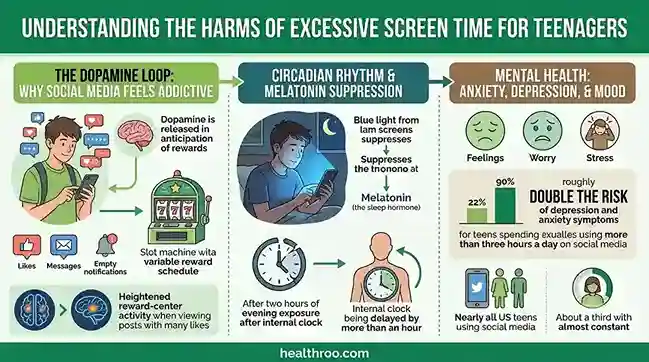
Calling social media “addictive” does not explain much on its own. The real driver is a variable reward schedule, the same mechanism used in slot machines. Your teen’s brain releases dopamine in anticipation of a reward, not only after receiving it.
A notification triggers that anticipation, and opening the app might deliver a like, a message, or nothing at all. That uncertainty is what keeps a teen checking. Brain imaging research on adolescents shows heightened reward-center activity when teens view posts with many likes, regardless of what the post actually shows.
Circadian Rhythm and Melatonin Suppression
Blue light from screens suppresses melatonin, the hormone that signals bedtime to the brain. One study found that just two hours of evening light exposure delayed the body’s internal clock by more than an hour.
For a teenager whose biology already leans toward a later natural sleep schedule, this delay compounds an existing problem.
Mental Health: Anxiety, Depression, and Mood
The US Surgeon General’s 2023 advisory found that teens who spend more than three hours a day on social media face roughly double the risk of depression and anxiety symptoms compared to lighter users, reinforcing the importance of teenage screen time limits for students. Nearly all US teens use some social media platform, and about a third describe their use as almost constant.
Academic Performance, Memory, and Executive Functioning
Heavy recreational screen use before homework cuts into working memory and sustained attention. Constant app switching trains a shorter attention span, which then carries over into classroom focus and test performance. Homework avoidance is often not laziness. It is the pull of a more immediately rewarding screen activity competing with a delayed academic reward.
Eye Health: Digital Eye Strain and Myopia
Long, close-range screen use causes digital eye strain: dryness, headaches, and blurred vision. It is also linked to faster myopia progression in children and teens who spend limited time outdoors. The 20-20-20 rule helps directly: every 20 minutes, look at something 20 feet away for 20 seconds.
Clinical Tip–
Set a 20 minute timer during homework or gaming sessions. When it rings, look out a window or across the room for 20 seconds before returning to the screen.
Physical Health: Obesity, Posture, and Inactivity
Extended sitting reduces daily physical activity, which raises the risk of weight gain and poor posture. Neck and shoulder strain from looking down at a phone, often called tech neck, now shows up in teenagers as often as in adults.
Social Skills and Relationships
Teenage screen time limits for students that replace face-to-face time can reduce practice with reading body language, handling disagreement, and sitting through an uncomfortable silence. Teens build these skills through repetition, not instruction.
Benefits of Healthy Screen Time Limits
- Better sleep quality and easier mornings
- Sharper concentration and steadier grades
- Stronger in-person friendships and family bonds
- Lower anxiety and fewer mood swings
- Healthier weight, from more movement during the day
- More room for creativity, hobbies, and offline interests
Healthy vs. Unhealthy Screen Habits: A Side-by-Side Comparison
| Activity | Healthy Pattern | Unhealthy Pattern |
| Bedtime device use | Devices off 60-90 minutes before sleep | Scrolling in bed until falling asleep |
| Social media use | Time-boxed, chosen check-ins | Compulsive, notification-driven scrolling |
| Study-related screen use | Single-task use, with breaks | Many tabs and apps open, constant switching |
| Meals | Screen-free family meals | Eating alone in front of a screen |
| Gaming | Time-boxed sessions with breaks | Late-night sessions that cut into sleep |
Warning Signs of teenage screen time limits for students: Need a Digital Detox?
- Cannot stop scrolling, even when they want to stop
- Gaming late into the night, with disrupted sleep
- Skipping or rushing through homework
- Grades declining over a term or two
- Eye strain, headaches, or neck and wrist pain
- Irritability or mood swings when asked to log off
- Pulling away from in-person friends or family time
If you count three or more of these signs, move to the sleep protocol and practical rules below.
Is Your Teen’s Screen Time Healthy? A Self-Assessment

- Is your teen using screens for more than 2 hours a day recreationally? If no, screen use likely already falls in the healthy range.
- Is sleep affected, with late nights or trouble waking? If yes, start with the sleep protocol in Section 10.
- Are grades falling, or is homework being rushed? If yes, add the practical rules in Section 11.
- Is your teen showing eye strain, headaches, or other physical complaints? If yes, add the 20-20-20 rule immediately.
In the above-mentioned four monitoring tools for self-assessment of teenage screen time limits for students, if out of four, three or more “yes” answers point to a high-priority case. One or two point to a moderate case worth monitoring closely.
The Screen Time-Sleep Connection: A Clinical Sleep Hygiene Protocol
Why Timing Matters: The 60-90 Minute Rule
Melatonin release begins roughly 60 to 90 minutes before your teen’s natural sleep time. Screen use inside that window delays melatonin release and pushes bedtime later, even if your teen feels ready for sleep. Stopping screens 60 to 90 minutes before bed gives melatonin room to build up on schedule.
Blue Light, Night Shift Modes, and Blue-Light Glasses
Night shift or warm-tone display settings reduce blue wavelength light, but they do not eliminate melatonin suppression on their own. They work best combined with lower brightness and an earlier stop time. Blue-light blocking glasses show mixed evidence, since the benefit depends heavily on how well a specific pair filters blue wavelengths.
Building a Screen-Free Bedtime Routine
Replace the last hour of screen time with something that winds the body down instead of stimulating it: reading a physical book, journaling, light stretching, or a short conversation with family. Consistency matters more than the specific activity you choose
Before-Bed Timeline
3 hours before bed: finish recreational screen time for the day.
1 hour before bed: switch to homework wrap-up only, no social apps.
30 minutes before bed: phone charges outside the bedroom, wind-down routine begins.Bedtime: lights off, room dark and cool.
Medical Disclaimer
This article on teenage screen time limits for students is intended for general informational and educational purposes only and does not constitute medical, psychological, or clinical advice. It is not a substitute for professional consultation, diagnosis, or treatment from a licensed pediatrician, child psychologist, or adolescent counselor.
If your teen shows signs of persistent low mood, sleep disruption, declining grades, or withdrawal linked to screen use, consult a qualified healthcare professional promptly. Healthroo.com and the author assume no liability for decisions made based on this content.
Teenage screen time limits for students: Every Family Can Follow
- Keep meals screen-free, for everyone at the table
- No phones in the bedroom overnight
- Protect daily outdoor play or exercise time
- Finish homework before recreational screen time starts
- Write a simple family digital agreement together
- Keep bedrooms device-free zones
- Use the Pomodoro method: 25 minutes of focused study, then a 5 minute break
- Allow a more relaxed screen schedule on weekends than on weekdays
Tips for Parents: Setting Limits Without the Power Struggle
- Set limits together with your teen, instead of announcing them, while discussing teenage screen time limits for students.
- Model the habits you want to see; your own phone use sets the norm
- Use built-in screen time tools as a starting conversation, not a punishment
- Build predictable daily routines around meals, homework, and sleep
- Check which apps get used, not only the total hours logged
- Offer real offline alternatives, not just restrictions
- Notice and acknowledge good habits, not only the slip-ups
Tips for Students: Managing Your Own Screen Time
- Turn off notifications for anything that is not essential
- Use your phone’s built-in app timers
- Keep your phone in another room while you study
- Follow the 20-20-20 rule during long screen sessions
- Take a real break every 45 to 60 minutes
- Protect your daily exercise time
- Aim for 8 to 10 hours of sleep every night
School-Based Strategies for Managing the Teenage screen time limits for students
- Build digital wellbeing lessons into the regular curriculum
- Apply phone policies consistently, across every classroom
- Use classroom management techniques that reduce distraction without confrontation
- Train teachers on healthy technology habits they can model
If you are a teacher or school counselor, these steps work best when the whole staff applies them the same way, not just one homeroom.
Yoga and Pranayama for Digital Detox: A 7-Day Plan for Teens

These practices support wellbeing alongside the steps above. They are not a medical treatment, and they do not replace professional care when it is needed.
Poses for Digital Detox
- Balasana (Child’s Pose): releases neck and shoulder tension built up from hours of looking down at a screen
- Viparita Karani (Legs-Up-the-Wall): supports the evening wind-down before the screen-free bedtime window. This is a very effective approach for detoxification of screen addiction and for making mange teenage screen time limits for students.
Breathwork
- Nadi Shodhana (alternate nostril breathing): helps settle the anxiety that often comes with FOMO and overuse
Sample 7-Day Structure
| Days | Routine |
| Day 1-2 | Balasana, 5 minutes; Nadi Shodhana, 5 minutes |
| Day 3-4 | Viparita Karani, 10 minutes; Nadi Shodhana, 5 minutes |
| Day 5-6 | Both poses combined, 10 minutes, plus breathwork |
| Day 7 | Full 15-minute routine, plus a short family reflection on the week |
Free Tools and Printable Resources
Healthroo is preparing a set of downloadable tools to make these rules easier to follow at home: a daily and weekly screen time tracker, a student digital routine template, a parent checklist, and a school digital wellness checklist.
The 7-Day Screen Reset Challenge: A Parent Action Plan
- Day 1: Track your own screen time first, before asking your teen to change anything
- Day 2: Hold a family discussion and set the plan together
- Day 3: Set up screen-free zones at home
- Day 4: Talk with your teen about how apps are built to hold attention
- Day 5: Brainstorm offline alternatives together
- Day 6: Run a trial of the new rules
- Day 7: Check in as a family and adjust what did not work
When Should Parents Seek Professional Help?
Some warning signs go beyond normal limit setting. Consult a pediatrician if sleep, appetite, or physical health changes alongside heavy screen use despite following teenage screen time limits for students. Consult a child psychologist or adolescent counselor if your teen shows persistent low mood, withdrawal, or anxiety tied to their online life.
Loop in a school counselor if grades or attendance drop sharply. Involving a professional early is almost always lighter than waiting for a crisis point.
Real Parent Experiences: Managing Screen Time in Indian Households
The accounts below are composite, illustrative examples drawn from common patterns seen in Indian households, not individual case histories.
- A Kolkata family cut short-video app use from four hours a day to about one, by moving the charging point to the living room and holding the change for three straight weeks
- A Delhi household separated coaching screen time from recreational use by asking their son to summarize each session out loud, which cut disguised scrolling inside the coaching app
- A joint family in a smaller city assigned one grandparent as the “screen time buddy” for younger cousins, which reduced arguments between parents and teens directly
Evidence Summary of Teenage screen time limits for students: What the Research Says
| Source | What It Contributes |
| WHO | Baseline global guidance on screen time and physical activity |
| American Academy of Pediatrics | Media balance framework and the 5 Cs |
| US Surgeon General | Social media-specific mental health risk data |
| Indian Academy of Pediatrics (2022) | India-specific screen time and digital wellness guidelines |
| National survey and school-based data | Indian teen smartphone and screen use patterns |
| Peer-reviewed studies (PMC, Frontiers) | Mechanistic evidence on dopamine pathways, melatonin suppression, and sleep-mental health links |
Frequently Asked Questions About Teenage Screen Time Limits for Students
What are realistic teenage screen time limits for students during exam season?
During exam season, teenage screen time limits for students should flex around study needs while still protecting sleep. Recreational screen time can drop closer to an hour a day, while study-related screen time expands based on the syllabus. Keep the last 60 to 90 minutes before bed screen-free regardless of exam pressure, since sleep loss hurts memory and recall more than an extra hour of revision helps
Should a 15-year-old have stricter screen time limits than a 13-year-old?
Not necessarily stricter, but different. Teenage screen time limits for students should account for the specific risks at each age, and 13 to 15 is often when social media use begins in earnest. A 15-year-old may handle more independence, but this age group also faces the sharpest rise in social comparison and FOMO, so parents should watch content and context as closely as total hours.
What is the average screen time for Gen Z students, and how does it compare to guidelines?
Recent survey data shows many teenagers spend four or more hours a day on screens outside schoolwork, well above most global caps of around two hours. This gap is exactly why teenage screen time limits for students focus on gradual reduction and healthy replacement activities rather than an abrupt cutoff, which rarely holds up under real household pressure.
What screen time limits for students are recommended for 16-year-olds preparing for board exams?
For 16-year-olds preparing for board exams, teenage screen time limits for students should separate study screens from recreational screens clearly. Recreational use can shrink to under an hour a day during peak exam months, while study screen time is guided by the syllabus rather than a clock. Protect sleep and short movement breaks even during the busiest weeks, since both directly support memory consolidation.
How much daily screen time should parents allow a 14-year-old, and does online tuition count?
A 14-year-old’s recreational screen time should generally stay under two hours a day. Online tuition and coaching sessions count separately as educational screen time, since teenage screen time limits for students treat study-related use by task, not by a fixed number. Watch for gamified features or social feeds inside coaching apps, since these can quietly convert study time into recreational scrolling.
What’s a realistic family strategy for enforcing screen time limits for teenagers without constant conflict?
Build the rule together instead of announcing it. Teenage screen time limits for students hold up better when your teen helps set them, since ownership reduces pushback. Pair the limit with a clear reason, protecting sleep or grades, and apply the same rule to parents’ own phone use at home. Consistency, not strictness, is what prevents the daily argument.
How should parents handle screen time differently on weekdays versus weekends?
Weekdays should prioritize schoolwork, sleep, and a tighter recreational cap, since teenage screen time limits for students need to protect the next day’s focus and energy. Weekends can allow a more relaxed schedule, with slightly longer recreational time, as long as sleep and outdoor activity stay protected. The key difference is flexibility, not abandoning the rule altogether.
How can parents reduce screen addiction in teenagers without removing devices entirely?
Removing a device entirely often backfires, since teens still need phones for schoolwork and social connection. Effective teenage screen time limits for students rely on structure instead: turning off non-essential notifications, keeping phones out of the bedroom overnight, and replacing scroll time with a genuine offline hobby. Gradual, consistent changes hold up far better than a sudden device ban.
Conclusion
Teenage screen time limits for students are not about counting hours on a clock. They are about protecting sleep, movement, schoolwork, and real relationships, the things screen time quietly displaces when it goes unchecked.
Start small this week. Pick one change from this guide, a screen-free dinner table, a charging point outside the bedroom, or the 20-20-20 rule during homework, and hold it for seven days before adding another. Try the 7-Day Screen Reset Challenge in Section 17, or download the Family Media Plan tools once they are live.
Every household finds its own balance, and yours does not need to look like anyone else’s. Explore more of Healthroo’s adolescent wellness content for the next step in supporting your teen.
Reference-
American Academy of Pediatrics
Indian Academy of Pediatrics (IAP)
Indian Pediatrics (Springer Nature)
Indian Pediatrics journal (IAP official journal)
U.S. HHS / Office of the Surgeon General
NCBI Bookshelf (National Institutes of Health)
World Health Organization (WHO)
PubMed (National Library of Medicine)
Children’s Hospital Los Angeles (CHLA)
Author Bio-
Sajal Samanta is the founder of Healthroo.com and holds an MSc in Anthropology alongside certification as an Adolescent Counselor. With more than 15 years of experience in RCT clinical research, he brings an evidence-based, culturally grounded lens to adolescent wellness content for Indian families, translating global pediatric guidance into practical, India-specific advice for parents, teachers, and students.