Learn how the Anaemia and WIFS programme helps to prevent adolescent anaemia in India by receiving IFA supplements, and how screening, deworming, and nutrition support help.
Peer-Reviewed by — Dr. Krishnandu Mondal, DCH, MD, Adolescent Consultant, and Satabdi Sinha Babu, MSW, Psychologist, Adolescent Counsellor, last reviewed, July,2026
Adolescent Anemia and WIFS
What is nutritional anaemia according to the Anaemia and WIFS programme
- The decrease of Hb in blood is called anaemia
- The level of Hb in blood depends on the age & sex of a person.
- Hb is the red coloured element present in RBCs.
- It gives red colour to our blood.
- Blood becomes pale when the level of Hb decreases.
- Hb carries O2 in the blood from the lungs to the cells of the body
- Decrease in level of Hb leads to less supply of O2 to body cells, which results in malfunctioning of body cells & organic systems
- Hb is made up of two elements – ‘heme ’, which contains iron, and ‘globin ’, which is protein
- For the formation of Hb, besides iron, vitamin C, vitamin-B12, protein & folic acid obtained from food, nutrients like copper, cobalt & pyridoxine are also essential.
- Deficiency of any of these nutrients leads to a decrease in the level of Hb in the blood, which is known as Nutritional Anemia
- Out of all these nutrients, anemia due to deficiency of Iron is more common.
Among all nutritional anemia, IDA is found in 85% of the cases
Read More Related Issue: Anaemia Mukt Bharat Abhiyaan
Haemoglobin levels to diagnose anaemia (g/dl) in respect to Anaemia and WIFS programme
| Age groups | No Anemia | Mild | Moderate | Severe |
| Children 6–59 months of age | ≥11 | 10–10.9 | 7–9.9 | <7 |
| Children 5–11 years of age | ≥11.5 | 11–11.4 | 8–10.9 | <8 |
| Children 12–14 years of age | ≥12 | 11–11.9 | 8–10.9 | <8 |
| Non-pregnant women (≥15 years of age and above) | ≥12 | 11–11.9 | 8–10.9 | <8 |
| Pregnant women | ≥11 | 10–10.9 | 7–9.9 | <7 |
| Men | ≥13 | 11–12.9 | 8–10.9 | <8 |

Hb concentration for the diagnosis of anaemia and assessment of severity. WHO, 2011
Magnitude of Problem: The Indian Challenge
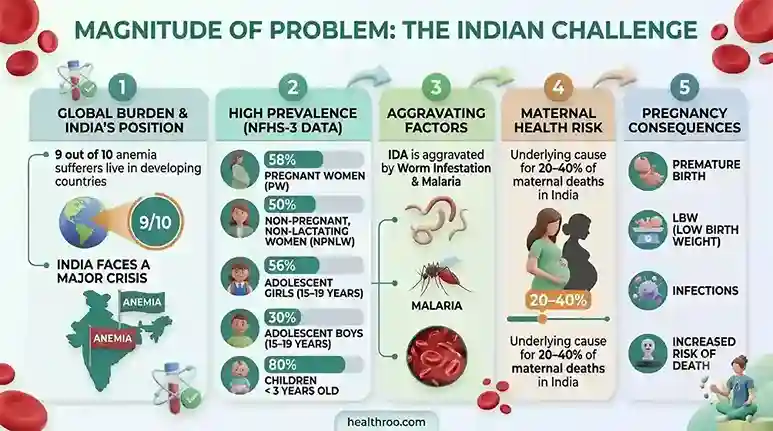
- 9 out of 10 anemia sufferers live in developing countries
- Very high prevalence of anemia, particularly among most vulnerable – 58% PW, 50% NPNLW, 56% & 30% of adolescent girls & boys(15–19 years), 80% < 3 children (NFHS-3)
- IDA is aggravated by Worm Infestation & Malaria
- Underlying cause for 20–40% of maternal deaths in India
- Health consequences during pregnancy include premature birth, LBW, Infections, and increased risk of death.
Causes of iron deficiency in the light of Anaemia and WIFS programme
Factors responsible for maintaining demand – supply balance of iron:
- Amount of iron in daily food –less quantity
- Absorption of iron from intestine – quality, low bioavailability; storage of iron in the body – poor stores in infancy, childhood, adolescenceIncreased requirement- Pregnancy, growing infant, adolescent
- Loss of iron from the body- loss of blood, destruction of RBC
- Generally, anemia develops due to less intake of iron in our food or hindrance in the absorption of iron from food due to lack of enhancers or excess intake of inhibitors
- Traditionally, women eat last & the least. Hence, even though the food prepared for the family is the same, women are more prone to develop IDA than other members of the family.
- Iron stored in the body is utilized when the amount of iron required by the body > than that absorbed from the intestine. If this condition continues for longer, iron deficiency develops in the blood, resulting in anemia.
Intergenerational cycle of Anemia
Anemia also results when there is loss of blood or destruction of RBCs
- Blood loss during menstruation in women of reproductive age group, especially adolescent girls & women with heavy menstruation.
- Delivery. Blood loss during accidental injury and surgery.Helminths such as hookworm cause chronic blood loss
- Malaria causes rupturing of RBCs & suppresses production of RBCs.
Iron deficiency is a consequence of
- Decreased iron intake
- Increased iron requirement
- Increased iron loss from the body
Who is affected- high risk groups Intergenerational cycle of Anemia
Nutritional anemia can occur in a person of any age and sex. However, certain age groups have more chances of becoming anemic, like ⤇
- women of reproductive age group (15-45 yrs age),
- Pregnant & Lactating women
- Adolescent girls (10-19 yrs)
- Children (6-24 months)
- (Adolescent girl enters reproductive age group with low iron stores )
- (Become Pregnant
Risk of delivering LBW & preterm baby)
- (Baby born with low iron & Hb levels)
- (Uncorrected anemia in infancy & childhood
Poor IYCF + Infection)
(Enter Adolescent with low iron & Hb level+ Menstrual blood loss )

What are the symptoms of anaemia according to the programme Anaemia and WIFS?
- The onset of anemia is gradual. The symptoms are seen when the level of hemoglobin decreases beyond the level considered normal as per a person’s age and sex.
- No symptoms are seen in mild anemia. But when the level of hemoglobin is less the following symptoms are seen:
- Weakness, fatigue, dizziness, loss of appetitePaleness / Pallor of palms, nail bed, conjunctiva (lower eyelids) of eyes, tongue; decreased level of concentration and lack of interest in work; breathlessness on labour work; koilonychia (spoon-shaped nails); puffiness on face and swollen (oedema) feet
- Craving for mud/clay (Pica): well-known feature of IDA in children

Adverse effects of anaemia
Due to anaemia, adolescents are affected in several dimensions, and each dimension is described below point-wise.
Reduced physical growth & development
- Impaired use of energy sources by muscle
- Reduces energy & work capacity
- Decreased work output
Impaired productive & reproductive capability
- Irregular menstruation
- Low pre-pregnancy iron stores
- Impairs O2 supply to fetus & interferes with normal IU growth
- IUGR, SB, LBW
- Poor preg. & birth outcome
- Preterm delivery, risk of PN & MD
Retarded psychomotor & cognitive development
- Impaired performance
- Impaired coord.of language & motor skills (equiv. to 5–10 pt deficit in IQ.)
- Diminished concentration
- Disturbance in perception
- Poor learning ability
Impaired immune status & high morbidity from infections
Why focus on Adolescents according to Anaemia and WIFS programme?
Demographic Profile (Census 2011)
- 10% are 15-19 years
- 12% are 10-14 years
- 20- 22% of total population
- 253 million adolescents in India
- Females: 47% of total adolescent population
20 % of Adolescents (10-19 years) in world are from India

In absolute numbers, India has the largest adolescent population in the world : 253 million
World Population Prospects: The 2012 Revision
India’s Adolescent Population: the Future Generation
| Year | No of Adolescent in Million |
| 1950- | 80.6 |
| 1970 | 124.2 |
| 1990 | 186 |
| 2010 | 236.6 |
| 2030 | 262 |
| 2050 | 297 |
Early Marriage
- 53% of women aged 20-24 in India are married by18 years of age (NFHS-3 Rural)
- In most states, % of women marrying by age 18 is decreasing & the median age at 1stbirth is increasing, but in a few states, the reverse is happening
Since NFHS-2
- Arunachal Pradesh, Punjab, Mizoram, Sikkim, Tripura & WB: % of women age 20-24 married by age 18 has increased; &
- Arunachal Pradesh, Punjab, Mizoram, & WB: median age at 1st birth has decreased
Early Marriage leads to early Pregnancy
- Vulnerable to physical and sexual violence, exposing them to unintended pregnancy and infection
- Though fertility in the 15-19 age group is decreasing, still, a substantial proportion of teenagers have begun childbearing.
- 12% of women 15-19 are already mothers
- 4% of women 15-19 are pregnant with their first child
- In total, 16% of women 15-19 have begun childbearing
- Initiation of Childbearing
- Median age at 1st birth for women (25-49 age): 20.9(U),19.3(R)
Median age at first birth increased from 19.3(NFHS-2) to 19.8 years (NFHS-3)
Under Nutrition (15-19 yrs)
- 56 % Anaemic
- 47% underweight
- (BMI< 18.5 kg/m2)
- 30% Anaemic
- 58% underweight
- (BMI < 18.5 kg/m2)
1 out of 2 Adolescent girls are anaemic ,1 out of 3 Adolescent boys are anaemic ,Important to address nutritional anaemia among both adolescent GIRLS & BOYS.
ADOLESCENT GIRLS: increased risk of developing anemia; explore in light of Anaemia and WIFS prog.
- Insufficient quantity of iron-rich foods
- Low bioavailability– less “iron enhancers” / excess “iron inhibitors” in diet
- Lack of knowledge and low awareness level
- Poor iron stores from infancy, childhood deficiencies & enters adolescence
- During adolescence, reaching a maximum at peak growth
- Early marriage & Teenage pregnancy
- Early age of menarche & Iron loss during menstruation
- Iron loss due to parasite load & infection (e.g., malaria, intestinal worms)
- Poor environmental sanitation and unsafe drinking water
- Poor capacity of health system to cater to comprehensive adolescent needs
Anemia: Preventable, Yet a Problem
Interventions in Anaemia and WIFS programme to prevent and correct iron deficiency anaemia
Strategies for prevention & control of IDA
- Supplementation
- Improved health services
- Infection Control: deworming, prev of malaria, etc
- Food based Strategies
- Dietary diversification
- Food
- fortification
Diet Diversification, Food Fortification & Supplementation in Anaemia and WIFS programme
- Supplementation: Highly concentrated vitamins & minerals in the form of cap., tab. or inj. & administered as part of specific nutrition campaigns.
- Dietary diversification: Encouraging consumption of micronutrient-rich foods (GLV, lentils, vit C rich fruits) – which may be available but underutilized by deficient population
- Food fortification: Addition of micronutrients to processed foods. In many situations, this strategy leads to improvements in micronutrient status of a population, & at very reasonable cost, especially if advantage be taken of existing technology & local distribution networks.
- Ministry of H & FW’s Revised Strategy: Food-based approaches (food fortification & dietary diversification) are direct & sustainable strategies for preventing IDA
It is difficult to influence dietary behavior as diets in India are primarily cereal-based & bioavailability of iron is limited. On the other hand, bioavailability from dietary animal sources is better, but consumption is rather low due to social reasons & poverty.
In such a scenario, key step towards addressing IDA would be provision of IFA supplementation & therapeutic management of mild, moderate, severe anemia in most vulnerable groups: children, adolescents, preg & lactating mothers & women
Supplementation through the Life Cycle
Children
6-60 months: IFA (20mg Fe/100mcg F/A ) administered biweekly, on fixed days, under direct supervision of ASHAs /ANM
5-10Years: Weekly IFA (45mg Fe/400mcg F/A ) at AWC & through schools
Adolescent
- NEW COMPONENT
- 10–19 years
- Weekly IFA (100mg Fe/500mcg F/A ) supplementation (WIFS) for both adolescent boys & girls in Govt/Govt aided/municipal schools & AWC (out of school)
Pregnant & lactating women
- Daily IFA(100mg Fe/ 500 mcg F/A ) 100 days in pregnancy
- Followed by similar dose of IFA for 100 days in P-P period, as ANC, PNC package, at all levels of HF, SC & outreach.
Reproductive Age group
- NEW COMPONENT
- Weekly IFA(100mg Fe/ 500mcg F/A ) to be distributed by ASHA during doorstep delivery of contraceptives throughout the reproductive period
Note: Prophylaxis with Fe be withheld in case of acute illness (fever, acute diarrhea, pneumonia etc.), SAM & in a known case of haemoglobinopathy / history of repeated blood transfusion.
Medical Disclaimer
This article on Anaemia and WIFS is for informational and educational purposes only and does not replace professional medical advice, diagnosis, or treatment. Anaemia screening, Iron Folic Acid supplementation, and therapeutic care under Anaemia and WIFS should be carried out under the guidance of a qualified healthcare provider, ASHA worker, or government health facility. Always consult a doctor before starting any anaemia treatment, especially for children, adolescents, pregnant or lactating women, or low birth weight infants.
Prevention Strategies in Anaemia and WIFS programme
Increased Iron Intake: Dietary Modification in Anaemia and WIFS Programme
The following points should be kept in mind to optimize absorption of iron taken in food.
- Encouraging the consumption of micronutrient-rich foods e.g. Chana Sag , Spinach, Onion Stalks, Mustard Leaves,, Methi, Pudina, Colocasia leaves, Dhal, Soya bean, Plantain Green, Watermelon, Pumpkin, Mutton, etc
- Encouraging consumption of “iron enhancers“ like Vitamin C-rich foods e.g. Cabbage, Drumstick Leaves, Coriander Leaves, Lemon, Amla, germinated seeds, etc
- Regular use of meat, eggs & other non-vegetarian items, if religiously allowed, affordable and suitable
- Avoid taking “iron inhibitors” e.g. tea/coffee, etc. with meals, sometimes before & after meal as well as while taking IFA
- Consume at least one seasonal fruit like orange, guava, etc. daily or form the habit of eating salads with meals.
The body can make maximum use of iron taken through food if the above instructions are followed.
WIFS – Program Elements
Objective of WIFS
To reduce the prevalence and severity of nutritional anaemia in the adolescent population (10-19 years).
Target groups
School-going Adolescent Girls and Boys (6th to 12th classes)
Adolescent Girls who are not in school
Intervention-
Fixed day, Fixed site
Weekly Blue IFA (100mg elemental Iron and 500μg folic acid) round the year
De-worming (Albendazole 400mg) every six months
Screening and Referral
Nutrition & Health Education counselling
Branding of IFA tablet as ‘BLUE WIFS-IFA’
- Blue coloured WIFS IFA to identify from other different types of IFA tablets
- Standard Specification of WIFS – IFA tablet
Iron Supplementation: Targeting
- All Adolescents from 10-19 years of age;
- In school- all boys & girls from classes 6th to 12th.
- All out-of-school adolescent girls 10-19 years of age
- Married and Non-Pregnant adolescents
Anaemia can be prevented by regular consumption of iron & folic acid tablets once a week, ideally 52 tablets in a year
Innovations for improved program implementation and coverage
- Branding of IFA tablet
- Fixed Day – Fixed Site
- WIFS Day
- School and Anganwadi centers as platform
- National Deworming Day – Feb. and Aug.
- Simplification and streamlining of reporting mechanism
- Establishing Emergency Response System across all health facilities
Inter-Ministerial Convergence is the key factor
Fulfillment implication of this flagship programme for combating anaemia in adolescent community, Govt. of West Bengal has taken convergence initiatives among the three departments, likely Education, Health, and Department of Women and Child Development ( ICDS) in converging mode.
Health
- Issue guidelines – technical support
- Allocate funds
- Capacity building – Field workers, teachers
- Logistics and distribution (IFA, Albendazole, reporting formats, IEC materials)
- NHE
- Emergency Response System
- Media Advocacy
- Monitoring, Reporting & Convergent Reviews
Education
- Submit indent of drugs to health
- Distribution of IFA to all schools – clubbed with Mid-day Meal
- Weekly (Monday) Supervised consumption of IFA by Teachers
- NHE, screening for anemia, referral
- Reporting & monitoring
ICDS
- Submit indent of drugs to health
- Distribution of IFA to all out-of-school girls – through Anganwadi centers
- Weekly (Monday) Supervised consumption of IFA by workers
- NHE, screening for anemia, referral
- Reporting & monitoring
Reporting and Monitoring integrated into Information System of each Ministries
Are there any Side Effects of Iron tablets?
- There are no serious side effects of IFA tablets. However, by taking these tablets, the patient may have some minor problems.
- By consuming Iron tablets, there can be black stools. Besides this, by taking these tablets, mild nausea, a burning sensation in the chest and abdomen, diarrhea, or constipation can occur.
- However, these problems are harmless, temporary, and with continued iron tablets, the problems may disappear in a few days.
- GoI-UNICEF study (2013-14) shows incidences of facing any undesirable effects reduced to only 3% by 3rd weekly IFA consumption
- It is recommended that, to prevent such problems, the Iron tablets should be taken after a meal.
COUNSELING IS IMPORTANT , Peers, parents and media key influencers
Why is Folic Acid added to an iron tablet?
- Folic acid is essential for the formation and maturation of RBCs as well as for cell growth and repair. Therefore, plays a very important role in the production of hemoglobin. Mostly, Folic Acid deficiency is found along with Iron deficiency in our food.
- If there is a deficiency of Folic Acid in the mother during the initial stage of pregnancy, then it affects the development of the nervous system of the foetus. During the first 17-30 days of pregnancy, if the process of joining of the brain, spinal cord, and spinal column remains incomplete, then the Nervous system is severely affected. This may result in foetal death or permanent defect after birth (congenital defects).
What is the connection between Anaemia and WIFS?
Anaemia and WIFS are closely connected because WIFS helps prevent and reduce nutritional anaemia among adolescents. The Weekly Iron and Folic Acid Supplementation programme provides iron and folic acid supplements to eligible adolescents, along with anaemia screening, deworming and nutrition counselling. These interventions help address iron deficiency and support better adolescent health.
What is WIFS and how does it help prevent anaemia?
Anaemia and WIFS are linked through the prevention of iron deficiency among adolescents. WIFS stands for Weekly Iron and Folic Acid Supplementation. The programme provides weekly iron-folic acid supplementation to eligible adolescents and supports screening, deworming and nutrition education. Together, these measures help prevent nutritional anaemia and promote healthy growth during adolescence.
Who receives WIFS supplements for anaemia prevention?
Anaemia and WIFS prevention efforts target adolescents who may be vulnerable to nutritional deficiencies. The WIFS programme generally covers school-going adolescent girls and boys, as well as out-of-school adolescent girls. Eligible adolescents receive iron-folic acid supplementation and other supportive interventions designed to prevent anaemia and improve their overall nutritional health.
How does WIFS help adolescent girls prevent anaemia?
Anaemia and WIFS are particularly important for adolescent girls because rapid growth and menstruation can increase iron requirements. WIFS provides regular iron and folic acid supplementation to help prevent nutritional deficiencies. The programme also promotes screening, deworming and nutrition awareness, supporting adolescent girls in maintaining healthy haemoglobin levels and reducing anaemia risk.
Does WIFS treat existing anaemia in adolescents?
Anaemia and WIFS should be understood as part of anaemia prevention and control. WIFS primarily provides preventive iron-folic acid supplementation, while adolescents with suspected or confirmed anaemia may require medical evaluation and appropriate treatment. Anyone with symptoms or diagnosed anaemia should consult a qualified healthcare professional for assessment and individualised management.
Why are screening and deworming included in the WIFS programme?
Anaemia and WIFS prevention involves more than iron supplementation alone. Anaemia screening helps identify adolescents who may need further evaluation or treatment, while deworming helps address intestinal worm infections that can contribute to nutritional problems. WIFS combines these measures with nutrition counselling to provide a broader approach to adolescent anaemia prevention.
What is the role of nutrition in Anaemia and WIFS?
Good nutrition strengthens the impact of Anaemia and WIFS prevention efforts. Adolescents should consume a varied diet containing iron-rich foods, along with vitamin C sources that support iron absorption. WIFS provides iron and folic acid supplementation, while nutrition education encourages healthier dietary practices. Together, supplementation and balanced nutrition can support adolescent health.
Is WIFS part of India’s strategy to prevent adolescent anaemia?
Yes. Anaemia and WIFS are important components of India’s broader efforts to address nutritional anaemia among adolescents. WIFS focuses on weekly iron-folic acid supplementation, anaemia screening, deworming and nutrition counselling for eligible adolescents. It complements wider national anaemia-control initiatives and supports efforts to improve adolescent nutrition and reduce anaemia-related health risks.
Reference
NHM, WIFS objectives, target groups, IFA supplementation, screening, deworming and counselling
National Health Mission – Anaemia Mukt Bharat
Ministry of Health & Family Welfare, Government of India
World Health Organization – Anaemia
WHO – Anaemia in Women and Children
National Centre for Biotechnology Information (NCBI)
PubMed – National Library of Medicine
Indian Council of Medical Research (ICMR)
National Institute of Nutrition (NIN), Hyderabad
Author Bio
Sajal Samanta holds an MSc in Anthropology and works as an Adolescent Counselor, with over 15 years of experience in RCT clinical research. Through Healthroo.com, Sajal translates government health programmes and adolescent nutrition science into clear, practical guidance for Indian families, drawing on fieldwork and counselling experience with adolescents and their caregivers across India.