![Social media: 13 proven detox strategies for youth [2026]](https://healthroo.com/wp-content/uploads/2025/03/WEBP-Fitured-image_11zon-1.webp)
In terms of social media, it refers to internet sites and apps that you can use for sharing content in the form of text, pictures, videos, etc., and responding to posts through likes and shares.
Peer-Reviewed Validation Statement
“This article presents a substantively grounded and clinically relevant overview of the relationship between social media engagement and adolescent mental health outcomes. The content accurately reflects key findings in contemporary sociological and psychological literature, including the dose–response association between daily social media .
Overall, this article is suitable for publication as a health education resource, provided it is accompanied by appropriate medical and editorial disclaimers.”
Sourav SamantaMA Sociology | MSc Psychology | Independent Adolescent Consultant
Areas of practice: Adolescent behavioural sociology, digital media and youth well-being, psychosocial intervention design.Note: This validation statement represents a structured academic commentary authored by the named consultant based on the published article content. It does not constitute a formal peer review in the manner of a double-blind academic journal process.
Through this content, we would like to explore the effect of this on adolescent mental health and navigation.
Introduction

In today’s digital world, social media plays a significant role in the lives of adolescents. Undoubtedly, use among young people is nearly universal, with up to 95% of adolescents and even 40% of children in the age group (8-12). With platforms like Instagram, TikTok, Snapchat, and Facebook, teenagers are more connected than ever.
While social media offers various benefits, such as staying in touch with friends, accessing information, and expressing creativity, it also presents challenges that impact adolescent mental health.
Understanding the effects of social media on young minds is crucial in ensuring a balanced and healthy digital experience. Despite this enormous use among children and adolescents, we do not yet have sufficient documents to draw a conclusion if social media use is practically safe for them, especially during adolescence, a particularly vulnerable phase of brain development.
Here are some frequently used social media platforms on the internet, described below in tabular form.
| Sl.No | Social media applications | Example |
| 1 | Social networking | Fitbit, Pinterest |
| 2 | Media Sharing | Facebook Messenger, WhatsApp, Telegram, Viber, TikTok |
| 3 | Messenger | WordPress, Wikipedia |
| 4 | Blogging platform | Facebook Messenger, WhatsApp, Telegram, Viber, TikTok |
| 5 | Discussion forums | Reditte , Twitter |
| 6 | Fitness & lifestyle | Fitbit, Pinterest |
Current Prevalence and the growing driving
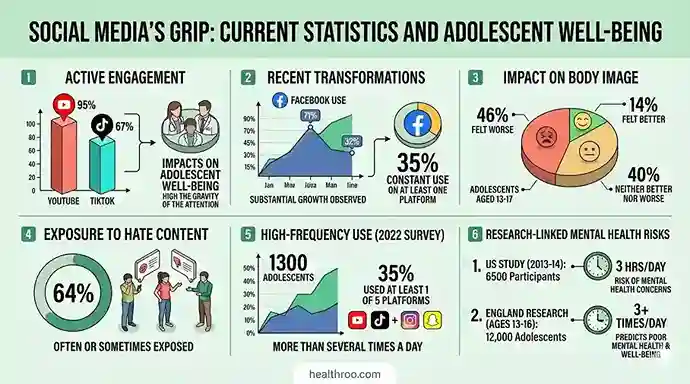
In an intensive study on social media use among adolescents, it has been revealed that active engagement in two particular fields, likely YouTube and TikTok, is 95% and 67%, respectively.
This unconventional engagement of social media among adolescents draws grave attention to mental health professionals and researchers on the issue of its impacts on adolescent well-being.
The scenario of using social media has been transformed very significantly in recent years.
A substantial growth of social media use has been found, particularly on the platform of Facebook, from 71% to 32% among adolescents. In this regard, it is a very remarkable report that perhaps 35% of adolescents at least use one social media platform constantly.
Whenever we considered the impact of social media on body image, 46% of adolescents (13-17) remarked that they felt worse, 40% put their feelings as neither better nor worse, and only 14% remarked that they felt better.
Adolescents are exposed to hate content often or sometimes use social media in around 64%.
In the year 2022, an intensive survey was done among the 1300 responsive adolescents; it was found that 35% of adolescents used at least one of the five social media—likely YouTube, TikTok, Facebook, Instagram, and Snapchat—more than several times a day.
The same type of study was done in the United States in the year 2013-14; among the 6500 participants, it was found that spending three hours a day using social media is directly linked to the risk of mental health concerns.
In England, research has been conducted on the use of social media in the age group ranging from 13 to 16. Among the 12,000 adolescents, it was found that more than three times a day using it predicted poor mental health and well-being.
The Influence of Social Media on Adolescent Mental Health
Social media does not influence all adolescents in the same way. It affects mental health in healthy and unhealthy ways. This varies from one to another.
As per an intensive study concerned with the impact of the use of social media on adolescent mental health, a conclusion has been drawn that not only one thing is responsible.
Collective traits like substance abuse, peer victimization, and technology-based behavior also affect mental health. Apart from that, the effect of social media on adolescent health depends on things such as
1. Issues of browsing things online.
2. Engaging period
3. Involvement of co-psychological factors like maturation and pre-existing mental disorder.
4. Individual life circumstances, including culture and socioeconomic status.
Some negative impacts of social media on adolescent mental health are described below:

1. Increased Anxiety and Depression
One of the most remarkable concerns about the impact of social media on adolescent mental health is directly linked to stress and anxiety.
A careful study on this particular issue expressed that it can lead to feelings of low self-esteem, inadequacy, and loneliness.
The continuous exposure to selected content, where people present idealized versions of their lives, can cause adolescents to compare themselves and develop virtual expectations.
After all, an adolescent who contributes their valuable time to using social media experiences fear of missing out (FOMO), which promotes stress and anxiety.
Feeling of exclusion and sadness whenever they see their friends participating in any social activities without them; this situation leads to the creation of depressive symptoms.
2. Cyberbullying and Its Consequences
Cyberbullying is another remarkable ultimatum to adolescent mental health.
Unlike traditional bullying, cyberbullying happens online, making it difficult to escape; it is also known as cyber victimization and has been reflected in the form of self-inflicted damage, suicidal ideation, and different internalizing and externalizing issues to a greater extent.
Bullying, like rumors, harassment, and negative comments on social media, leads to emotional distress, anxiety, depression, and even suicidal thoughts.
Intensive research suggests that victims of cyberbullying already have experience of a mental health disorder.
The obscurity of online interactions often aggravates aggressive behavior, which makes a greater chance for cyberbullying to victimize any adolescent facing it without immediate consequences.
3. Sleep Disruptions and Poor Mental Well-being
The adolescents who basically prefer to use social media on their mobiles at bedtime have this habit directly linked with sleep apnea or sleep disturbance that affects mental health and well-being.
So many adolescents spend their time scrolling through social media feedback or chatting at night and making delayed sleep schedules.
The human body always maintains a proper biological clock, which is directly linked to the production of melatonin. Using social media for a prolonged period at night, a blue light is emitted from the mobile screen, which promotes the production of melatonin, making it difficult to fall asleep.
Inadequate sleep can lead to poor concentration, decentralized focus, shorter sleep length, decreased sleep quality, and daytime tiredness, increasing the stress level and creating mood swings.
Without taking sufficient rest, adolescents may face different mental health issues like anxiety and depression, and become more vulnerable.
A study has claimed that 36% of adolescents wake up at least once in the course of sleep to check their device, and 40% of adolescents use their device within five minutes of going to bed.
Because the use of social media itself creates substantial risk for subsequent mental health.
4. Unrealistic Beauty Standards and Body Dysmorphia Issues
On the platform of social media exists an explosion of images of influencers and celebrities; adolescents use tools for filtering and editing images to enhance their appearance, particularly women.
The virtual thoughts of beauty standards contribute to creating negative impacts on adolescent mental health.
Adolescents feel pressure to accept these beauty ideas, which promotes the creation of low self-esteem and manifests in unhealthy behavior, such as unhealthy dieting and overexercising.
A tendency appeared like “fitspiration” and “thinspiration as the contribution of social media ultimately reached in eating disorders.
5. Addiction and Social Media Dependence
The addition of social media promotes negative effects on adolescent mental health and leads to encouraging compulsive use.
The design of the algorithm of any social media keeps the user more engaged and sometimes leads to an increase in screen time.
The algorithm mechanism of social media creates dependency through the constant response of comments, likes, and validation of social media; it is difficult to escape from this trap.
The addition of social media leads to a reduction in social communication, face-to-face communication, productivity, and creativity, and decentralization in his study and extracurricular activities.
Ultimatum contributions of social media addiction increase stress and social isolation.
6. Feelings of loneliness despite being “connected.”
Prolonged use of social media makes adolescents feel lonely, which leads to increased substance use, alcohol consumption, and various harmful attitudes and destructive behaviors.
The Positive Aspects of Social Media on Adolescent Mental Health

The use of social media has a number of negative implications; it also contributes several positive implications to adolescent mental health when it is used very responsibly.
1. Social Support and Connection
For many adolescents, social media serves a crucial role in keeping connected with friends and family.
It improves sense of belongingness and emotional support towards adolescents, particularly those who feel isolated from family and friends.
In social media, online groups allow adolescents to share their expressions and feelings, knowledge, and seek advice at a similar level.
Through the use of social media, access to opportunities for humor and entertainment, and creative expression can help solve the identity crisis.
2. Mental Health Awareness and Resources
Social media is the only platform today for raising awareness about adolescent mental health.
Many philanthropists, organizations, therapists, and mental health professionals have shared valuable recommendations, suggestions, information, and thoughts through different content that will be helpful for building up their coping skills and supporting network.
Adolescents struggling to escape from mental health problems; social media is the best tool to access valuable resources and encourage themselves to face similar challenges and stay in their network.
3. Creative Expression and Self-Discovery
Adolescence is a transitional phase of human development and also a very crucial time for self-discovery, and social media platforms contribute a wide spectrum for expressing one’s potential.
Social media is a showcase where adolescents can express their art, music, video, and other aesthetic drives of culture and ability.
For improving individual potentiality, YouTube and TikTok are very useful platforms for expressing one’s passion and interest with supportive audiences.
13 proven strategies to navigate this mental health situation of adolescence

Parents, educators, and other social stakeholders of our community must take responsibility together for finding the way out, how to navigate this adverse mental health situation, and promote how to use social media for adolescents in a healthy way.
Here are some proven strategies for navigation:
1. Set Screen Time Limits
Encourage the adolescents to use a balanced mechanism between offline and online activities.
To prevent excessive use of social media, setting screen time on a daily basis side-by-side should ensure that they perform their physical activities, academics, and interaction with each other physically.
So make a plan in an integrated manner involving teachers, health care providers, and parents for minimizing the time for access and using the device at bedtime.
2. Encourage Digital Detoxes
The adolescents who are struggling to come out of the trap of the impact of social media are encouraged to do digital detoxification regularly and in a planned way, which may be helpful for mental well-being.
This approach promotes reducing stress, enhancing self-esteem, and promoting mindfulness.
3. Promote Open Conversations
Undoubtedly, open communication between parents and adolescents or children is considered an easy but more effective tool for understanding the mental health situation of adolescents, which is already mobilized by social media.
Through this foster care approach, adolescents can explore their feelings, expressions, emotions, etc. Encourage the adolescent to discuss; it should not be confined to any particular issue, but also expand on cyberbullying, online safety, self-image, and virtual thoughts.
4. Teach Critical Thinking Skills
In life skills education, critical thinking skills are a very effective tool for adolescents, which can enhance learning, coping skills, and promote understanding between reality and virtual content.
Through this skill, adolescents can differentiate between reality and curated content from the online world.
Encouraging them to enhance their skills helps them understand that social media often portrays an unrealistic version of life.
5. Encourage Positive Online Communities
It is repetitive and discouraging regarding the use of social media and its adverse effect on mental health; it is not a healthy way to navigate. Rather, you may encourage adolescents to connect with positive and educational communities.
This may be enhanced through advocacy of mental health, the creation of educational pages, and attachment with motivational speakers.
6. Monitor Online Activity without Invading Privacy
Parents should be more cautious about the cavities of their adolescents rather than overly intrusive in this phase.
Using the parental control mechanism through open discussion on the issue of online safety, cyberbullying, and fostering trust can help create a safer digital environment.
7. Policymakers can
The stakeholders of the nation can take steps to make safety standards and limit accessibility of online services, or use social media for the age group of children and adolescents to better protect children’s privacy and support media and digital literacy.
8. Technology companies
Technology companies can assess the impact of any product and its effectiveness on children easily and more accurately.
So it is possible to make the design of software or apps more user-friendly while maintaining the health and safety standards. It is possible to share the data of this online service with any independent researcher.
As per the recommendation, apps or any software should be developed keeping in mind the issue of protecting children’s privacy, age limitation, and effective and timely responses to complaints.
9. Parents and caregivers
Parents, caregivers, and other facilitators can make a plan for establishing a tech-free zone in their household, which promotes better sleep, taking a meal, and doing homework, and creates interpersonal relationships.
Educate their adolescent about responsible online behavior and reporting problematic content and activities.
10. Children and adolescents
Adolescents and children themselves can adopt healthy practices such as using online platforms for limited times, blocking their seating in mobile for unpredictable content, being careful of sharing personal data, and reporting harassment or abuse on online platforms. Apart from that, they can follow self-care practices like
Physical Well-being—
a. Practising exercise on a regular basis for a minimum of 30 minutes.
b. Making a sleep schedule of 8-10 hours nightly consistently.
c. Take balanced nutrition.
Mental Well-being
a. Journaling every day for emotional processing
b. Exposure to nature for stress reduction in a scheduled plan.
c. Mindfulness meditation sessions
Social Well-being
a. Regular open communication.
b. Participation in offline community activities
c. Building supportive relationships
11. Comprehensive Research
A comprehensive research has to be done in an integrated way on the issue of social media and adolescent mental health that supports the establishment of standards and evaluates the best mental practices of adolescents and children.
12. Manage any challenging behaviors.
You must start to talk with your adolescent if you see that your adolescent challenges your rules on using social media, and try to find a probable solution. In this concern, you may talk with a friend of your teens and study his/her internet history.
13. Be a role model for your adolescent.
You may share with your adolescent the use of social media habits or practices. In this time, what are the basic problems you have faced, and how do you overcome them? All things you may share with them can helpfully set a good example and keep it in regular basics.
Medical Disclaimer
Medical & Editorial DisclaimerThe content published on this page — including information about social media, adolescent mental health, digital detox strategies, anxiety, depression, cyberbullying, sleep disruption, and related topics — is intended solely for general health education and informational purposes. It is not a substitute for professional medical advice, psychiatric evaluation, psychological assessment, or clinical treatment.In a mental health emergency: Please contact your local emergency services, a certified crisis helpline, or visit the nearest hospital immediately
Conclusion
Nowadays, the use of social media is an integral part of adolescent life, promoting their mental health in different ways.
While enormous use and adverse interaction create depression, anxiety, and virtual body image. On the other hand, responsible usage can provide self-expression, emotional support, and educational and employment opportunities.
Ensuring the positive impact of the usage of social media on adolescent mental health, key factors are open communication and fostering of healthy relationships with media in a balanced way.
By promoting mindful digital habits, society can help adolescents navigate the online world while safeguarding their mental well-being.
There is a little but statistically remarkable correlation between social media use and depressive symptoms in adolescents, but the determinant is not clear, and there is a need for further research to develop explanatory models and hypotheses for future studies.
In this respect, qualitative methods can also be used for understanding the impact of social media on adolescent mental health as per their perspectives.
FAQ on the Impact of Social Media
How does social media affect a teenager with mental health challenges?
For a teenager with mental health vulnerabilities, social media can worsen anxiety, depression, and low self-esteem. Constant exposure to idealised content, cyberbullying, and fear of missing out (FOMO) can amplify pre-existing conditions. However, responsible and limited use can also provide emotional support, community connection, and mental health resources.
What percentage of adolescents use social media daily?
According to recent research, up to 95% of adolescents actively use platforms like YouTube and TikTok. Around 35% use at least one platform more than several times per day. This widespread usage raises significant concern among mental health professionals regarding its impact on adolescent well-being.
Can social media cause depression and anxiety in teenagers?
Yes. Studies show that spending more than three hours per day on social media is directly linked to increased risk of mental health concerns in adolescents. Feelings of exclusion, FOMO, and comparison to idealised online personas are key drivers of depressive symptoms and anxiety in teens.
What is cyberbullying and how does it impact adolescent mental health?
Cyberbullying involves online harassment such as rumours, negative comments, and threats. Unlike traditional bullying, it is difficult to escape. It is associated with self-inflicted harm, suicidal ideation, and internalising disorders. Research confirms that victims frequently have pre-existing mental health conditions, making a teenager with mental health concerns especially vulnerable.
How does social media disrupt sleep in adolescents?
Blue light emitted from screens at night suppresses melatonin production, disrupting the biological sleep cycle. Studies reveal 36% of adolescents wake during the night to check devices, and 40% use devices within five minutes of bedtime. Poor sleep leads to mood swings, reduced concentration, and heightened mental health risk.
What are the positive effects of social media on adolescent mental health?
When used responsibly, social media offers social connection, emotional support, and access to mental health resources. It enables creative expression through platforms like YouTube and TikTok, helps reduce isolation, and provides communities where adolescents can share experiences. Therapists and mental health organisations also use it to share coping strategies and support.
What is a digital detox and how does it help a teenager with mental health issues?
A digital detox involves a planned reduction in screen time and social media use. For a teenager with mental health struggles, it reduces stress, enhances self-esteem, and promotes mindfulness. Regular digital detoxes support emotional regulation, improve sleep, and create space for real-world social interaction and physical activity.
How can parents help manage their teenager’s social media use?
Parents can set daily screen time limits, establish tech-free zones at home (especially at mealtimes and bedtime), maintain open communication about online safety and cyberbullying, and use parental controls without being overly intrusive. Being a positive role model by practising healthy social media habits themselves is also highly effective.
Does social media cause body image issues in adolescents?
Yes. Research shows 46% of adolescents aged 13–17 reported feeling worse about their body after using social media. Exposure to filtered images of influencers and celebrities promotes unrealistic beauty standards, leading to low self-esteem, unhealthy dieting, over-exercising, and in serious cases, eating disorders such as those driven by “thinspiration” trends.
What self-care strategies can adolescents adopt to protect their mental health online?
Adolescents can protect their mental health by limiting daily platform use, blocking unwanted content, practising mindfulness meditation, maintaining 8–10 hours of sleep, journaling for emotional processing, and participating in offline community activities. Reporting harassment and being cautious about sharing personal information online are also essential protective practices.
Referrence
American Psychological Association
National Institute of Mental Health
Centers for Disease Control and Prevention
Author Bio
Sajal Samanta
MSc Anthropology | Adolescent Counsellor | Clinical Research Specialist
Sajal Samanta is a qualified adolescent counsellor holding an MSc in Anthropology, with over 15 years of experience in Randomised Controlled Trial (RCT) clinical research focused on youth behavioural health. Drawing on both anthropological frameworks and applied counselling practice, Sajal’s work spans adolescent psychosocial development, digital media influence on emerging mental health patterns, and community-based intervention design. His research contributions bridge academic evidence and accessible public health communication, with a focus on underserved adolescent populations across cultural and socioeconomic contexts.










Informative content
Can you be more specific about the content of your article? After reading it, I still have some doubts. Hope you can help me.
Thank you for your sharing. I am worried that I lack creative ideas. It is your article that makes me full of hope. Thank you. But, I have a question, can you help me?
Thanks for sharing. I read many of your blog posts, cool, your blog is very good.
Thank you for your sharing. I am worried that I lack creative ideas. It is your article that makes me full of hope. Thank you. But, I have a question, can you help me?