![Career Preparedness: Build Teen Resilience Now [2026]](https://healthroo.com/wp-content/uploads/2025/04/WEBP-Fitured-Image-from-Chat_11zon-1.webp)
Discover the impact of emotional intelligence on career preparedness for adolescents. Learn how self-awareness, empathy, and social skills shape future success in the workplace.
PEER-REVIEWED VALIDATING STATEMENT
Reviewed by: Sourav Samanta | MA Sociology, MSc in Psychology | Independent Adolescent Consultant. Last reviewed on May,2026
“The content presented in this article accurately reflects the established theoretical framework of emotional intelligence as articulated by Salovey, Mayer, and Goleman, and its applied relevance to adolescent career preparedness is well-supported by current socio-psychological literature. The five-component EI model — self-awareness, self-regulation, motivation, empathy, and social skills — forms a robust foundation for understanding how adolescents can be prepared for the evolving demands of modern workplaces. The article’s emphasis on Social-Emotional Learning (SEL) as a school-based intervention, alongside parental modeling and career counselling, is consistent with evidence-based practices in adolescent developmental psychology.
Sourav Samanta MA Sociology | MSc in Psychology Independent Adolescent Consultant [Declaration: This review reflects independent professional opinion based on published literature and the content provided. No conflicts of interest are declared.
Introduction
Emotional intelligence is a skill or ability of adolescents to understand, recognize, and manage themselves and influence others, involving the emotions of driving behaviors and impacting people positively or negatively. Adolescents can navigate the social situation, Career Preparedness, and personal relationships with this skill.
Definition of Emotional Intelligence

Emotional intelligence, as first introduced by Salovey and Mayer in 1990 and popularized by Daniel Goleman in 1995, encompasses the capacity to perceive, understand, manage, and use emotions effectively. This multifaceted construct is increasingly recognized as a critical determinant of an individual’s ability to thrive in the workplace.
Components of EI
Psychologist and author Daniel Goleman defines the five key components of EI, which are used for career preparedness, as follows:
Self-awareness—
Being self-aware, adolescents understand their emotions and triggers and also know about the effects of emotions and actions in their surrounding environment.
Self-regulation
Self-regulation is the capacity to adjust and control the emotions of an adolescent, which generates more positive effects. It is essential to control your feelings in any situation because it leads to creating a strong effect on other adolescents for career preparedness.
Motivation
Motivation is nothing but a simple intention to do anything; it directly relates to EI because it promotes different feelings and a sense of something.
Empathy—
The skill of empathy promotes an adolescent’s ability to identify and understand the feelings of others, which may help to navigate workplace situations properly. For instance, when another adolescent is faced with a stressful situation, you can react empathetically.
Social Skills—
Social skills are the only effective tools that an adolescent uses to communicate and interact with others. Being empowered with these skills, an adolescent can talk, listen, and resolve conflicts very effectively. This skill is also used for career preparedness, career development, and leadership in any workplace.
This article explores how much emotional intelligence (EI) is effective for career preparedness and takes a look at how an adolescent uses this skill for the enhancement of future career prospects.
Why is EI crucial for career preparedness in today’s competitive world?
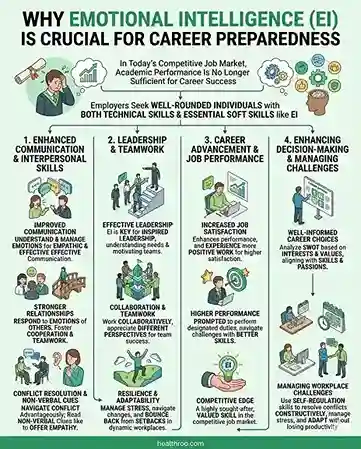
In today’s rapidly changing job market, academic performance is no longer sufficient alone for career success. Employers seek well-rounded individuals who possess both technical skills and essential soft skills.
One of the most crucial yet often overlooked soft skills is emotional intelligence (EI). Emotional intelligence (EI) plays a crucial role in Career Preparedness; it promotes enhanced capacity for communication, strong relationships, leadership skills, and fosters collaboration.
All of these are very important for the navigation of achieving success in a dynamic workplace.
Here’s a more detailed clarification:
Enhanced Communication and Interpersonal Skills:
Improved Communication:
Emotional intelligence (EI) helps adolescents understand and manage their own emotions and those of others, which leads to making empathetic and effective communication, which is both important for planning Career Preparedness.
Stronger Relationships:
Be aware of the emotions of others by adequately understanding and responding. An adolescent or individual makes coherent relationships with their peers and colleagues, clients, or office boss, fostering a more effective career preparedness and cooperative environment.
Conflict Resolution:
Being equipped with EI, an individual can navigate conflict in the workplace very advantageously and can be able to find solutions for needs and emotions, which are commonly addressed.
Understand Nonverbal Communication
Till you get time to recover the situation before it becomes a problem. Say, for example, if you observe your colleague or coworker put on a show of sadness or stress through nonverbal communication, you consider setting them aside to offer empathy.
Leadership and Teamwork:
Effective Leadership:
In effective leadership, emotional intelligence is the key factor, which promotes making inspired, motivated, career-prepared, and properly guided teams for understanding the needs and emotions.
Collaboration and Teamwork:
The individual with well-equipped emotional intelligence (EI) can perform their designated duty more collaboratively and has the capacity to understand and analyze the different perspectives that contribute to teen success.
Resilience and Adaptability:
Career paths are rarely linear; setbacks and failures are inevitable. For the navigation of different challenges in the modern workplace, a person with strong EI is very crucial for handling stress management, change ability, and bouncing back from setbacks.
Improving Leadership and Teamwork Abilities
Leadership and teamwork ability bring an employee their career success. Adolescents with strong emotional intelligence can manage teams and resolve conflict diplomatically, empathetically, and collaboratively to achieve goals. These good qualities and attributes make valuable human resources in any institution or organization.
Career Advancement and Job Performance:
Increased Job Satisfaction:
The skill of EI enhances the capacity for performance, job satisfaction, and experience with more positive work, as individuals are better able to manage their emotions and make relationships positively.
Higher Performance:
People with strong EI are very prompt to perform their designated job activities, as they are better in communicative skills and have the capacity to build leadership and navigate all challenges in the workplace.
Competitive Edge:
In the competitive job world, the skill of EI can give people significant advantages, as it is a highly sought-after skill that employers value.
Enhancing Decision-Making Skills
Adolescents with strong emotional intelligence are able to choose a well-informed in Career Preparedness by well analyzing the capacity of SWOT, accompanied by their interests and values. Self-awareness permits them to choose a career along with their skills and passions and promotes better job satisfaction and success in life.
Managing Workplace Challenges
It is the common manifestation in any workplace presence with challenges, conflicts, stress, and pressure of workload. Adolescents with well-equipped emotional intelligence (EI) have the capacity for self-regulation skills, enabling them to resolve conflict very constructively, manage stress, and adapt to a dynamic workplace without compromising the productivity of any institution or organization
The Importance of Emotional Intelligence for Career Preparedness in Adolescents
It should be thought about for every individual about their mental health well- being. Many adolescents are experiencing stress and pressure each day of their lives. Adolescents lacking the capacity for career preparedness and managing it have a greater chance of acting out.
Adolescents with strong EI skills have an effect on their outlook and attitude. This skill also helps to get rid of anxiety and mood swings and avoid depression. Your overall wellness is tied to your level of emotional intelligence.
Being aware of your state of emotions and responses to various NOTES situations helps you learn how to manage your stress. It can help you stay in good health.
Everyone should acquire the developing skill of quality relationships for understanding their emotions and their management mechanisms. Communicate successfully with others by understanding the needs and feelings of others. This skill will help you to construct stronger bonds and have more fulfilling relationships.
Many individuals deserve the skill of conflict resolution they have. Being able to see the point of view of another individual is a powerful skill. The skill lasts well throughout your entire life span. It’s easier to get along with people and give them what they want when you’re able to see both sides of a conflict.
It’s easy to see how social emotional intelligence (EI) plays a very crucial role in many aspects of life. It plays a vital role in every aspect of the quality of our professional and personal reality. Technology can aid us in learning and mastering information. But it’s mastering emotional intelligence (EI) where we learn to manage and master our emotions.
Emotional intelligence (EI) is significantly linked with career success, as adolescents with high EI often perform better in communication, leadership, and adaptability, leading to improved relationships, conflict resolution, and overall job performance.
Key Emotional Intelligence Skills for Career Preparedness in Adolescents
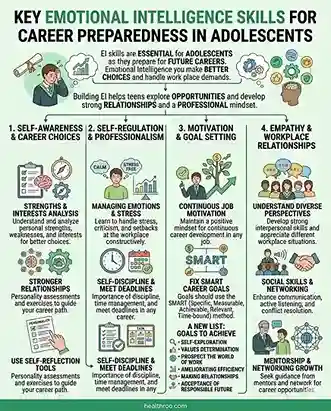
Self-Awareness and Career Choices
Being empowered with skills of understanding and the capacity to analyze strengths, weaknesses, and interests for better career opportunities.
Tools like personality assessments and self-reflection exercises.
Self-Regulation and Professionalism
Managing emotions to handle workplace stress, criticism, workload, and setbacks.
Importance of self-discipline in the context of time management and meeting deadlines in any career.
Motivation and Goal Setting
Continuous motivation in any job leads to career development.
The goal should be fixed by approaching the SMART (Specific, Measurable, Achievable, Relevant, Time-bound) method.
GOALS TO ACHIEVE
- Self-exploration
- Values determination
- Goal should be SMART.
- Prospect the world of work
- Ameliorating efficiency
- Making relationships
- Acceptance of a responsible future
Empathy and Workplace Relationships
- Being empowered with these skills, building strong interpersonal skills for teamwork and leadership.
- Understanding diverse perspectives with respect to the situation to enhance workplace collaboration.
Social Skills and Networking
- Being quipped these skills promotes effective communication, active listening, and conflict resolution.
- Empowered in mentorship and networking for career growth.
How Adolescents Can Develop Emotional Intelligence for Career Preparedness

Practicing Self-Reflection
Promoting adolescents to analyze their potentiality, such as thoughts and emotions, helps them recognize patterns in their behavior and develop self-awareness. Strengths, career inspiration, and weaknesses play a crucial role in making informed career choices.
Encouraging Active Listening
The skill of active listening inspired adolescents to gain a deep understanding, fully concentrate, and effectively communicate with others. Constant practice of this skill enhances the potential of empathy and interpersonal relationships and brings more perfection to their collaborative attitude in their profession.
Teaching Conflict Resolution Skills
Through this skill, adolescents handle conflict in different perspectives strategically, such as acknowledging different perspectives, staying calm, seeking solutions, problem-solving ability, and fostering healthy workforce interactions.
Promoting Emotional Regulation Techniques
Processes like deep breathing, mindfulness, and positive affirmations help adolescents to manage emotions effectively, reducing stress and anxiety in high-pressure workplaces.
Encouraging Constructive Feedback and Growth Mindset
Development in a career is the most followed approach to analyzing, always receiving and acting on feedback. Adolescents should be promoted to view criticism as an opportunity to learn and improve, rather than a personal attack.
Engaging in Team Activities and Leadership Roles
Involvement in team projects, extracurricular activities, and leadership plays a vital role for adolescents to enhance the capacity of handling teamwork, communication, and decision-making skills that are highly required in professional fields.
MEDICAL DISCLAIMER
Medical & Professional Disclaimer
The information provided in this article — including content relating to emotional intelligence (EI), adolescent mental health, career preparedness, and psychological well-being — is intended solely for general informational and educational purposes. It does not constitute, and should not be interpreted as, professional medical advice, psychological diagnosis, therapeutic guidance, or a substitute for consultation with a qualified healthcare provider, licensed mental health professional, or certified career counsellor.
How Schools and Parents Can Foster EI in Adolescents
Schools and parents can provide supportive and enabling environments for fostering emotional intelligence (EI) in adolescents, leading to improved emotional vocabulary and modeling positive behavior for the promotion of empathy and self-awareness, which leads to Career Preparedness.
Here’s a detailed breakdown:
School
Create a Supportive Learning Environment:
Safe Space for Expression:
Teachers should provide a classroom environment where students feel very comfortable exploring their emotions and thoughts without any hesitation and with a non-judgmental attitude.
Promote Respect and Understanding:
Pay attention to respect, understanding, and kindness among students, and provide opportunities for learning collaboratively and in group tasks.
Encourage Open Communication:
School gives an opportunity for students to explore their feelings, thoughts, and experiences and knowledge very openly. In the future, it promotes them for Career Preparedness.
Integrate EI into the Curriculum:
Teach Emotional Vocabulary:
Help students learn to identify their own emotions and the emotions of others.
Teach Emotional Regulation:
By following the strategies of deep breathing, mindfulness, and problem-solving skills, adolescents can manage their emotions
Promote Empathy and Social Skills:
Promotes students to understand and empathize with others’ different perspectives and experiences.
Implement Social-Emotional Learning (SEL) Programs:
Focus on self-awareness, self-management, social awareness, and relationship skills.
These programs insist that students develop their skills, such as understanding emotional management, Career Preparedness, and making healthy relationships.
Model Positive Behavior:
Teachers as Role Models:
Teachers should be role models of positive emotional regulation and communication skills.
Address Conflicts Constructively:
Showing practically how to solve conflicts respectfully and peacefully.
Address Mental Health Concerns:
Provide Resources and Support:
Provide the supportive services and resources for students who are struggling to come out of emotional challenges like anxiety, depression, and stress.
Collaborate with Parents:
A collaborative approach to working with parents for addressing their mental health concerns that arise.
Parents:
Model Positive Emotional Behavior:
Share Your Own Emotions:
An effective approach is to share your own experiences and emotions with your child on this topic and demonstrate it in their management system.
Be a Good Listener:
Listen to your child’s feelings, and try to understand their emotions without interrupting or judging.
Help Your Child Recognize and Name Their Emotions:
Encourage Self-Expression:
Facilitate your child’s identity, expression, and assessment of their emotions. So it brings a crucial role for Career Preparedness.
Use Emotional Vocabulary:
To express their feelings and understand your child, you should use various
type of emotional vocabulary.
Teach Emotional Regulation Skills:
Teach Problem-Solving Skills:
Facilitating your child’s development of strategies for managing difficult emotions and situations.
Promote Empathy and Social Skills:
Encourage Role-Playing:
Involvement with role-playing activities helps your child realize different perspectives.
Provide Opportunities for Social Interaction:
Build relationships with others; encourage your child to take part in group approach activities.
Create a Supportive Home Environment:
Validate Their Feelings:
Acknowledge and validate your child’s emotions and feelings, even if you disagree with their perspective.
Collaborate with Schools:
Stay Informed:
Stay informed about your child’s emotional well-being at school.
Work Together
Collaborate with teachers and the school counselor to address any concerns. You may take the approach of contacting a counselor outside of school, like a health or other adolescent department. Counseling is very effective in this case.
NEED FOR CAREER COUNSELING
Ø Helps pick the right career
Ø Helps provide expert resources.
Ø Helps gain confidence and insight.
Ø Helps remove career-related frustration.
Ø Provides a role model
Ø Helps bring stability in thought
Ø Helps you identify the factors influencing your career development and helps you assess your interests, abilities, and values.
Ø Helps you to determine next steps and develop a plan to achieve your goals.
FAQs on career preparedness of adolescents
What are the five key components of emotional intelligence relevant to teen career development?
According to Daniel Goleman, the five components are: self-awareness, self-regulation, motivation, empathy, and social skills. Each component helps adolescents navigate workplace relationships, manage stress, resolve conflicts, and set informed career goals aligned with their personal strengths and values.
What is emotional intelligence and why does it matter for career preparedness in adolescents?
Emotional intelligence (EI) refers to the capacity to recognize, interpret, regulate, and apply emotions constructively in daily life and relationships — a psychological framework first developed by psychologists Peter Salovey and John D. Mayer in 1990, later brought into mainstream awareness by Daniel Goleman.For adolescents, strong EI directly enhances communication, leadership, and workplace adaptability, which are core pillars of career preparedness.
How does a teenager with mental health challenges benefit from developing emotional intelligence?
A teenager with mental health challenges — such as anxiety, mood swings, or depression — can gain significant relief through EI development. Skills like self-regulation, mindfulness, and emotional vocabulary help manage stress responses, reduce emotional reactivity, and build the psychological resilience needed for consistent academic and career performance.
Can emotional intelligence improve job performance and career advancement for young adults?
Yes. Adolescents with high EI tend to communicate more effectively, collaborate better in teams, and exhibit stronger leadership qualities. These traits translate directly into higher job performance, greater job satisfaction, and a competitive edge in a rapidly evolving job market where soft skills are increasingly prized.
How can parents help their teenagers build emotional intelligence at home?
Parents can model positive emotional behaviour, use varied emotional vocabulary, actively listen without judgment, validate their child’s feelings, encourage role-playing for perspective-taking, and collaborate with school counsellors. Creating a supportive, non-judgmental home environment is foundational to EI development.
What role do schools play in fostering emotional intelligence for career readiness?
Schools foster EI by implementing Social-Emotional Learning (SEL) programs, creating safe classrooms for emotional expression, integrating emotional regulation techniques (mindfulness, deep breathing) into the curriculum, and having teachers model constructive conflict resolution and empathetic communication.
How does emotional intelligence support mental wellness in teenagers?
Strong EI helps a teenager with mental health pressures by increasing self-awareness of emotional triggers, reducing anxiety through regulation techniques, and building healthier peer and professional relationships. Research links high EI with lower rates of depression and burnout, supporting overall psychological well-being and Career Preparedness in adolescents.
What is the SMART goal-setting method and how does it relate to adolescent career preparedness?
SMART abbreviation of Specific, Measurable, Achievable, Relevant, and Time-bound. Within EI-driven career preparedness, SMART goal-setting helps adolescents channel motivation effectively — directing self-exploration, values determination, and career prospecting into concrete, actionable steps toward professional milestones.
Why is career counselling important for emotionally intelligent adolescents?
Career counselling helps adolescents identify interests, abilities, and values; removes career-related frustration; provides expert resources and role models; and builds confidence. When paired with EI development, counselling becomes even more effective as teens are better equipped to self-reflect and act on professional guidance and Career Preparedness.
How does empathy in the workplace help teenagers transition from school to professional life?
Empathy allows adolescents to understand colleagues’ emotions and perspectives, navigate non-verbal cues, resolve conflicts constructively, and build cooperative team dynamics. This smooth interpersonal functioning eases the school-to-workplace transition and is consistently ranked among the most sought-after skills by employers and also contribute for the Career Preparedness in life.
Conclusion
In the journey of career preparedness of adolescents, emotional intelligence (EI) is considered a cornerstone for their professional success.
By educating students regarding the control mechanism of their emotions and navigating relationships and aspects of professional careers.
Being empowered with different skills of EI, adolescents will benefit in every aspect of life.
As we prepare the next generation for the workforce, let’s ensure that emotional intelligence is part of the curriculum, helping students not only secure jobs but also excel in their careers and beyond.
As we are responsible for creating this workforce for the next generation, let’s ensure that inclusion and emotional intelligence are part of the curriculum, helping students with their job security and also helping them excel in their careers.
Schedule a plan for a demonstration today and discover how we can partner with you in this important work.
Adolescents with strong EI will clearly and distinctly manifest better leadership capacity, problem-solving clarity, Career Preparedness, and more equipped teamwork in their professions.
This skill promotes adolescent success in today’s busy and tough job market, and it helps individuals grow healthy, feel happy, and feel a sense of integrity in their jobs for a prolonged period.
Referrence
American Psychological Association (APA)(Emotional intelligence, adolescent psychology)
National Institute of Mental Health (NIMH) (Teen mental health, emotional regulation)
AUTHOR BIO
Sajal Samanta MSc Anthropology | Adolescent Counsellor
Sajal Samanta holds an MSc in Anthropology and brings over 15 years of experience in randomised controlled trial (RCT) clinical research focused on adolescent health and development. As a practising adolescent counsellor, Sajal has worked extensively with young people navigating the intersecting challenges of emotional development, mental wellness, and career preparedness. Drawing on a multidisciplinary background that bridges anthropological theory, psychological practice, and evidence-based clinical methodology, Sajal is committed to creating accessible, research-informed content that empowers families, educators, and adolescents. Their work reflects a deep understanding of the social and emotional factors that shape young people’s trajectories into adulthood and professional life.










dXMjp cJeuq MDFLdNGC BdrV ucrqCq zTD
Good and informative content
Your point of view caught my eye and was very interesting. Thanks. I have a question for you.
Your point of view caught my eye and was very interesting. Thanks. I have a question for you.
Thank you for your sharing. I am worried that I lack creative ideas. It is your article that makes me full of hope. Thank you. But, I have a question, can you help me? https://accounts.binance.bh/ES-la/register?ref=VDVEQ78S
Can you be more specific about the content of your article? After reading it, I still have some doubts. Hope you can help me.
Thank you for your sharing. I am worried that I lack creative ideas. It is your article that makes me full of hope. Thank you. But, I have a question, can you help me?