
Empower adolescents with career counselling to explore interests, set goals, and make informed decisions about their future career paths.
Author: Sajal Samanta
Sajal Samanta is an education and youth-development content writer with a strong interest in adolescent psychology, career planning, and holistic learning approaches. He focuses on simplifying complex counselling concepts into practical, actionable guidance for students, parents, and educators. His work emphasizes evidence-based insights, skill development, and future-ready career awareness for young learners in the Indian context.

Peer-Reviewed By
Surav Samanta – Psychologist
Surav Samanta is a practicing psychologist specializing in adolescent behaviour, emotional development, and educational psychology. He contributes professional insights on student motivation, decision-making patterns, and mental well-being during transitional academic phases.
Sanjoy Maity – Adolescent Counsellor
Sanjoy Maity is an adolescent counsellor with experience in career guidance, student mentoring, and vocational orientation programs. His work focuses on helping teenagers align interests, aptitudes, and real-world career opportunities through structured counselling techniques. latest reviewed in February 2026
Disclaimer
The information provided in this article is intended for educational and informational purposes only. It does not substitute professional psychological, medical, or career counselling advice. Individual career decisions should be made after consulting certified counsellors, psychologists, educators, or relevant professionals based on personal circumstances, aptitude, and interests. While every effort has been made to ensure accuracy and reliability, readers are encouraged to verify information and seek personalized guidance before making academic or career-related decisions
Introduction of Career Counselling
Career counselling for adolescents is no longer a luxury—it’s a necessity in today’s competitive, challenging, and evolving world. This is a very real and alarming picture that employment opportunity gradually decreasing in both Govt. as well as Private sector in world based.
Moreover, for the fulfillment of existing vacancies required different dimensional skills and specific qualification. With rapidly changing career trends, technology advancements, particularly the application of AI, and the growing pressure to succeed, adolescents often find themselves confused about their career paths.
Smart career counselling bridges the gap between confusion and clarity, facilitating teens to make more informed, confident choices about their futures.
In this article, we delve into smart career counselling tips for adolescents, explore their importance, benefits, strategies, and expert techniques with expected outcomes to empower teens toward success.
Addressing the Problem
The young, productive people are living in a society where there is little scope as well as complexity to build sustainable career opportunities. In this connection, guidance has played a very crucial and fostering role as motivating support, creating opportunities for smart career choice options, preventing school dropout, and providing proper training as required.
Students or their family members may give priority to conventional education over VET, while VET pathways might very well be the best fit for a student’s preferences or priorities, attitudes, learning style, and capabilities—allowing students to properly explore their potential and take better advantage of career opportunities. Guidance avoids the usual biases about learning pathways, putting the focus on personal skills and interests.
In VET, it always have the vocational nature and specification at a high level that offers various choices in this learning track. Guidance can be facilitated for navigation of options of VET and the often complex application procedures.
Appropriate guidance helps young people understand their learning needs and career preferences based on their strengths and characteristics rather than stigmatizing them as “bad students” and generating feelings of inadequacy.
Appropriate guidance facilitates young students to comprehend their learning needs and career preferences with respect to their strengths and characteristics, rather than stigmatizing them as “bad students” and generating a sense of inadequacy
It can foster young students to have an active, more engaging approach to education and learning in general.
Support during studies plays a crucial role in a successful learning path. Such support may involve help with the choice of a specialization, the transition to the workplace (e.g., for work-based learning), or networking into the occupational community, among other aspects.
Prevalence of Career Counselling for Adolescents in India –
In India, it is now highly recognized that career counselling for adolescents is day by day gradually increasing its demand and plays a crucial role in making informed career decisions, but it still remains in a limited position.
While many students benefit from career guidance, a significant percentage still lack access to professional counselling, particularly in schools.
Key findings about career counselling in India:
High Need:
A large proportion of students, over 80%, report that career counselling is beneficial.
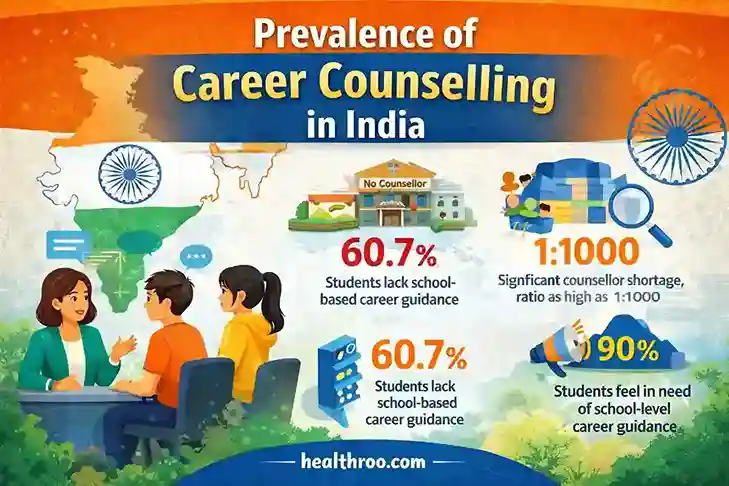
A publication prevalence report in this regard in the journal International Journal of Research of Bharathiar University Coimbatore, Tamil Nadu, in the year 2022, found that among the respondents of government and private schools, 60.7% of them had not received any career guidance at the school level, and 90% of them opined that they were in need of career guidance at the school level.
In India, 73 percent of students begin career discussions with their parents between the ages of 10 and 14, with conversations often centring around employability and financial planning.
Early Discussions:
Many students (73%) begin discussing career options with their parents between the ages of 10 and 14.
Limited Access:
A substantial number of schools, particularly in the public sector, lack dedicated career counsellors.
Counsellor Shortage:
India faces a significant shortage of trained career counsellors, with some reports indicating a counsellor-to-student ratio as high as 1:1000 or more, especially in public and rural schools.
Benefits of Counselling:
Career counselling helps students identify necessary skills, align career goals with skill development, and understand available career paths and educational options.
Role of Technology:
There’s growing potential to leverage AI and other technologies to improve access to personalized and student-centered career guidance.
Focus on Disadvantaged Students:
Studies highlight the importance of targeted interventions for disadvantaged students and girls, who may experience greater career indecision.
Counselling Needs:
Adolescents need guidance on academic, personal, social, and career-related issues during this transitional phase of life.
Factors Influencing Prevalence:
Socioeconomic Factors:
The prevalence of accessing career counselling among the young students, the socioeconomic background, and the type of school attended may be crucial factors.
School Resources:
The availability of career guidance services is often linked to the resources and infrastructure of the educational institution.
Parental Influence:
Parents play a significant role in career decisions, but professional guidance can provide more comprehensive support.
Integration in Schools:
There’s a growing movement to integrate career counselling into school curricula and provide more structured guidance services.
Defining Career Counselling

A career is essentially the sum total of an individual’s work experiences in a specific field or across multiple fields. Career counselling is a branch of counselling that deals with mentoring/coaching on issues related to an individual’s career. It is educational and occupational in nature and basically helps individuals in making rational choices about their career development.
Career counselling encompasses
Career Development:
Emphasizing learning about, preparation for, entry into, and progress in the world of work
Career Education:
Educating an individual regarding various ways for ensuring career development and thus, preparing him/her to get into the world of work (this is one of the primary responsibilities of a school)
Career Guidance:
Guiding an individual with the help of assessments and other activities aimed at facilitating career planning and related decision-making
Career Coaching:
Helping individuals to set goals, identify procedures to achieve their goals, and evaluate related progress
Occupational Information:
Providing information concerning training and related educational programs, careers, career patterns, employment trends, and opportunities
Vocational Education:
Education that prepares an individual to work in a vocational or technical field
Career Counselling for Adolescents
Adolescence is a phase of transition as adolescents prepare to step into adulthood. Choosing a career is an important part of this transition. Career counselling can help adolescents gain greater understanding of themselves, their areas of interest and ability, and their aptitudes; it can help strengthen their ability to explore options and decision-making skills.
Objectives of the career counselling for adolescents
- Helping adolescents identify their own areas of interest (vocational/occupational), abilities, and aptitudes.
- Providing information about possible educational courses and career options matching their areas of interest.
- Creating awareness about possible career options and promoting related dialogue among students, parents, and teachers at secondary and senior secondary education levels.
Why Career Counselling Matters for Adolescents in Today’s World
- Adolescents are at a stage of self-discovery. They are exploring their interests, values, strengths, and aspirations. However, without proper guidance, they may fall into unsuitable careers due to peer pressure, parental expectations, or lack of awareness.
- Apart from that, the academic experience of a student is no longer limited to typical professional options. The emergence of varied sectors such as artificial intelligence, graphic design, freelancing, SEO expertise, and environmental research has created unlimited options. However, navigating these options can be disconcerting.
Avoiding Career Confusion

It is widely observed that students are frequently confronting the situation in question regarding their future employment opportunities and the possibility of absorption.
In this situation, career counseling is the only way to navigate this situation, because it is the only scientific process or approach to determine individuals’ interests and match them with appropriate job opportunities.
Reducing Academic Pressure
In many metropolitan cities in India, like Kolkata, many students are under intense pressure to excel in specialized disciplines such as medicine or engineering.
Career counseling allows individuals to explore unconventional but rewarding possibilities, lowering the stress of achieving false expectations.
Adapting to Changing Job Markets
With sectors continually expanding, career counseling provides students with the skills and knowledge required to thrive in today’s workforce.
Exploration and Identity Formation:
Adolescents are discovering their interests, values, and strengths. Career counseling helps them explore various career options and identify potential paths.
Informed Decision-Making:
Career counselling provides adolescents with relevant information on career options, industries, job roles, skill upgradation, and educational pathways to make informed decisions about their future academic and career pursuits.
Development of Career Goals:
Career counselling helps adolescents set realistic and achievable career goals, aligning with their strengths, interests, and values. In a single word, a goal should be SMART.
Improved Academic Performance:
Career counselling can motivate adolescents to perform better academically, as they understand the relevance of their studies to their future careers.
Enhanced Self-Awareness:
Career counselling fosters self-awareness, enabling adolescents to understand their strengths, weaknesses, and learning styles for meeting their self-identity crisis.
Better Preparation for the Future:
Career counselling prepares adolescents for the challenges and opportunities of the rapidly changing workforce.
Reduced Anxiety and Stress:
Career counselling can alleviate anxiety and stress related to career choices and future uncertainty.
Increased Confidence:
Career counselling empowers adolescents to make informed decisions, boosting their confidence and self-esteem.
Key Benefits of Career Counselling for Teens
Professional career counsellors can support people with career-related challenges in many ways. For Instance:
- They can help clients look at the bigger picture. evaluate their qualification, experience, strengths, and weaknesses with respect to the desired vocation /occupation, the job market, and other contextual aspects
- Through their counselling and teaching abilities, career counsellors can additionally support clients in gaining a better understanding of what really matters for them personally, how they can plan their careers autonomously, or help them in making tough decisions and getting through times of crisis
- Career counsellors can support their clients in finding suitable placements/jobs, in working out conflicts with their employers or accessing other services as needed
- Counselling introduces teens to a variety of career fields beyond traditional ones.
- Students learn to make data-driven, well-researched decisions.
- A clear plan of action boosts self-esteem and reduces anxiety.
- Early guidance avoids regret or career dissatisfaction in the future.
Career Readiness
The ability of a person to effectively navigate pathways that connect education and employment to achieve a fulfilling, financially secure, and successful career is termed as career readiness.
Being career-ready in today’s constantly changing economy requires adaptability and a commitment to lifelong learning as well as mastery of key academic, technical, and workplace knowledge.
Career counselling can help clients understand the value and practice career readiness.
Smart Career Counselling Tips for Adolescents bya Career Counsellor
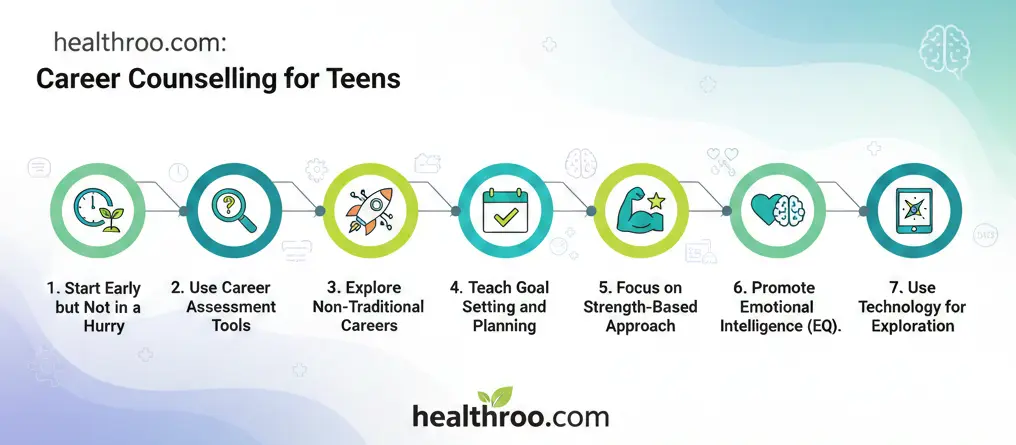
1. Start Early but Not in a Hurry
Introduce career exploration by early adolescence (13–15 years), but avoid pressuring teens to choose prematurely.
2. Use Career Assessment Tools
Tools like MBTI, Holland Code, and Aptitude Tests provide insight into interests, personality, and skills.
3. Involve Parents Carefully
Include parents in the journey, but ensure the child’s voice remains central to the decision-making process.
4. Explore Non-Traditional Careers
Expose teens to emerging careers like AI development, ethical hacking, digital marketing, content creation, etc.
5. Encourage Internships and Volunteering
Hands-on experiences give clarity and enhance CVs.
6. Teach Goal Setting and Planning
Use SMART goals to help teens outline academic and career targets.
7. Incorporate Real-World Exposure
Encourage teens to attend career fairs, webinars, or informational interviews with professionals.
8. Focus on Strength-Based Approach
Emphasize what the teen does well instead of areas of weakness.
9. Promote Emotional Intelligence (EQ)
EQ helps teens handle stress, failures, and communication challenges in their career journey.
10. Discuss Financial Realities
Help teens understand the costs of education, earning potential, and job market trends.
11. Don’t Rely Solely on Academic Performance
Grades matter, but skills, creativity, and drive are equally important.
12. Use Technology for Exploration
Platforms like LinkedIn, Coursera, YouTube Career Channels, and Skillshare can provide insights and upskilling.
13. Normalize Career Shifts
Teach teens that changing direction is okay. Flexibility is a strength.
14. Promote a Growth Mindset
Failure is part of learning. Resilience leads to long-term success.
15. Use Career Storytelling
Inspire teens by sharing the journeys of successful people in varied fields.
16. Focus on Skill-Based Careers
Not all great careers require traditional degrees—skills in coding, design, photography, and social media are highly valued.
17. Create a Career Vision Board
Visualize goals and milestones using images, quotes, and timelines.
18. Encourage Continuous Learning
Career success demands lifelong learning. Instill curiosity and passion for knowledge.
19. Build Strong Communication Skills
Public speaking, writing, and networking are career boosters for any field.
20. Connect with Certified Career Counsellors
A trained professional counsellor brings expertise, objectivity, and customized planning for success.
Duties of a Career Counsellor
A career counsellor must fulfil the following duties.
- Meet with adolescents regarding educational and vocational matters and help them identify their areas of interest and further educational and/or job opportunities
- Provide relevant information and other support, which may include sharing pamphlets, school/college application forms, catalogues, job applications, and other documents.
- Mint has contact with individuals/agencies such as business owners, college administrators, parents of students, and other key actors.
- Learn about and share information and answer questions about possible sources of financial aid, scholarships, etc., and the procedures for applying for such support
- Maintain detailed files about each adolescent and make necessary updates during follow-up
How Parents Can Support Their Child during Career Counselling
The journey of career counselling for adolescents becomes more effective with active parental involvement.
Here are some methods to support your child:
Be Open-Minded
Avoid pushing your child into a career based solely on your expectations. Instead, listen to their aspirations and allow them to explore diverse opportunities.
Encourage Participation
Motivate your child to attend career counselling sessions, workshops, or internships. Exposure to several professions allows individuals to make informed selections.
Trust the Experts
Professional counsellors use psychometric tests and in-depth assessments to provide accurate guidance. Trust the process and give your child the space to discover their true potential.
Regular Communication
After each counselling session, discuss the findings with your child. Encourage them to express their opinions and discuss any issues they may have.
Role of Schools and Communities
Schools must integrate career counselling into the curriculum through
- Dedicated counsellors
- Career planning workshops
- Regular seminars with professionals
- Parent-student counselling sessions
Career counsellors attached to schools may also have to
- Undertake group sessions on career planning for specific classes.
- Take on the role of guidance counsellor and provide crisis intervention for students, sponsor after-school activities, and provide counselling services for various needs.
Communities can support adolescents by:
- Offering internships and mentoring programs
- Organizing career awareness camps
- Providing scholarships and training
The Digital Age and Career Counselling
Today, adolescents are digital natives. Smart counselling should embrace
- Virtual counseling platforms
- Career planning apps
- AI-based career guidance tools
- Gamified self-assessments
- Digital resume and portfolio building
Blending traditional values with modern tools ensures relevance and reach.
Career Testing
Career counselling can strongly benefit from the use of aptitude tests or career testing. These tests help shortlist possible job options that match the attributes of the person being tested. It does so by referencing people with similar personalities who enjoy/are successful at their jobs.
Psychometric testing is one of the key means of career testing. It uses in-depth psychological profiles to assess personality and cognitive functioning (i.e., aptitude, interest, attitudes, intelligence, etc.). Significantly, it also helps assess skills. Personal goals, strengths, and weaknesses can also be understood.
Career Counselling for Persons with Disabilities( PWD)
- Adolescents with disabilities constitute a particularly vulnerable group as they have to cope with the pains and pressures of adolescence along with the implications of their disability.
- The career counsellor should help them in assessing their areas of vocational and occupational interest and match these with their skills and abilities.
- He/she may be empathetic and sensitive in explaining options and helping adolescents to arrive at the appropriate decision. He/she should also share information about the provisions and benefits that persons with disabilities are entitled to.
Challenges in Career Counselling
One of the major challenges associated with career counselling is encouraging participants to fully engage with the process.
Also, some clients may prefer to rely on the advice of peers rather than accept interventions/inputs provided by professional career counsellors. This is particularly true for adolescents. They may feel that their peers and other acquaintances know them better and can give more accurate advice.
Of course, many people do play a formal/informal role in giving career advice—i.e., parents, teachers, managers, trainers at the workplace, etc.
Nonetheless, the career counsellor can provide specialized inputs and guide the adolescents in a balanced manner; he/she should be able to build such a relationship wherein the adolescent can recognize the value of his/her inputs.
Recommendations for Career Counselling in India:
- Integrate Career Counselling: Increase the presence of career counsellors in schools and educational institutions.
- Train Counsellors: Expand training programs for career counsellors to address the growing demand.
- Utilize Technology: Integrate AI and other technologies to provide accessible and personalized career guidance.
- Address Disparities: Focus on providing tailored support to disadvantaged students and girls, who may face unique challenges.
Expected Outcomes:
- The role of career guidance in preventing early leaving is widely acknowledged. Research suggests that students who have a career plan are more likely to engage positively in education.
- Systematic career education and guidance can also help at transition points—to other levels and pathways of education and training, to work, or to a related occupation.
- Quality early and persistent career guidance is particularly important to support young people in choosing VET as a positive option, rather than ‘ending up’ in VET due to a negative selection process. The following outcomes can be expected.
FAQs on Career Counselling for Adolescents
What is career counselling for adolescents?
Career counselling for adolescents is a structured guidance process that helps young individuals understand their interests, aptitudes, personality traits, and academic strengths before choosing future study or work paths. Research in educational psychology shows that early guided exploration improves decision-making confidence and reduces random career selection. It usually includes aptitude assessments, one-to-one discussions, goal planning, and exposure to career information so students make realistic and informed long-term choices.
At what age should students start career guidance?
Most education experts recommend beginning exploratory guidance between ages 13 and 15, when identity formation and subject specialization start influencing future academic decisions. Developmental psychology studies indicate that early adolescence is ideal for introducing awareness, not pressure. The purpose is exposure rather than final commitment. Starting too late often leads to rushed decisions, while early structured exploration allows gradual clarity and reduces anxiety linked with board examinations and competitive entrance planning.
Does career counselling really improve academic performance?
Yes, multiple school-based studies indicate that students who receive structured guidance often show improved academic engagement. When learners understand the relevance of subjects to future goals, intrinsic motivation increases. Educational behaviour research suggests clarity of direction reduces procrastination and academic burnout. Improved performance does not come from pressure but from purpose. Students become more consistent with studies because they connect classroom learning with tangible career possibilities rather than viewing education as abstract or forced.
How do aptitude and psychometric tests help students?
Aptitude and psychometric assessments measure cognitive abilities, interests, personality dimensions, and learning styles using standardized tools. These tests do not decide a career but provide scientific indicators of strengths and preferences. International counselling associations emphasize that such tools are most effective when interpreted by trained professionals. They help students avoid mismatch between personal capability and career demands, leading to better satisfaction, reduced dropout risk, and improved adaptability in higher education or vocational training.
Can career counselling reduce stress and anxiety among teenagers?
Yes, structured guidance significantly lowers uncertainty-related stress. Adolescents often face confusion due to parental expectations, peer comparison, and competitive environments. Counselling introduces clarity, realistic planning, and emotional support, which improves self-esteem and emotional regulation. Psychological well-being studies show that clarity of future direction reduces fear of failure and enhances coping mechanisms. Students who receive supportive mentoring often report higher confidence, improved communication skills, and a more positive outlook toward academic and professional transitions.
Is academic grade the only factor in choosing a career?
No, grades alone are not sufficient indicators of future success. Modern workforce research highlights the importance of skills, adaptability, creativity, communication ability, and emotional intelligence alongside academic performance. Many emerging fields value portfolios, certifications, and practical exposure more than marks alone. A balanced evaluation of interests, aptitude, values, and personality leads to sustainable career satisfaction. Over-reliance on grades can limit exploration and may result in mismatched choices that reduce long-term engagement and fulfillment.
How important is parental involvement in career planning?
Parental involvement plays a crucial supportive role, but it should be collaborative rather than directive. Studies in family psychology indicate that adolescents perform better when parents provide encouragement, open communication, and exposure to opportunities instead of imposing choices. Balanced participation strengthens trust and reduces conflict. When parents listen to the child’s interests while also considering financial and practical realities, decision quality improves. Professional guidance often helps families align expectations with the student’s capabilities and aspirations.
Are online career counselling platforms reliable?
Online platforms can be reliable if they employ certified counsellors, validated assessment tools, and transparent methodologies. Digital counselling has expanded access, especially in regions where school-based services are limited. Research on tele-guidance indicates comparable effectiveness to face-to-face sessions when ethical standards and data privacy are maintained. However, credibility depends on qualifications, user reviews, and professional affiliations. Hybrid models combining virtual assessments with personalized interaction often provide the best balance of accessibility and depth.
Can students change their career path later in life?
Yes, career flexibility is increasingly common in modern economies. Labour market studies show that individuals often shift professions two to five times across their working life due to technological change and evolving interests. Early guidance does not lock a person into a single direction; instead, it builds transferable skills and decision-making ability. Adaptability, continuous learning, and upskilling are more important than rigid planning. Career transitions are normal and often lead to improved satisfaction and financial growth.
How does career counselling support job readiness?
Career counselling enhances job readiness by developing practical competencies such as communication, interview skills, resume preparation, networking behaviour, and workplace etiquette. It also introduces students to internships, volunteering, and real-world exposure. Workforce development research highlights that students who receive structured preparation demonstrate stronger employability skills and adaptability. Beyond technical knowledge, guidance fosters resilience, time management, and professional confidence, which are essential for navigating competitive recruitment processes and long-term career sustainability.
Conclusion
Smart career counselling empowers adolescents to dream big and plan wisely. It equips them with clarity, direction, and confidence to navigate the complex career world. As educators, counsellors, and parents, we must nurture their potential and help them shape a fulfilling, future-ready career.
Career counselling is not just about helping students choose a career—it’s about empowering them to reach their full potential. Different metropolitan cities of India, like Kolkata, where the pressure to excel is high, professional counselling provides clarity and confidence, allowing students to thrive in their chosen fields.
Encouragement and support from parents can have a significant impact. Start your child’s journey with career counselling for students in Kolkata today and help them pave the way to a successful and fulfilling future.
Referrals
ICS Career GPS – School & Student Career Counselling Services









2 thoughts on “Smart Career Counselling Tips for Adolescents Today”