![Effective OCD Treatment for Teens: know more it’s symptoms and types [2026]](https://healthroo.com/wp-content/uploads/2025/03/WEBP-Fitured-Image_11zon.webp)
Obsessive-Compulsive Disorder (OCD) is a state of human mental health, and obsessions and compulsions manifest it. Obsessions are called thoughts, and compulsions (also called rituals) are called actions.
Reviewed By: Sourav Samanta , Last reviewed , May,2026
Psychologist & Independent Adolescent Behavior Rehabilitation Consultant
“This comprehensive guide on OCD in teenagers has been meticulously reviewed for clinical accuracy and therapeutic relevance. The integration of Cognitive-Behavioral Therapy (CBT) and Exposure and Response Prevention (ERP) protocols aligns with current evidence-based practices for adolescent mental health intervention. This content serves as a vital resource for families seeking to understand the multifactorial nature of Obsessive-Compulsive Disorder and the path toward behavioral rehabilitation.”
Understanding OCD in Teenagers
Obsessive-Compulsive Disorder is a specific state of a mental health condition characterized by the persistence of obsession, which depends on intrusive thoughts and compulsions, which are the actions of intrusive thoughts. It has occurred repeatedly through certain behavioural actions.
These states of action create disruption in the day-to-day lives of teens/ adolescents very significantly by affecting their education, their social relationships, and their well-being.
The teenagers with Obsessive-Compulsive Disorder are stuck with experiencing the stressful cycle of thoughts and actions.
The person with Obsessive-Compulsive Disorder, especially teenagers, often struggles with anxiety – and- fear -driven compulsions, such as frequent handwashing, checking repeatedly, counting the number of times, or making symmetrical anything that needs to be times.
In this concern, it is the moral recognition that early detection is the early prevention through the proper way of treatment and management.
Not only is Obsessive-Compulsive Disorder a mental problem or disorder, but our social practise is that any type of mental problem or disorder does not get any attention for early detection and early prevention, and a common perception we have is that the mental situation or state will automatically correct in a certain period.
So it is our request to all teens with Obsessive-Compulsive Disorder to talk to your parents or an adult in your life to communicate with doctors or mental health care providers.
To provide the proper guidance to help their adolescent, they first have to educate themselves on the issue of therapy and train themselves to help teens.
Through this content, the author tries to explore the conceptual clarity of OCD and how a teen can overcome this mental state.
Different Types of Obsessive-Compulsive Disorder
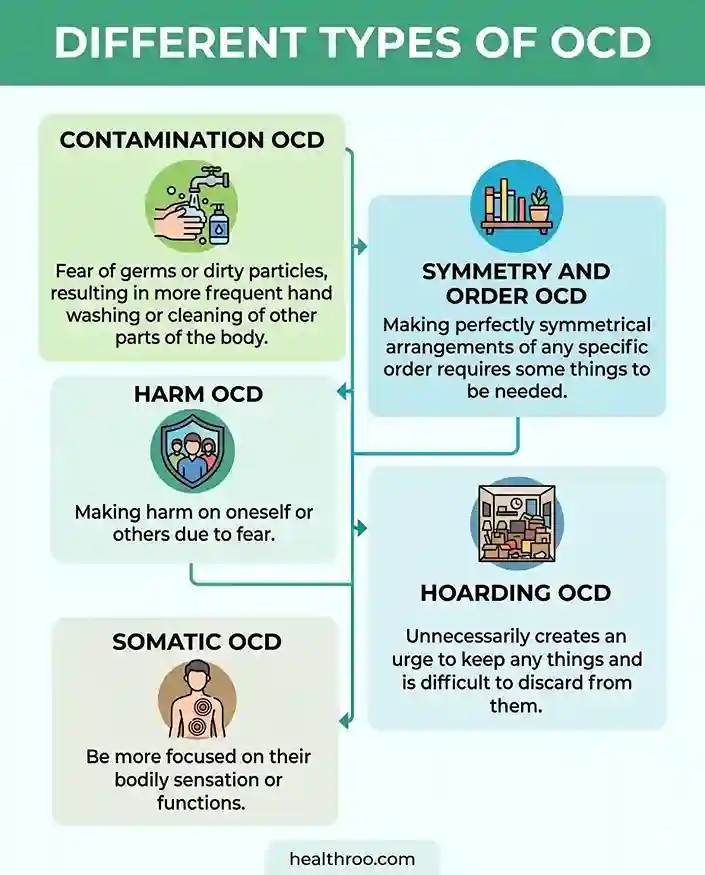
As per the signs & symptoms of OCD, it can be categorised into different types, and every type is accompanied by different types of obsessions and compulsions. Among these categories, some of its internal symptoms and outward signs may develop over time in others
Here are some common types:
Contamination Obsessive-Compulsive Disorder:
Fear of germs or dirty particles results in more frequent hand washing or cleaning of other parts of the body.
Symmetry and Order Obsessive-Compulsive Disorder:
Making perfectly symmetrical arrangements of any specific order requires some specific things to be needed.
Harm Obsessive-Compulsive Disorder:
Making harm to oneself or others due to fear.
Hoarding Obsessive-Compulsive Disorder:
Unnecessarily creates an urge to keep anything and is difficult to discard.
Somatic Obsessive-Compulsive Disorder:
Be more focused on their bodily sensation or functions.
Common Symptoms of OCD in Teenagers
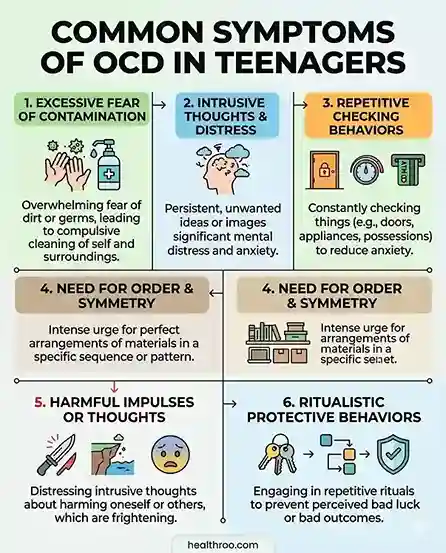
The symptoms of it are manifested differently on an individual basis, and now we are trying to put some common symptoms of this disorder –
- Excessive fear of contamination by germs, which leads to compulsive cleaning.
- Intrusive thoughts create uncontrollable distress.
- Checking all performing activities like door locking, switching off the gas, pulling out an ATM card from the ATM machine, etc. Repetitively.
- Excessive need of ant materials for the arrangement of any specific sequence or symmetrically.
- Intrusive thoughts, which can lead to harming for oneself or others
- Ritualistic behaviors to prevent perceived bad outcomes
What Are Obsessions?
The causes of anxiety have occurred due to an obsession. This derives from fear thoughts and the things that will happen in the near future, or thoughts about how things have to be.
These thoughts actually nag at doubts, but really, things are okay. This intrusive thought is images or ideas about things that seem scary, bad, or wrong.
Obsessive-Compulsive Disorder causes these stressful thoughts to come to mind over and over. They can be about anything, but for many people with OCD, they are thoughts about:
- Harm, Injury, Germs, and illness.
- The things which seems to be bad, rude, or wrong
- These things may be straight or placed just as they should be
- Sometimes feelings of any colors or numbers that seem to be bad, unlucky, or have special meaning
- Whether something might come true in the near future.
What Are Compulsions?
Compulsions of any teen with OCD have shown up in certain activities that are strongly urged for him. These behaviours are also known as rituals. The teen with Obsessive-Compulsive Disorder realises these rituals by stopping thinking, fixation of things, be safe. Here are some examples of rituals.
Here, we put some common rituals in the form of Compulsions for the teen with OCD.
- Washing of hands repeatedly
- Spending of time by erase of any things, rewriting, or starting any work after a prolonged period.
- Frequent use of repeated words, phrases, or questions
- Repeatedly checking of performed activities like door closed, door locked, home clean, etc.
- Touch, tap, or steps are common approaches for doing anything frequently.
- Trying to put everything in just the right order, doing things a set way.
Always try to avoid the number or colour that seems to be unlucky
What’s It Like for Someone With OCD?
Most of the teens with OCD have known thoughts and rituals have no feelings practically. But it leads to feeling this, being very unsure, and promoting the urge to do things like this. As per their realization that rituals give some relief from bad thoughts and feelings.
Rituals become multiple spontaneously. They take more time and energy, and as a consequence, the worried thoughts keep coming back again.
This is the coherent relationship between thoughts and rituals. This is how OCD becomes a stressful cycle. On the other hand, the rituals keep it going, instead of stopping OCD
Teens with Obsessive-Compulsive Disorder will spend more than an hour a day and become bothered by worry thoughts and rituals.
For the realization of Okay of any performed activity, basically, they do check, arrange, fix, erase, or count.
Causes and Risk Factors of OCD in Teenagers

What the exact causes are behind that is still unclear now. But as per several researchers argue that the etiology of it is multifactorial.
1. Genetic factors
Genetics can play a crucial role in the flow from one generation to another of OCD. The child grew up with OCD in the family, which indicates a genetic predisposition in the family.
Several research studies express that if the child is raised in a family where anxiety disorders, depression, or Obsessive-Compulsive Disorder are already present, there is a greater chance to replicate the family members.
Research also says genetics is not the only factor for the determination of a child has OCD, but lifestyle, environment, and early intervention can reduce the severity of symptoms.
Early intervention is the key for teen boys & girls who belong to a family where OCD already exists.
2. Brain Chemistry and Functioning
Apart from the structural configuration of the human brain, the neurochemicals like serotonin play a vital role in creating OCD in children.
Basically, Neurotransmitters help transmit signals in the brain to make an impact on mood, anxiety, and behaviour. But Imbalances in serotonin and other chemicals create diverse effects in the brain, which promote intrusive thoughts, trapping children in a cycle of worry and compulsions.
This situation leads to promoting suffering from Obsessive-Compulsive Disorder, particularly in adolescents, because at this time the brain undergoes radical changes, and they are experiencing heightened compulsions due to hormonal shifts, social pressures, and stress from academic demands.
3. Environmental Triggers (Infections and Autoimmune Response)
Pediatric Autoimmune Neuropsychiatric Disorders associated with Streptococcal infections (PANDAS) and Pediatric Acute-onset Neuropsychiatric Syndrome (PANS) are the responsible factors that promote the onset of Obsessive-Compulsive Disorder in the childhood stage.
Through this disorder, the response of the immune system reacts to brain function that leads to leading to arising of the symptoms of OCD or any psychiatric issues. These are visualised through intense rituals, tics, or mood swings that may happen suddenly.
Diagnosed the evolution of all the symptoms very quickly and took the initiative for the initiation of treatment as early as possible, because it alleviates very quickly.
4 Parenting Styles
When the parenting style is not directly linked with the cause of OCD in teens, then a few dynamics can play a crucial role in making an impact on the intensity or expression of OCD.
Say, for example, a teen learns how to cope with stress by overly protective anxiety, which can inadvertently reinforce a teen with Obsessive-Compulsive Disorder.
When a teen becomes thriving in his environment, it is very natural to feel very much pressure and sometimes perform in obsessive behaviour by fostering the environment to promote resilience.
In this situation, parental support to their teens in a healthy way is applied without any reinforcement of compulsive tendencies.
5 Cognitive and Behavioral Patterns
It is a very common symptom of teens with OCD to have reparative thinking and behaviour to control anxiety and reinforcement of diseases.
Not only that, but it also found more attachment with rituals for preventing something bad from happening by oneself, so the teen ingrained this particular behaviour.
The teen with OCD can reduce or overcome it through checking behaviours or sticking to a routine.
Effective OCD Treatment for Teenagers
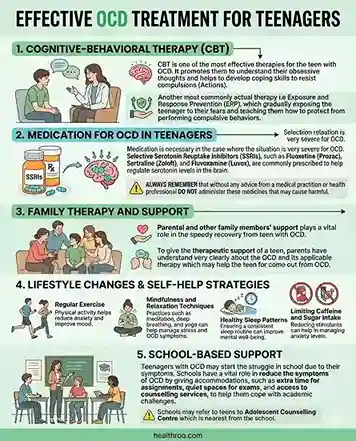
1. Cognitive-Behavioral Therapy (CBT)
CBT is one of the most effective therapies for the teen with OCD. It helps them understand their obsessive thoughts and helps to develop coping skills to resist compulsions( Actions ).
The other most commonly used therapy, i.e., exposure and response prevention (ERP), which gradually exposes the teenager to their fears and teaches them how to protect themselves from performing compulsive behaviors.
2. Medication for OCD in Teenagers
Medication is necessary in cases where the situation is very difficult for Obsessive-Compulsive Disorder. Selective serotonin reuptake inhibitors (SSRIs), such as fluoxetine (Prozac), sertraline (Zoloft), and fluvoxamine (Luvox), are commonly prescribed to help regulate serotonin levels in the brain.
In this context, always remember that without any advice from a medical practitioner or health professional, do not administer these medicines that may cause harm.
3. Family Therapy and Support
Parental and other family members’ support plays a vital role in the speedy recovery of a teen with OCD. To give the therapeutic support to a teen, parents have to understand very clearly about Obsessive-Compulsive Disorder and its applicable therapy, which may help the teen to come out of OCD.
4. Lifestyle Changes and Self-Help Strategies
Apart from a professional approach, a teen gains benefits from the following ways in addition to practicing self-care.
Regular Exercise: Physical activity helps reduce anxiety and improve mood.
Mindfulness and Relaxation Techniques: Practices such as meditation, deep breathing, and yoga can help manage stress and OCD symptoms.
Healthy Sleep Patterns: Ensuring a consistent sleep routine can improve mental well-being.
Limiting Caffeine and Sugar Intake: Reducing stimulants can help in managing anxiety levels.
5. School-Based Support
Teenagers with OCD may start the struggle in school due to their symptoms. From the point of view, the schools have a vital role in reducing the symptoms of Obsessive-Compulsive Disorder by giving accommodations, such as extra time for assignments, quiet spaces for exams, and access to counselling services, to help them cope with academic challenges.
Schools may refer teens to the Adolescent Counselling Centre, which is nearest to the school.
When to Seek Professional Help
Here are some basic situations or observations that would be found for the teen with Obsessive-Compulsive Disorder, and then parents and guardians should seek help from professionals who would be well capable of handling this case very carefully.
Interference of both obsession and compulsion with daily activities
Reached a significant distress situation.
Lead to an increase in the avoidance of social or academic responsibilities
In this remarkable situation, a mental health professional, such as a psychologist or psychiatrist, can only be able to provide a proper diagnosis and recommend making an appropriate treatment plan.
In the treatment protocol for teens with OCD, Cognitive Behavioural Therapy (CBT) is the most effective and appropriate management way.
Through this therapeutic approach, the therapist tries to talk with clients or patients, learn, and practise the different skills that help them to overcome these conditions.
What Is the Treatment for OCD?
In therapy, people might learn:
To know the effective relationship among the thoughts, feelings, and behaviors
People realise how OCD is like a brain ‘trick’ for feeling like bad things and do not escape from this situation unless they do rituals.
Doing rituals keeps Obsessive-Compulsive Disorder going strong, simultaneously
But even when a teen with Obsessive-Compulsive Disorder knows this, it’s not easy to just stop doing rituals. That’s why therapy educates them in some skills as follows:
Educate on coping and calming skills for anxiety.
How to deal with worried thoughts.
How to face fears safely.
How to resist doing rituals.
Through all this therapy, teens with Obsessive-Compulsive Disorder practice using these skills very carefully. This practice helps to teens to face their fears without any rituals, working day by day.
This creates uncomfortable feelings at first, but it quickly gets easier by practicing it. The more teens with OCD can resist rituals, the more worry thoughts fade. Through this continuation of practising skills, brain activity becomes better.
The need for time for recovery from Obsessive-Compulsive Disorder by applying this therapy, which actually depends on how they use it. Most of the teens with OCD take a few months or more.
In this process, the therapist is trying to educate the parents of the patient as well as the patient themselves. Parents can bust up the effectiveness of the therapeutic skills because only parents can identify the weaknesses of their teen.
So whenever they practise, more attention will be paid to the weakness. In this way, parents help teens to overcome obsessive-compulsive disorder fears and rituals at home.
Click here to listen:
What Should I Do if I Think I Have OCD?
If you think you might have OCD:
First of all, talk with a parent or adult in your life about what you’re going through.
If you identify as a person with OCD-
Go to therapy.
Before going to therapy, it is better to know everything about it and then go to any concerned therapist for early recovery.
Practice the skills you learn in therapy.
Constant Practise brings more perfection in results, which actually happens in this case, more perfectly you practise, the more quickly you will be able to recover soon.
Get support from people who care.
Parents are the good masters to help you practice it and share in your success and progress.
Be patient with yourself.
Dealing with OCD is tiring and stressful. And therapy takes time and practice.
OCD creates tiring and stressful situations in the life of a teen, and the therapist takes a long time for its recovery. In this situation, we have lost our patients. So, it must remember that most of the people can do this, and you can too.
Make time for good things.
Find a little time to relax and do some things that you like that bring you joy. The people who make you laugh and feel good. This brings you energy to help overcome OCD.
FAQ On OCD
What is OCD in teenagers and how does it start?
Obsessive-Compulsive Disorder is a mental health condition where a teenager experiences intrusive, unwanted thoughts (obsessions) and feels driven to perform repetitive behaviors (compulsions). It often starts during puberty due to a mix of genetic factors, brain chemistry changes, and environmental triggers.
What are the most common symptoms of OCD in teens?
Common symptoms of Obsessive-Compulsive Disorder include an excessive fear of germs (contamination), a need for perfect symmetry, repetitive checking (like doors or stoves), and intrusive thoughts about harm. You may also notice your teen spending hours on specific rituals or avoiding certain “unlucky” colors or numbers.
Can OCD in teenagers go away on its own?
Generally, Obsessive-Compulsive Disorder does not go away without intervention. While symptoms may wax and wane, professional treatment like Cognitive-Behavioral Therapy (CBT) is typically required to break the cycle of obsessions and compulsions effectively.
What are the types of Obsessive-Compulsive Disorder in adolescents?
The main types of Obsessive-Compulsive Disorder include Contamination OCD, Symmetry and Order OCD, Harm OCD, Hoarding OCD, and Somatic OCD (focusing on bodily functions). Each type involves unique triggers but follows the same cycle of anxiety and ritualistic behavior.
What is the most effective treatment for OCD in teens?
The “gold standard” treatment for Obsessive-Compulsive Disorder is Exposure and Response Prevention (ERP), a specific type of CBT. In some cases, doctors may also prescribe SSRIs (medication) to help balance brain chemistry and reduce the intensity of anxiety.
How do genetics influence the development of OCD?
Research suggests that Obsessive-Compulsive Disorder has a strong genetic component. A teenager is at a higher risk if a first-degree relative (parent or sibling) also struggles with an anxiety disorder or obsessive-compulsive behaviors.
Is there a link between infections and sudden-onset OCD?
Yes. Conditions like PANDAS or PANS involve an autoimmune response to infections (like Strep throat) that can cause a very sudden and intense onset of symptoms of Obsessive-Compulsive Disorder in children and teenagers.
How can parents support a teenager with OCD?
Parents can support their child by educating themselves on the disorder, attending family therapy, and resisting the urge to participate in the teen’s rituals. Encouraging the use of CBT skills at home is crucial for long-term recovery.
Does OCD affect a teenager’s performance in school?
Yes, Obsessive-Compulsive Disorder can lead to “brain fog,” slow completion of assignments due to perfectionism, and social withdrawal. Schools can help by providing accommodations like extra time or a quiet testing environment.
When should I seek professional help for my teen’s OCD?
You should seek help from a mental health professional if the obsessions and compulsions take up more than an hour a day, cause significant distress, or interfere with school, friendships, and daily hygiene.
Conclusion
Undoubtedly, a teen with OCD has to face very challenging situations towards heir up coming days, but it can be managed in this distressing situation and lead to a fulfilling life by taking early initiatives for medical or hepatic intervention.
In this process, medical intervention, family support, & Cognitive behavioural therapy ( CBT) and changing lifestyle have a very crucial role for recovery. To cope with OCD, professional help and fostering support of enabling environments are the key factors for helping the teenagers.
If you accept the challenge of struggling with OCD, then mental health professionals would be the best guides to overcome this situation because there are a lot of the best treatment options available to them.
Disclaimer:
This content has no intention to give this natural remedial process for improving the status of teens with OCD. It is recommended to all audiences to consult with a medical practitioner or mental health professional before applying it. The level of improvement depends on a variety of patients and conditions (the degree of severity ofdiseases).
Author Description
Sajal Samanta
Anthropologist & Adolescent Counselor
Sajal Samanta is a professional Anthropologist and dedicated Adolescent Counselor with over fifteen years of research experience in wellness and naturopathy. As the lead content strategist for healthroo.com, he specializes in bridging the gap between cultural behavioral patterns and clinical mental health strategies.
Sajal’s work focuses on creating high-quality, research-driven educational materials—including technical meal plans and diagnostic infographics—to help teenagers and their families navigate complex health challenges like OCD. His commitment to early detection and structured intervention is reflected in his strategic roadmaps designed to foster long-term resilience in young adults.










Can you be more specific about the content of your article? After reading it, I still have some doubts. Hope you can help me.
OCD is highly treatable. The combination of Exposure and Response Prevention (ERP) and, when needed, SSRI medication is considered the gold standard for treatment.