![Toxic Substance Use Disorder in Teens: Effects & Care [2026]](https://healthroo.com/wp-content/uploads/2025/04/WEBP-Fitured-image_11zon.webp)
Learn about adolescent substance use disorder, its causes, warning signs, long-term risks, and evidence-based strategies for prevention, management, and treatment.
PEER-REVIEWED STATEMENT
Reviewer: Sourav Samanta, MA Sociology, MSc in Psychology, Independent Adolescent Consultant
“This article presents a comprehensive, multi-dimensional account of Substance Use Disorder (SUD) among adolescents, accurately reflecting the biopsychosocial framework widely endorsed in contemporary adolescent health research. The epidemiological figures cited — including UNODC’s 2016 global estimates, SAMHSA’s 2020 U.S. data, and India’s population-level SUD prevalence statistics — are consistent with peer-reviewed literature and authoritative institutional sources.
Overall, this content is educationally sound, clinically informed, and suitable for dissemination to parents, educators, and community health advocates as a reliable reference resource on adolescent substance use disorder.”
— Sourav Samanta MA Sociology | MSc in Psychology Independent Adolescent Consultant Statement provided for editorial and educational reference purposes.
Last reviewed , May,2026
Understanding of Substance Use Disorder & Its Prevalence
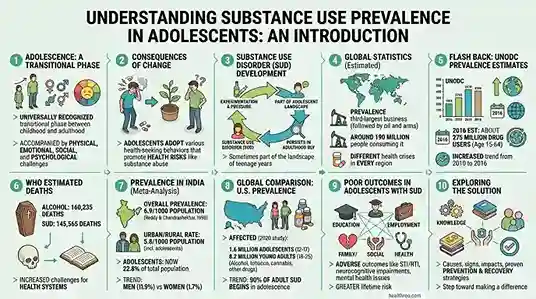
It is universally recognized that adolescence is the transitional phase of childhood and adulthood, a period of development accompanied by numerous changes and challenges, such as physical, emotional, social, and psychological.
As a consequence of change, adolescents adopt various health-seeking behaviors that promote health risks like substance abuse. Sometimes it becomes part of the landscape of teenage years. At the beginning, it acts as experimentation and pressure, but it persists in adulthood very smoothly, unknowingly, and finally becomes Substance Use Disorder (SUD).
According to global statistics, concern about the prevalence of substance use is the third-largest business in the world, followed by oil and arms trades, with around 190 million people consuming it, creating different types of health crises in every region of the world.
If we flash back to its prevalence, in 2016, the United Nations Office on Drugs and Crime (UNODC ) estimated about 275 million people consuming drugs at least once in the age group of 15-64, a trend of increasing SUD from 2010 to 2016.
WHO also estimated that deaths have occurred due to the use of alcohol and SUD, respectively, 160,235 and 145,565, which leads to great challenges for the health system of any country
In India, the prevalence of the use of any form of substance is 6.9/1000 overall, with urban and rural rates of 5.8/1000 population, including adolescents, as revealed in a meta-statistical analysis done by Reddy and Chandrashekhar in 1998.
Now India has conceived 22.8% of adolescents out of the total population. The study reflects the trends found among men (11.9%) and women (1.7%), respectively.
This prevalence is not only found in India but also in the U.S., where 1.6 million adolescents (12 to 17) and 8.2 million (18 to 25) were affected by SUD (alcohol, tobacco, cannabis, and other drugs), according to a study done in 2020. Among them, 90% of adults began this habituation during the adolescent stage.
Poor outcomes are generally found in adolescents with substance use disorder in their different aspects, like education, employment, family/social, and health, and experiencing greater lifetime risk is likely to result in adverse outcomes, STI/RTI, poor FP, neurocognitive impairments, and mental health.
In this article, we’ll explore the causes, signs, impacts, and, most importantly, proven prevention and recovery strategies for teen substance abuse. Whether you’re a parent, teacher, or just a concerned community member, understanding this issue is a step toward making a difference.
What is substance abuse?
The term substance use is attributed to non-medical use of chemical substances to achieve alteration in psychological functioning and has been termed “substance abuse.
Why do adolescents take drugs?
The time of adolescence is characterized by the acceptance and refusal of different experiences and challenges through the error and trial method, and learning from them. Often, they also involve experimenting with their boundaries, perceiving little risk by taking drugs or alcohol.
Basically, why are adolescents taking drugs—
- Relieve boredom
- Feel good
- Forget their troubles and relax.
- Satisfy their curiosity.
- Ease their pain
- Feel grown up
- Show their independence
- Belong to a specific group
How do drugs work in the brain?
In substance use disorder (SUD)drugs intervene in signal processing mechanisms like the sending and receiving of any message of neurons through neurotransmitters in the brain, and some of them, like marijuana and heroin, can create a mimic of natural neurotransmitters due to their chemical structure.
Although these drugs can mimic brain chemicals, but not activate neurons like a natural neurotransmitter, they lead to the creation and sending of abnormal messages in this network.
Drugs like amphetamine or cocaine can release huge amounts of natural neurotransmitters or prevent normal recycling of brain chemicals, interfering with transporters. This amplification creates disruption of normal communication between neurons.
As per old perception, neurotransmitter dopamine is produced by drugs directly due to euphoria, but scientists revealed dopamine can repeat pleasurable activities (reinforcement) rather than producing pleasure directly.
Any pleasurable experience, the consequence of an outburst of dopamine signals, is cognized and remembered about the happenings. This dopamine signaling process changes the neural connectivity that leads to creating repeatedly without thinking about it, which promotes habitual practice.
What is Adolescent Substance Use Disorder?
The Diagnostic and Statistical Manual of Mental Disorders (DSM) is an important diagnostic tool published by the American Psychiatric Association.
This tool is considered a gold standard measurement tool used in mental health for the investigation, diagnosis, and treatment of mental disorders and addiction.
The tool DSM-5 is the fifth edition, which was introduced in 2013 through the contribution of different eminent mental health professionals.
In accordance with DSM-5, substance use disorder (SUD) in adolescents is a clinically significant impairment or distress, manifested by 2 or more symptoms that appear within 12 months.
DSM-5-TR Substance Use Disorder Criteria

Substance use disorder (SUD) in adolescents is a widespread variety of problems arising from substance use, covered by 11 different criteria introduced by McLellan and Trans Am Clin Climatol Assoc in Substance Misuse and Substance Use Disorder: Why Do They Matter in Health Care?
- Taking the substance in larger amounts or for longer than you’re meant to
- Wanting to cut down or stop using the substance, but not managing to
- Spending a lot of time getting, using, or recovering from use of the substance
- Cravings and urges to use the substance
- Not managing to do what you should at work, home, or school because of substance use
- Continuing to use it, even when it causes problems in relationships
- Giving up important social, occupational, or recreational activities because of substance use
- Using substances again and again, even when it puts you in danger
- Continuing to use, even when you know you have a physical or psychological problem that could have been caused or made worse by the substance
- Needing more of the substance to get the effect you want (tolerance)
- Development of withdrawal symptoms, which can be relieved by taking more of the substance
Substance Use Disorder (SUD)

Whenever someone’s level of drug use has spiraled out of control, they will experience the following symptoms: this is called Substance Use Disorder (SUD).
- They are unable to control their substance use.
- They continue to use it in spite of exceedingly negative consequences.
- They cannot perform ADL (activities of daily living) without taking drugs.
- They have unrestrained personal relationships and hobbies.
- They have issues with the law more frequently.
- They lead an unhealthy and dangerous life.
Addiction itself is a disease that develops from using a drug over a prolonged period. It is directly related to the brain’s reward pathway mechanism and leads to prioritizing the use of the drug over all else carefully.
The person becomes unsuccessful whenever they try to cease it; consequently, they have a relapse experience that is very dangerous and prohibits them from returning to their previous behaviors in substance use disorder.
Generally, people in this phase can rarely feel their high prospects and continue to use the drug to keep withdrawal at bay.
It is the ultimatum in this phase: only treatment. Always keep in mind that it can be started at any time in any phase of drug use. Apart from medication, there are several additional ways, like behavioral therapy and counseling, for recovery from addiction.
Types of Substance Use Disorder—
Some of the common types are as follows:
1) Alcohol use disorder
2) Cocaine use disorder
3) Cannabis use disorder
4) Tobacco Use Disorder
5) Methamphetamine use disorder
6) Opioid Use Disorder.
It is very frequently found that more than one SUD is present at a time, such as alcohol use disorder and tobacco use disorder, which is called polysubstance use disorder. In the US, alcohol use disorder is found very commonly.
Common substances abused by adolescents
Adolescents frequently use substances, alcohol more than any other drug, like tobacco and marijuana.
There are several popular drugs among teens, all with different effects and rates of use.
2. Common Causes and Risk Factors
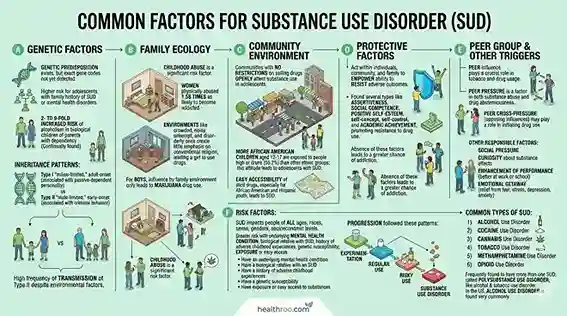
Till now, it is not well understood what is behind the cases of addiction or substance abuse or substance use disorder (SUD). In this regard, after research, it has been discovered that your brain’s reward mechanism is the potential cause of this condition.
After the careful study regarding this issue, there are many dimensional factors that are responsible for making adolescent substance use disorder (SUD). Some reasonable factors are described below.
Common Factors
Genetic Factors—
Studies have confirmed the existence of a genetic predisposition to substance dependence, although the exact gene codes are yet to be detected. Adolescents with a family history of substance abuse or mental health disorders may be at a higher risk of developing similar issues.
Biological adolescents of parents who have been adopted with dependency on alcohol consumption continually have an increased risk (2- to 9-fold) of developing alcoholism.
In research, it has been discovered that the inheritance pattern between type I “milieu-limited,” adult-onset alcoholism (that is associated with a passive-dependent personality) vs. type II, “male-limited,” early-onset alcoholism (that is more associated with criminal behavior).
In this case, there is a high frequency of transmission of heritability of type II alcoholism despite the environmental factors from parents to child.
Family Ecology
Childhood abuse is a very significant risk factor for becoming a substance abuser later. Women who were physically abused were 1.58 times as likely to become addicted to drugs compared to their non-abused counterparts. The girl seems to be more influenced by environmental factors in her own shelter.
Situations like crowded, noisy, unkempt, and disorderly ones can create little emphasis on the lifestyle of conventional religion, which leads to making a girl a drug user later.
On the contrary, for boys, being influenced by the family environment only leads to becoming marijuana users.
Community Environment
In the community where there are no restrictions on selling any drugs openly, there is a great possibility of affecting substance use in community adolescents. That is actually found in the African American community in the age group 12-17.
More African American children aged 12 to 17 years are more exposed to people who are high or drunk (55.7%) than children of other ethnic groups; thus, this attitude leads to adolescents with SUD.
Easy accessibility of illicit drugs, especially in the community of African American and Hispanic youth, leads to Substance Use Disorder (SUD).
Protective factors
Protective factors act within the individuals, community, family, and environment to empower the ability of one to resist adverse outcomes.
In the community, we are found in several types of protective factors like assertiveness, social competence, positive self-esteem, self-concept, self-control, and academic achievement, all of which promote resistance to drug use.
In the community where this type of protective factor is not found, there is a greater chance of becoming addicted to drugs.
Peer Group
Peer influence plays a crucial role in addiction to tobacco and drug usage. Peer pressure may be a factor not only in substance abuse but also in drug abstinence.
Peer cross-pressure, that is, the opposing influences on individuals exerted by the choices they make or by their socioeconomic standing or social group membership, may play a role in the initiation of drug use.
Apart from that, factors also responsible for making adolescents with substance drug disorder (SUD) are—
Social pressure
- Curiosity about substance effects
- Enhancement of performance (to do better at work or school)
- Emotional getaway (like relief from fear, stress, depression & anxiety).
Risk factors—
Substance use disorder (SUD) impacts people of all ages, races, sexes, genders, and socioeconomic levels.
You may fall into more risk if you—
- Have an underlying mental health condition
- Have a biological relative with an SUD
- Have a history of adverse childhood experiences.
- Have a genetic susceptibility
- Have exposure or easy access to substances.
- The progression of substance use disorder followed these patterns
The manifestation of progression to substance use disorder often follows this manner:
- experimental use—using substance materials for a trial or as directed.
- Occasional use: using it socially or as per prescription, not as directed.
- Heavy Use—Taking drugs routinely or consistently.
- Substance Use Disorder: Taking drugs daily or multiple times within a day. Unfortunately, sometimes some intrinsic factors like obsessive-compulsive disorder (OCD), attention deficit/hyperactivity disorder (ADHD), autistic spectrum disorders (ASD), conduct disorders, anxiety, stress, and depression contribute to addiction to substance use.
3. Warning Signs of Teen Substance Abuse
- Use lists for readability and rich snippets potential.
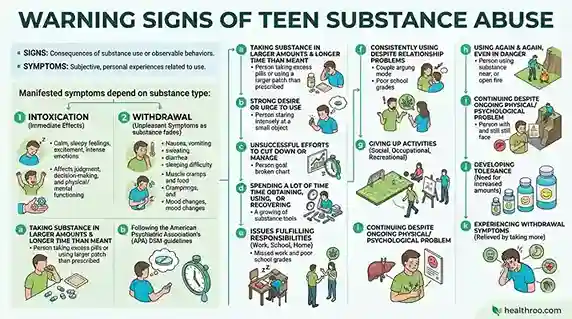
- Signs are basically consequences of using substance materials or observable behavior outwardly.
- Symptoms are subjective experiences or personal experiences related to the use of substance materials.
The symptoms that are manifested in substance use disorder (SUD) depend on the type of substance you have used, as follows:
- Intoxication—This is a short and immediate effect on your body, manifested by calm, sleepy feelings, excitement, intense emotions, etc. It also affects judgment, decision-making, and physical or mental functioning.
- Withdrawal—Manifested when short-term effects of a substance fade and the substance starts to leave your body unpleasantly, showing in the symptoms of nausea and vomiting, sweating, diarrhea, sleeping difficulty, muscle cramps, and mood changes.
In accordance with the American Psychiatric Association’s Diagnostic and Statistical Manual of Mental Disorders, signs of SUD are included.
- Taking the substance in larger amounts and for a longer period of time than you’re meant to if it’s a prescription
- Having a strong desire or urge to use the substance
- Having unsuccessful efforts to cut down on or manage substance use
- Spending a lot of time obtaining or using the substance or recovering from its effects
- Having issues fulfilling responsibilities at work, school, or home due to substance use
- Consistently using a substance, even when it is a problematic factor in relationships
- Giving up social, occupational, or recreational activities because of substance use
- Using substances again and again, even when it puts you in danger
- Continuing substance use despite an ongoing physical or psychological problem that’s likely caused or worsened by the substance
- Developing capacity of tolerance (need for increased amounts to get the same effect)
- Experiencing withdrawal symptoms, which can be relieved by taking more of the substance
Tips for parents and teachers on early detection
First of all, as such, there are no remarkable symptoms manifested in adolescents regarding substance use; it is found whenever they visit the doctor’s chamber due to accidental injury caused by others.
Clear clinical manifestation depends on basically two things: one is the frequency of intake, and the other is the length of time since the last substance used.
Common clinical manifestations are described below.
- Weight loss
- Constant fatigue
- Red eyes
- Little concern for hygiene
SO, PARENTS BEWARE
Parents should always keep up with technology.
It is a very promising contribution of the combined approach of smartphones, social media networking, and e-commerce platforms that has opened opportunities for adolescents for easy accessibility of illicit drugs at their doorsteps by using Instagram, WhatsApp, Signal & Wicker.
So equipped with knowledge about social media and its applications, we can reduce the risk of drugs being sold through D-commerce and marketing transactions platforms by drug peddlers.
Be aware of the Reddit forum called INDIAN ENTS for purchasing marijuana through sharing of location in Google Maps, typing in “ SCORE ADDA,” and payment made by cryptocurrency.
Parents should be aware of the use of different forms of marijuana, like cookies, brownies, and even pakoras being fried in cannabis oil, due to peer pressure, impulsive behavior, and experimentation among adolescents.
4. Short-Term and Long-Term Effects of Teen Drug Use
In terms of misuse, abuse, or addiction, drugs can create both long-term and short-term effects on the human body.
SHORT-TERM EFFECTS
- Changes in appetite
- Sleeplessness or insomnia
- Increased heart rate
- Slurred speech
- Changes in cognitive ability
- A temporary sense of euphoria
- Loss of coordination
- An inability to cease using a drug
- Relationship problems
- Poor work or academic performance
- Difficulty maintaining personal hygiene
- Changes in extreme weight loss are manifested in appearance.
- Increased impulsivity and risk-taking behaviors
- Loss of interest in formerly enjoyable activities
LONG-TERM EFFECTS All misused drugs affect the brain.
Our emotions, motivations, and feelings of pleasure are regulated by the secretion of a large amount of dopamine, a neurotransmitter in the brain, and produce a “high.
This behavior promotes substance dependency or drug addiction. Chronic drug addiction leads to alterations in the brain structure and function, resulting in long-term psychological effects, such as –
- Depression
- Anxiety
- Panic disorders
- Increased aggression
- Paranoia
- Hallucinations. Long-term drug use can also affect a person’s memory, learning, and concentration.
The long-term physical effects of drug use
- Chronic drug use is associated with the following health conditions:
- Cardiovascular diseases, such as cocaine and methamphetamine use (damaging to the heart and blood vessels), arrhythmia, and heart attack.
- Respiratory problems, like chronic respiratory infections and diseases,
- Failure or damage of the kidney due to the consumption of substances like ketamine, heroin, or synthetic cannabinoids.
- Chronic liver diseases or liver cirrhosis are due to the consumption of alcohol or drugs for a prolonged period.
LIFE-CHANGING COMPLICATIONS Dependence on drugs can create a number of dangerous and damaging complications, including:
Life-threatening Complications
Highly frequent for getting a chance of communicable diseases, like HIV/AIDS, hepatitis B and C, and STI/RTI, endocarditis, and promote not practicing health-seeking behavior.
The influence of addiction leads to accidents or reckless driving and meaningless risk-taking behavior.
The people who are addicted to drugs have a greater chance of committing suicide than any other normal people.
It is the normal manifestation in a family where the consumption of drugs is a frequent way, family conflict, or custodial issues must arise.
Drug use can create negative effects on academic performance, career preparedness, and motivation to excel in school.
Drug users are confronted with different legal problems for buying or possessing illegal drugs and stealing to support their drug addiction.
Spending money for the purpose of drug use, taking away money from others’ needs, and leading to debt—these behaviors lead to the creation of financial issues.
5. Prevention Strategies of Substance Use Disorder

Advice to Parents:
The following precautionary measures are to be taken for the prevention of drug abuse by your adolescent or children.
Communicate with your adolescent about the effects of drug consumption and misuse openly.
Become a good listener while your child expresses their peer pressure, and be supportive of their efforts to resist it.
Stand as a role model in front of your adolescent to motivate them about the misuse of drugs and their risks.
Make a strong and stable relationship with your children and adolescents to strengthen the bond and reduce your child’s risk.
Parental supervision and monitoring have a crucial role in the prevention of drug use by your adolescent or child; it can be enhanced day by day through imparting the training.
Praise for appropriate behavior.
Focus on the activities of your adolescent very carefully and try to know their whereabouts, and try to find out who encourages your teen to get involved in these activities.
Establishing rules and consequences in the family can lead to the prevention of drug use. Rules may be such that not attending the party where there is no restriction for drug use or not riding in the car of a driver who is a drug user breaks a rule. You should enforce consistency on your teen by reading the consequences.
Use an authoritative parenting style and a clear distinction of its limitations. & set ‘clear limits.’
Monitoring the use of social media platforms and exposure.
Know your adolescent’s friends; sometimes it may be a passive way to engage in drug use, as an experiment, or to feel pleasure.
Life skill education, as a pivotal role for the enhancement of self-esteem and self-confidence, leads to the development of coping skills, critical thinking, and many more.
Ensuring a healthy lifestyle
Recommendations for Adolescents
Avoid temptation and peer pressure anywhere in society or community, maintain healthy relationships and friendships, and avoid friends or any family who can create pressure to use substances. To avoid the peer pressure, simply say NO very strongly.
Being aware of the environmental, biological, and physical risk factors that are sometimes responsible for tendencies toward mental illness and addiction, this knowledge helps you to examine the risk factors to make decisions about relationships with others.
Keep a well-balanced life.
Practicing substance intake is not a substitute for the management of stress; healthy stress management skills are the only way to bring you a balanced and healthy life. So follow the stress management skills.
Focus on developing proper goals, seating, and dreams for your future.
SCHOOL-BASED PREVENTION PROGRAMS
1. Promoting Alternative Thinking Strategies (PATHS)
PATH is a very unique and comprehensible approach for promoting mental health and social competencies, also used for reducing aggression in children in elementary education.
This K–5 curriculum is designed for use by educators and counselors in a multiyear, universal prevention model.
The PATHS method promotes protective factors and reduces behavioral risk factors, affecting youth problem behavior.
2. Skills, Opportunity, & Recognition (SOAR)
(Formerly, Seattle Social Development Program) This universal school-based intervention for grades one through six seeks to reduce childhood risks for delinquency and drug abuse by enhancing protective factors.
This method is formerly known as the Seattle Social Development Program. This unique school intervention approach is applicable for one to six students for reducing childhood risk behavior for delinquency and drug abuse by enhancing protective factors. For the promotion of bonding with school, the above training should be imparted to teachers, parents, and children for their academic achievement.
3. Life skill training
Life skill training is the best training tool for promoting protective factors and risk management, along with drug resistance skills.
Apart from these statutory structural approaches for the prevention of Substance Use Disorder (SUD) for adolescents, focused on different governmental approaches in different countries as per their national policies,
In India’s biggest initiative, i.e., the National Tobacco Control Programme (NTCP), under the Ministry of Health and Family Welfare, Govt. of India,
In the US, i.e., the National and State Tobacco Control Program (NTCP), as per the CDC,
In the UK, i.e., Local Stop Smoking Services & the NHS Tobacco Dependency Programme,
In China, i.e., the Framework Convention on Tobacco Control (FCTC).
Being followed and practice of preventive methods of the Tobacco Control Program for the prevention of SUD for adolescents.
Medical Disclaimer
The information presented in this article on Substance Use Disorder (SUD) in Adolescents is intended solely for general educational and informational purposes. It is not a substitute for professional medical advice, diagnosis, or treatment.
If you believe an adolescent in your care may be experiencing signs or symptoms of substance use disorder, or any co-occurring mental health condition, please seek immediate guidance from a licensed physician, psychiatrist, psychologist, or adolescent health specialist.
© 2025 | All Rights Reserved | Content prepared for educational publication.
6. Treatment Options for Adolescent Substance Use Disorders
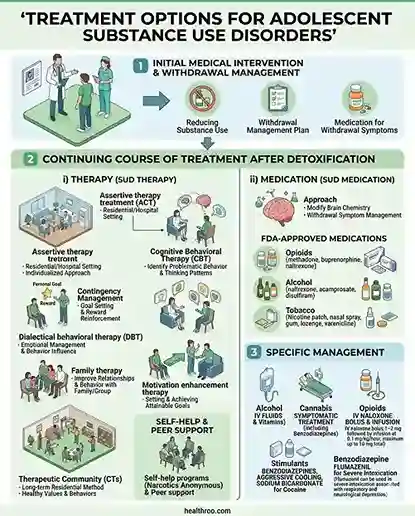
In medical intervention for the treatment of Substance Use Disorder (SUD) for the adolescent, health care professionals take the first step for withdrawal management, which promotes reducing or stopping the use of substance materials. As severity increases, health care professionals make a plan for medication to lessen the effects of withdrawal symptoms.
Continuing the course of treatment after detoxification in basically two ways:
- Therapy
- Medication.
The treatment of substance use disorder is highly individualized. In treatment, recovery depends on the types of treatment systems (treatment setting, inpatient and outpatient settings) and the time of therapy (long-term or short-term)
SUD therapy—
Different types of therapy help for the treatment of SUD and co-occurring mental health problems. Some effective therapies are as follows:
i) Assertive therapy treatment (ACT)
The therapy is exclusively in a residential or hospital setting rather than a community setting, and the approach is very individualized, as per the needs and goals of the future.
ii) Cognitive Behavioral Therapy (CBT) –
Therapy helps to identify the problematic pattern of behavior and thinking.
iii) Contingency Management –
Encouraging personal goal setting, after achievement, it is reinforced with a reward.
iv) Dialectical behavioral therapy (DBT)
It is a talk therapy similar to CBT that helps to make you a designee for emotional management and understand how your thoughts influence your behaviors.
v) Family therapy
It improves relationships and behavior with their family and group members.
vi) Motivation enhancement therapy—
With the help of a mental health professional, this therapy encourages setting and achieving attainable goals.
vii) Therapeutic Community (CTs)
Therapy itself is a long-term residential method focused on the development of healthier values and behaviors related to substance use, accompanied by other co-occurring mental health states.
Apart from that, in this case, self-help programs (Narcotics Anonymous) and peer support can play an important role in reducing or stopping SUD.
SUD medication
The approach of medication helps you to modify your brain chemistry and manage withdrawal symptoms.
The following medicines are used for treatment and are approved by the U.S. Food and Drug Administration (FDA).
Opioids—methadone, buprenorphine, naltrexone
Alcohol—naltrexone, acamprosate, disulfiram
Tobacco—A nicotine patch, nasal spray, gum, lozenge, or varenicline.
Specific management:
• Alcohol: Introduce intravenous (IV) fluids with glucose and vitamins.
• Cannabis: Rarely serious and may not require anything more than symptomatic treatment, including benzodiazepines.
• Opioids: Administered IV naloxone bolus 1–2 mg followed by infusion at 0.1 mg/kg/hour, maximum up to 10 mg total
• Stimulants: Introduce benzodiazepines, aggressive cooling, and sodium bicarbonate for cocaine.
• Benzodiazepine: Flumazenil can be used in severe intoxication associated with respiratory and neurological depression.
FAQ of Substance Use Disorder
What exactly is substance use disorder in adolescents, and how is it diagnosed?
Substance use disorder in adolescents is a clinically significant condition diagnosed when 2 or more DSM-5-TR criteria occur within 12 months, including cravings, tolerance, and impaired daily functioning. Any teenager with mental health vulnerabilities is at heightened risk and benefits from early professional screening and structured intervention.
What are the most common warning signs that indicate substance use disorder in a teenager?
Warning signs of substance use disorder include unexplained weight loss, chronic fatigue, red eyes, declining hygiene, poor academic performance, and social withdrawal. Parents of a teenager with mental health or behavioral shifts should treat these indicators seriously and consult a healthcare professional without delay for proper assessment.
Why are adolescents particularly vulnerable to developing substance use disorder?
Adolescents are vulnerable to substance use disorder because of peer pressure, curiosity, stress, and impulsive risk-taking during brain development. A teenager with mental health conditions like anxiety, depression, or ADHD is especially susceptible, often turning to drugs or alcohol as an unguided emotional coping strategy that escalates rapidly.
How does substance use disorder affect the brain of a developing adolescent?
Substance use disorder disrupts dopamine-driven neurotransmitter pathways, causing structural and functional brain alterations. These changes impair memory, learning, emotional regulation, and decision-making. Since the adolescent brain develops into the mid-twenties, a teenager with mental health challenges who develops substance use disorder faces compounded, long-lasting neurological consequences.
What are the long-term physical and psychological effects of substance use disorder in teens?
Long-term substance use disorder causes cardiovascular disease, liver cirrhosis, kidney damage, and heightened HIV/AIDS risk. Psychologically, it leads to depression, paranoia, anxiety, and hallucinations. A teenager with mental health co-occurring conditions who develops substance use disorder is at significantly greater lifetime risk for disability and reduced quality of life.
What evidence-based therapies are most effective for treating substance use disorder in adolescents?
Effective treatments for adolescent substance use disorder include Cognitive Behavioral Therapy (CBT), Dialectical Behavioral Therapy (DBT), Family Therapy, Contingency Management, and Motivational Enhancement Therapy. For a teenager with mental health comorbidities, a personalized, multi-modal treatment plan addressing both substance use disorder and co-occurring conditions simultaneously produces the best recovery outcomes.
. How does genetics increase an adolescent’s risk for substance use disorder?
Genetics plays a major role in substance use disorder risk. Adolescents with a parent who has alcohol dependence face a 2–to 9-times greater likelihood of developing the disorder themselves. Recognizing that a teenager with a mental health or substance use disorder carries an inherited biological vulnerability is essential for targeted early prevention.
How can parents actively prevent substance use disorder in their adolescent children?
Parents prevent substance use disorder by maintaining open dialogue, enforcing clear household rules, monitoring social media, modeling healthy behavior, and building life skills. When raising a teenager with mental health challenges, collaborating early with adolescent health professionals and school counselors further reduces the risk of substance use disorder through consistent protective support.
What school-based programs help prevent substance use disorder among adolescents?
PATHS, SOAR, and Life Skills Training are validated school-based programs proven to reduce substance use disorder risk by strengthening protective factors and resistance skills. These programs are especially impactful for any teenager with mental health vulnerabilities, offering structured social-emotional learning that counters early gateway behaviors leading to substance use disorder.
What FDA-approved medications are used to treat adolescent substance use disorder?
FDA-approved medications for substance use disorder include methadone, buprenorphine, and naltrexone for opioids; naltrexone, acamprosate, and disulfiram for alcohol; and nicotine replacement therapy or varenicline for tobacco. For a teenager with mental health and substance use disorder comorbidities, medication is most effective when combined with structured behavioral therapy.
Conclusion: Breaking the Stigma and Building a Supportive Future
It is well recognized that prevention is better than cure, so more emphasis has to be given to the elaboration of preventive approaches for the prevention of SUD for our teen community, rather than medical intervention for SUD.
Although it is not easy to do because this behavioral disorder is linked with different aspects like teen growth and development magnitude, culture, environment, family, community, and many more.
Not only in India but everywhere in the world, the prevention of it requires understanding culturally situated protective mechanisms.
Substance use disorder (SUD) in adolescents is not only an individual or family issue; it’s a public health concern.
As per constitutional provision and national developmental policy, every country should be given more priority in making programs or projects in a single or converging way, considering all components of the issue. Prevention starts at home, at school, and in communities in a wider sense.
Apart from the government sector, NGOs and CSR must be involved with this movement
Parents should be facilitated to talk to their adolescent about the importance of modelling health choice, positive peer selection, and open communication for preventing substance abuse.
We think that early intervention, a strong support system, and compassionate care can help people recover easily from this disorder and co-occurring mental health problems.
Let’s raise our slogan, “Talk early. Listen often. Help always.”
Reference
National Institute on Drug Abuse (NIDA), Adolescent brain, drug effects, SUD science
Substance Abuse and Mental Health Services Administration (SAMHSA)
World Health Organization (WHO), Global alcohol/drug mortality statistics
American Psychiatric Association (APA), DSM-5-TR diagnostic criteria for SUD
Centers for Disease Control and Prevention (CDC), Teen substance abuse data, NTCP, tobacco control
United Nations Office on Drugs and Crime (UNODC), Global SUD prevalence and drug use statistics
National Alliance on Mental Illness (NAMI), Co-occurring mental health and SUD in adolescents
AUTHOR BIO
Sajal Samanta MSc Anthropology | Adolescent Counselor
Sajal Samanta holds an MSc in Anthropology and brings over 15 years of hands-on experience in Randomized Controlled Trial (RCT) clinical research focused on adolescent health and development. As a practicing adolescent counselor, Sajal bridges the gap between empirical research and real-world intervention, with a particular focus on behavioral health, psychosocial development, and substance use prevention among youth. His work spans community health programs, school-based consultations, and clinical trial environments, making his perspectives both evidence-based and practice-grounded. Sajal is committed to advancing culturally sensitive, developmentally appropriate approaches to adolescent well-being.










Important and informative content and also very useful to every adolescents and parents