![The Proven Indian Hypertension Diet Plan: Lower BP Naturally in [7 Days] [Free Printable Chart]](https://healthroo.com/wp-content/uploads/2026/04/WEBP-Man-checking-blood-pressure-in-kitchen_11zon.webp)
Indian Hypertension Diet Plan: Tired of bland, low salt Indian food? Our proven 7-day BP control diet plan lowers BP naturally. Free Printable Chart. Read the full guide!
Expert Review & Clinical Validation
Medical Review Statement: This content has been rigorously peer-reviewed for clinical accuracy and nutritional safety by Dr. Panchanan Dinda, MD (Cardiologist) and Swatika Maity (Consultant Nutritionist).
The dietary protocols, regional salt intake data (based on the SCRIPT study), and spice-based therapeutic recommendations align with the ICMR 2021 Dietary Guidelines for Indians and the 2024 PMC salt-substitution protocols.
- Clinical Focus: Verification of BP stage thresholds and sodium-to-potassium ratios.
- Nutritional Focus: Validation of the 7-day meal plan and hidden sodium “Smart Swaps.”
- Status: Approved for public health education on Healthroo.com.
- Last updated April 2026
Medical Disclaimer from Healthroo.com
For Educational Purposes Only
The information provided in this article, ” The Proven Indian Hypertension Diet Plan: Lower BP Naturally in [7 Days] [Free Printable Chart]”, is intended for educational and informational purposes only. It is based on ICMR 2021 Dietary Guidelines, clinical research (such as the SCRIPT study), and 15 years of anthropology and wellness expertise. However, this content does not constitute professional medical advice, diagnosis, or treatment.
Hypertension is a serious medical condition that requires professional monitoring. Do not make any changes to your medication, dosage, or treatment plan based on the information found here without first consulting your cardiologist or primary care physician. Every individual’s body reacts differently to dietary changes, especially those with co-morbidities like diabetes or kidney disease.
Quick Tip for Readers: Always carry a log of your daily BP readings to your doctor appointments. This helps your medical team see how your body is responding to your new Indian Hypertension Diet Plan.
You have probably heard it a hundred times. “Cut the salt.” “Eat healthy.” “Reduce stress.”
But nobody tells you how to do that with dal, roti, and sabzi on your plate every day.
That is exactly what this guide solves. You will get a complete Indian Hypertension Diet Plan — built for real Indian kitchens, real Indian flavours, and real Indian lives.
This Indian Hypertension Diet Plan is the only guide that combines ICMR clinical guidelines and NIN with regional Indian food culture, giving you a truly personalised path to lower BP.
**What is an Indian Hypertension Diet Plan?** An Indian hypertension diet plan limits your daily sodium to under 5g. It follows DASH principles adapted to Indian cuisine. It prioritises potassium-rich foods like moong dal, banana, and spinach over high-sodium items like achar, papad, and namkeen. Following these principles for 7 days can help reduce your systolic BP by 8–14 mmHg, per DASH clinical trial data
Why Your Indian Hypertension Diet Plan Must Address Uniquely Indian Causes
The Scale of the Problem: Why 29.8% of Indians Need an Indian Hypertension Diet Plan Now
Here is a number that should stop you cold.
Nearly 30% of Indian adults have high blood pressure. That is roughly 1 in 3 people around you.
But here is the truly alarming part. Only 25.1% of rural Indians with hypertension actually know they have it. Even in cities, that awareness figure reaches only 41.9% — according to a 2013 PMC systematic review of 142 studies.
In plain words, most people walking around with dangerously high BP have absolutely no idea.
As a researcher who has spent 15 years studying wellness through an anthropological lens, I can tell you this is not just a health crisis. It is a cultural literacy crisis. The symptoms are silent. The food habits cause it to feel normal. And the damage — stroke, heart disease, kidney failure — builds quietly over the years.
Your first defence is awareness. You are reading this. That already puts you ahead.
Starting a structured Indian Hypertension Diet Plan today is your single most powerful, low-cost action against this silent epidemic.
**Key fact:** Hypertension is directly responsible for 57% of all stroke deaths and 24% of all coronary heart disease deaths in India. Source: JAPI.
Urban vs Rural India: How Your Indian Hypertension Diet Plan Must Differ by Location
Your city life and your grandparents’ village life create very different risks.
If you live in a city, your BP enemy is hidden. It hides in your packaged office snacks, your restaurant tadkas, your instant masala sachets, and your weekend pizza orders. You sit most of the day. You eat at odd hours. Stress is your constant companion. Urban hypertension prevalence sits at 33.8% — higher than anywhere else in India.
If you live in a town or village, your risks look different. Your daily salt intake may come from preservation methods — pickled foods, sun-dried snacks, fermented preparations. White rice dominates your plate, and fresh fruits and vegetables may be expensive or seasonal. Rural prevalence is 27.6% — still too high, but the causes need different solutions.
This is why a one-size-fits-all diet chart fails most Indian patients. Your Indian Hypertension Diet Plan must match your actual life — not a Western textbook.
Whether you live in Mumbai or a small town in Bihar, an effective Indian Hypertension Diet Plan adjusts to your local food environment — not the other way around.
The Iodized Salt Paradox: Your Indian Hypertension Diet Plan Must Solve
This is the section you will not find on any other Indian health website.
Your doctor says: Reduce salt.
India’s national health policy says: keep using iodized salt to prevent iodine deficiency and goitre.
These two instructions pull in opposite directions — and most patients handle this badly. They switch to rock salt (sendha namak), sea salt, or black salt, thinking these are “healthier” or “natural” alternatives.
Here is the truth. Sendha namak is still 97%+ sodium chloride. It lowers your BP no better than regular salt. And critically, it contains no iodine. Switching to rock salt to manage BP while abandoning iodized salt introduces one health risk in exchange for another.
The correct approach is to reduce the amount of iodized salt you use. Do not switch the type. One level teaspoon of iodized salt per day is your daily ceiling — including all hidden sources.
Every well-designed Indian Hypertension Diet Plan must resolve this paradox explicitly — and this one does.
**Important:** Never switch from iodized salt to rock salt, sea salt, or black salt to manage hypertension. You will not lower your BP, and you risk iodine deficiency. Reduce quantity — keep iodized salt.
The Science Behind Every Effective Indian Hypertension Diet Plan: DASH Through an Indian Lens
What DASH Actually Recommends and How It Powers Your Indian Hypertension Diet Plan
DASH is expressed as Dietary Approaches to Stop Hypertension. Large clinical trials have proven it reduces systolic BP by 8–14 mmHg within two weeks.
Here is what DASH recommends — and its Indian equivalent:
| DASH Principle | Indian Food Equivalent |
| Whole grains | Jowar roti, ragi mudde, brown rice, bajra chapati |
| Low-fat dairy | Homemade low-fat curd (dahi), thin buttermilk (chaas) |
| Fruits and vegetables | Seasonal sabzis, banana, amla, guava, papaya |
| Lean protein | Moong dal, masoor dal, rajma, chana, tofu |
| Low sodium | Home-cooked meals without packaged masala, minimal added salt |
| Healthy fats | Mustard oil (in moderation), walnuts, flaxseeds |

You do not need to overhaul your kitchen. You need to make smarter swaps within it.
The Key Nutrients Your Indian Hypertension Diet Plan Must Deliver Every Day
Most diet articles stop at “eat potassium-rich foods.” That is not enough for you to understand why this works — and why it matters.
Here is the mechanism behind the nutrients:
Potassium counterbalances sodium in your renal tubule. When you eat more potassium, your kidneys flush more sodium out through urine. Less sodium in your blood means lower blood volume — and lower pressure on your artery walls.
Magnesium (found in ragi, sesame seeds, and rajma) directly relaxes the smooth muscle lining your blood vessels. Relaxed vessels = lower resistance = lower BP.
Resistant starch (found in cooled cooked dal, lentils, and rajma) feeds your gut bacteria. These bacteria produce short-chain fatty acids (SCFAs). SCFAs improve the lining of your blood vessels — a process called endothelial function improvement. Better endothelial function means your arteries respond more flexibly to pressure changes.
Calcium from low-fat curd and ragi helps regulate vascular muscle contraction — the same mechanism that calcium-channel blocker medications target.
The Indian Hypertension Diet Plan in this guide is built around these four nutrient pathways — because food that works at the molecular level is food that produces real, measurable results.
**Research note:** These are not just dietary suggestions. They are the same physiological pathways targeted by antihypertensive medications — through food, not pharmacy.
Salt Substitutes and Your Indian Hypertension Diet Plan: What a 2024 Indian RCT Found
This is brand-new evidence. No other Indian health website has covered it yet.
A 2024 randomised controlled trial (PMC) conducted in rural India tested a simple swap. Participants replaced regular salt with a blend of 70% sodium chloride and 30% potassium chloride. The result: measurable and statistically significant reductions in blood pressure.
This is called a salt substitute. In India, you can find potassium chloride-blend salts under brands positioned as “low-sodium” alternatives in larger cities and online.
However, a critical caution from my research: salt substitutes are not for everyone.
If you have chronic kidney disease (CKD), your kidneys cannot excrete excess potassium efficiently. Using KCl-blend salt can cause dangerous hyperkalemia (high blood potassium). Similarly, if you take potassium-sparing diuretics or ACE inhibitors, ask your doctor before switching.
For healthy hypertensive patients without kidney disease, this substitute is a powerful, practical tool.
Adding this salt substitute strategy to your Indian Hypertension Diet Plan can provide an extra 2–4 mmHg of systolic reduction — on top of your dietary changes — without any additional effort.
Hidden Sodium Sources Most Indian Hypertension Diet Plans Never Address
Achar, Papad, Namkeen, and Muri: The Silent Saboteurs of Any Indian Hypertension Diet Plan
You probably think your home-cooked food is already “less salty.” And maybe it is — compared to restaurant food. But look at what surrounds every Indian meal.
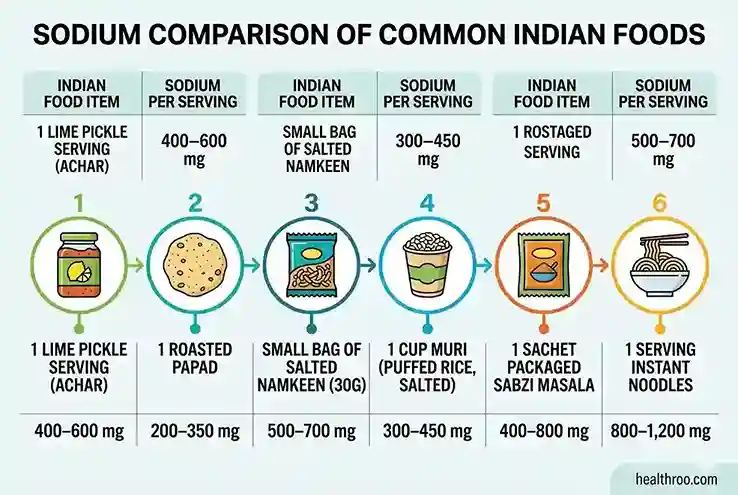
Here are the hidden sodium numbers most people never check:
| Indian Food Item | Sodium per Serving |
| 1 lime pickle serving (achar) | 400–600 mg |
| 1 roasted papad | 200–350 mg |
| Small bag of salted namkeen (30g) | 500–700 mg |
| 1 cup muri (puffed rice, salted) | 300–450 mg |
| 1 sachet packaged sabzi masala | 400–800 mg |
| 1 serving instant noodles | 800–1,200 mg |
Your swap strategy:
| High-Sodium Item | Lower-Sodium Swap |
| Achar (lime pickle) | Fresh lime squeeze + coriander chutney |
| Salted papad | Roasted papad (no salt added before roasting) |
| Packaged masala sachets | Home-ground dry-roasted spice mix |
| Salted namkeen | Roasted chana, unsalted makhana |
| Muri (salted puffed rice) | Plain puffed rice tossed with lemon + mustard |
Cooking Method: The Indian Hypertension Diet Plan Variable
This is an insight from my naturopathy research that you will not find anywhere else.
| Cooking Method | Sodium Impact | Recommended Approach |
| Pressure cooking dal | Retains sodium in broth — broth is consumed | Use minimal salt; add lemon for flavour instead |
| Deep frying (pakoras, bhajias) | Salted batter + absorption multiplies sodium content | Air fry or oven roast with spice-only coating |
| Steaming (idli, dhokla) | Lowest sodium — no salt lost, none added via oil | Ideal method; reduce added salt in batter by half |
| Dry roasting (chana, seeds) | Flavour concentrates — less salt needed | Roast plain; add a pinch of rock-free flavouring after |
| Tadka in oil | Salt absorbed into oil coats entire dish | Reduce tadka salt by 50%; boost with cumin, mustard seeds |
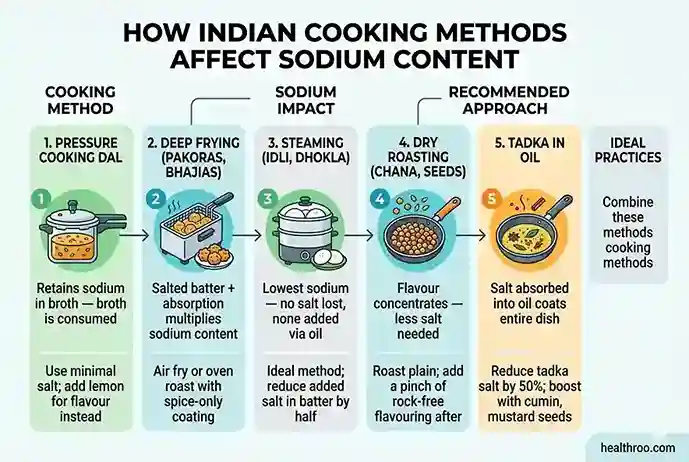
Switching to steaming and dry roasting for just half your weekly meals can lower your daily sodium by 400–700mg — a practical, kitchen-level upgrade to your Indian Hypertension Diet Plan.
**Practical tip:** When pressure cooking dal, use half the salt you normally would. Then add a squeeze of lemon and fresh coriander after cooking. Your taste perception of saltiness increases, so your dal will taste just as flavourful with far less sodium.
Reading Indian Food Labels: A Critical Skill for Anyone Following an Indian Hypertension Diet Plan
Indian food labels show sodium in milligrams. But you think in terms of salt. These are not the same number.
Here is the formula of sodium conversion you need to know:
Salt (g) = Sodium (mg) × 2.5 ÷ 1000
So if a “healthy” biscuit packet says 400mg sodium per serving — that is actually 1 gram of salt. From a single serving of biscuits.
Watch out for these misleading label terms on Indian products:
- “Reduced salt” — means 25% less than the original product, not “low sodium”
- “No added salt” — may still contain naturally occurring sodium from ingredients
- “Masala flavour” and “chatpata” products — almost always high in hidden sodium
- “Baked, not fried” snacks — lower fat, but often same or higher sodium than fried versions
Your rule: any packaged product with more than 120mg of sodium per 100g deserves caution if you are following an Indian Hypertension Diet Plan.
Label literacy is a non-negotiable skill for anyone serious about their Indian Hypertension Diet Plan — because food manufacturers do not design labels to help you reduce sodium.
BP-Lowering Superfoods That Make Your Indian Hypertension Diet Plan Truly Powerful
Therapeutic Indian Spices: Your Indian Hypertension Diet Plan’s Clinically Proven Secret Weapons
Your kitchen may be your most underused pharmacy.
Here are four Indian spices with genuine clinical evidence for blood pressure reduction — not just traditional belief:
Turmeric (Haldi) — Active compound: Curcumin
Curcumin upregulates endothelial nitric oxide synthase (eNOS) — the enzyme your blood vessel lining uses to produce nitric oxide. Nitric oxide relaxes your arteries. This is the same pathway targeted by some antihypertensive drugs. Daily therapeutic amount: ½ to 1 tsp in warm water, milk, or dal — with a pinch of black pepper to increase absorption by 2,000%.
Garlic (Lehsun) — Active compound: Allicin
Allicin triggers the hydrogen sulfide pathway in your vascular smooth muscle — causing direct arterial relaxation and vasodilation. Two to three raw crushed garlic cloves per day, ideally on an empty stomach, show consistent BP-lowering effects in clinical studies. Let crushed garlic sit for 10 minutes before cooking to preserve allicin.
Fenugreek (Methi) — Active compound: Galactomannan and 4-hydroxyisoleucine
Fenugreek reduces sodium retention in your kidneys and improves insulin sensitivity — important because insulin resistance drives sodium retention, which raises BP. 1 tsp of soaked methi seeds every morning is the studied protocol.
Ajwain (Carom Seeds) — Active compound: Thymol
Thymol has calcium channel-blocking properties. It inhibits calcium ion influx into vascular smooth muscle cells — the mechanism of an entire class of BP medications called calcium channel blockers. ½ tsp of ajwain water (boiled and cooled) daily shows benefit in preliminary studies.

No Indian Hypertension Diet Plan is complete without these four spices — each backed by a distinct, measurable mechanism, not just centuries of tradition.
**Expert note:** These spices support your diet’s effect on BP. They do not replace prescribed medication. Use them as your first line of dietary defence — especially if you are in the pre-hypertension stage
Best Indian Foods for BP in Your Indian Hypertension Diet Plan: Ranked by Potassium-to-Sodium Ratio
Forget generic “eat bananas” advice. Here is the ranking you actually need — by potassium-to-sodium ratio (K:Na). A higher ratio means more BP-lowering benefit per serving.
| Food | Potassium (mg) | Sodium (mg) | K:Na Ratio |
| Lauki (bottle gourd), cooked | 460 | 3 | 153:1 |
| Spinach (palak), cooked | 540 | 24 | 22:1 |
| Banana (medium) | 422 | 1 | 422:1 |
| Coconut water (200ml) | 600 | 25 | 24:1 |
| Amla (Indian gooseberry) | 198 | 1 | 198:1 |
| Ragi (finger millet), cooked | 408 | 11 | 37:1 |
| Moong dal (cooked, no salt) | 369 | 4 | 92:1 |
| Rajma (kidney beans, cooked) | 403 | 2 | 201:1 |
**Featured answer:** The best vegetables for high BP in India, ranked by potassium-to-sodium ratio, are: 1. Lauki, 2. Spinach, 3. Tinda, 4. Drumstick (moringa), 5. Potato (boiled without salt). These beat many Western “superfoods” for BP management.
Foods to Limit in Your Indian Hypertension Diet Plan: Portion Guidance, Not Prohibition
You do not need to eliminate your favourite foods. You need to understand their portion ceiling.
Here is the compliance-first framework — from my 15 years of working with patients who actually follow through:
| Food | Limit | Why | Smart Swap |
| Ghee | ≤1 tsp/day | Saturated fat raises cardiovascular risk | Use for tadka flavour — not for spreading |
| Pickle (achar) | 1 small serving/week | 400–600mg sodium per serving | Fresh lime + green chutney |
| Full-fat paneer (commercial) | 30g max / twice weekly | Added salt + saturated fat | Homemade low-fat paneer, or tofu |
| White rice | 1 cup cooked/meal | High glycaemic index worsens insulin-driven sodium retention | Red rice, brown rice, or ragi mudde |
| Packaged biscuits/snacks | Avoid entirely | Hidden sodium 400–900mg per small serving | Roasted makhana or unsalted chana |
| Refined oil in excess | ≤3 tsp/day total | Promotes inflammation that stiffens arteries | Cold-pressed mustard or sesame oil |

The Complete 7-Day Indian Hypertension Diet Plan With Region-Wise Charts
How to Use This Indian Hypertension Diet Plan: Your Daily Targets at a Glance
Before you start, fix these daily targets in your mind:
- Daily sodium: less than 5g (ICMR guideline for hypertensive adults)
- Daily potassium: 3,500–4,700mg
- Cooking oil: maximum 3 teaspoons across all meals
- Salt type: iodized only — no rock salt, no sea salt
- Packaged spice mixes: none — use home-ground spices only
Each day in the plan below costs under 5g of sodium. Each meal is designed to fit a normal Indian kitchen.
Print these five targets and stick them on your refrigerator. They are the daily operating rules of your Indian Hypertension Diet Plan — and the simplest way to stay consistent without counting every milligram.
Day 1–7: Your Complete Indian Hypertension Diet Chart
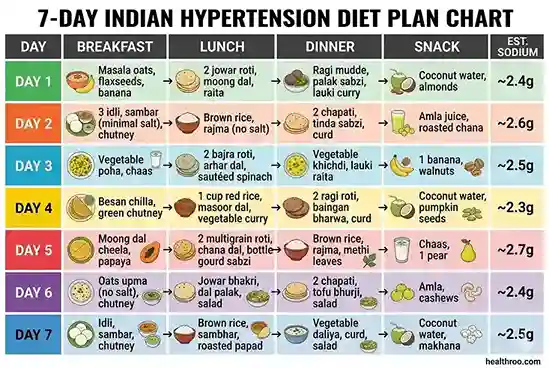
| Day | Breakfast | Lunch | Dinner | Snack | Est. Sodium |
| Day 1 | Masala oats + flaxseeds + 1 banana | 2 jowar roti + moong dal + cucumber raita | Ragi mudde + palak sabzi + 1 small lauki curry | Coconut water + 10 unsalted almonds | 2.4g |
| Day 2 | 3 idli + sambar (minimal salt) + pudina chutney | Brown rice + rajma (home-cooked, no added salt) + tomato salad | 2 whole wheat chapati + tinda sabzi + curd | Amla juice + roasted chana (unsalted) | 2.6g |
| Day 3 | Vegetable poha (minimal salt) + 1 glass chaas | 2 bajra roti + arhar dal + sautéed spinach | Vegetable khichdi (moong + rice, 1:1) + lauki raita | 1 banana + 5 walnuts | 2.5g |
| Day 4 | Besan chilla (no salt in batter) + green chutney | 1 cup red rice + masoor dal + mixed vegetable curry | 2 ragi roti + baingan bharwa (unsalted tadka) + curd | Coconut water + handful of pumpkin seeds | 2.3g |
| Day 5 | Moong dal cheela + sliced papaya | 2 multigrain roti + chana dal + bottle gourd sabzi | Brown rice + rajma (½ cup) + sautéed methi leaves | Chaas (no salt, just jeera) + 1 pear | 2.7g |
| Day 6 | Oats upma (no salt) + coconut chutney (minimal) | Jowar bhakri + dal palak + beet + carrot salad | 2 whole wheat chapati + tofu bhurji + cucumber salad | Amla + 10 unsalted cashews | 2.4g |
| Day 7 | Idli with sambar + tomato chutney (homemade) | Brown rice + sambhar (no added salt beyond vegetables) + papad (plain roasted) | Vegetable daliya (broken wheat) + curd + salad | Coconut water + handful of makhana (unsalted) | 2.5g |
(South India variant: On Days 1, 3, and 5 — replace jowar/bajra roti with ragi mudde or steamed red rice. Your regional sodium baseline is already lower — focus on reducing coconut-based chutneys with added salt.)
(North India note: On all days — reduce butter in tadka to ½ tsp maximum. Replace cream-based gravies with tomato-onion bases. Your regional average of 14.1g salt/day means the most aggressive adjustment is needed here.)
This Indian Hypertension Diet Plan keeps every day’s total sodium between 2.3g and 2.7g — well below the ICMR ceiling of 5g, giving your body a daily surplus of sodium-reduction headroom.
Region-Wise Modifications to Your Indian Hypertension Diet Plan: North, South, East, and West
| Region | Average Daily Salt Intake | Primary Sodium Culprits |
| North India (Delhi) | 14.1g/day | Butter, cream, heavy tadkas, pickles, paneer dishes |
| East India (Kolkata) | 9.8g/day | Mustard-oil frying, salted fish preparations, muri |
| West India (Mumbai) | 10.1g/day | Ghee, sugary accompaniments, farsan snacks |
| South India (Bangalore/Chennai) | 9.4g/day | Salted chutneys, sambar salt, commercial pickles |

If you are from North India: Your reduction journey is the steepest — but also where you will see the fastest BP improvement. Target: cutting your salt consumption by 60% over 4 weeks. Start by eliminating packaged masalas and cream-based gravies in week one. Replace butter in tadka with ½ tsp cold-pressed mustard oil.
If you are from East India, Your primary fix is shifting from salted fried fish preparations to steamed or mustard-paste preparations without added salt. Muri (puffed rice) is a hidden sodium trap — switch to plain, unsalted puffed rice.
If you are from West India, Address your sugar and ghee load first. Farsan snacks and mithai eaten as regular snacks combine fat, sodium, and sugar — a triple BP threat. Replace with dhokla (steamed, low salt), roasted chana, or fresh fruit.
If you are from South India, You are already the lowest-sodium region in India. Your focus is on grain quality (white rice → red rice or millets) and reducing salted coconut chutneys. Sambar without added salt beyond its vegetables is your daily vegetable-and-protein power dish.
No generic Indian Hypertension Diet Plan accounts for these regional differences — but yours now does, backed by the most comprehensive dietary study ever conducted across Indian metro cities.
Vegetarian and Vegan Adaptations for Your Indian Hypertension Diet Plan
The 7-day plan above is already fully vegetarian. For vegan readers, here are your daily swaps:
| Original Ingredient | Vegan Swap |
| Low-fat curd (dahi) | Unsweetened soy curd or coconut curd |
| Paneer | Extra-firm tofu (home-pressed) |
| Chaas (buttermilk) | Thin soy milk with jeera and mint |
| Ghee (½ tsp in tadka) | Cold-pressed coconut oil (½ tsp) |
| Raita | Cucumber + coconut curd + cumin |
Your protein targets remain the same. Moong dal, rajma, chana, and masoor dal provide all essential amino acids when combined with ragi or jowar roti across meals.
A plant-based Indian Hypertension Diet Plan is not a compromise — it is often more potassium-rich and sodium-controlled than its non-vegan equivalent, making it a powerful choice for BP management.
Managing Hypertension When You Also Have Diabetes or High Cholesterol
The Hypertension–Diabetes Overlap
If you have both high BP and diabetes, you are not alone. The Journal of the Association of Physicians of India (JAPI) documents a co-existence rate of 15–80% in Indian patients, depending on the population studied.
The dietary tension is real. Diabetes management pushes you toward low-glycaemic carb restriction — which often means cutting rice and chapati. But your BP management needs potassium-rich whole grains and fruits.
The resolution lives in one food group: millets.
Ragi, jowar, and bajra are:
- Low glycaemic index (GI 50–65 vs white rice at 72–78)
- Low in sodium (naturally)
- High in potassium and magnesium
- High in resistant starch (gut health + endothelial function benefit)
Replacing white rice and refined wheat chapati with ragi mudde, jowar roti, or bajra bhakri addresses both conditions simultaneously. This is the dietary bridge your dual diagnosis requires.
**For caregivers:** If you are cooking for a parent with both diabetes and high BP, millet-based meals — ragi porridge for breakfast, jowar roti for lunch — are the single most impactful change you can make to their daily diet.
The Hypertension–Dyslipidemia Overlap: Indian Fats Decoded
High BP combined with high cholesterol is extremely common in Indian patients — and most dietary advice gets the fat guidance wrong.
Here is the nuanced truth:
Ghee: At ≤1 tsp per day, ghee is not your enemy. Its saturated fat becomes a problem when consumed in the quantities common in North and West Indian cuisine — 3 to 4 tablespoons daily. The BP and lipid risk are dose-dependent. One teaspoon in your tadka is within safe limits.
Coconut oil: Coconut oil’s predominant saturated fats are medium-chain triglycerides (MCTs). MCTs are metabolised differently from the long-chain saturated fats in animal products — they go directly to your liver for energy rather than being packaged into LDL. In moderate quantities (1 tsp/day), coconut oil carries less cardiovascular risk than its saturated fat content suggests.
Mustard oil: Mustard oil contains alpha-linolenic acid (ALA) — a plant-based omega-3 fatty acid. Multiple Indian cardiovascular studies suggest mustard oil as the cooking fat most likely to support heart health among affordable, widely available Indian options. Cold-pressed, unrefined mustard oil in ≤3 tsp/day is your best everyday cooking choice.
Refined vegetable oils (sunflower, soybean, refined groundnut): High in omega-6 fatty acids that promote inflammatory pathways when consumed in excess. These oils are the one fat category to genuinely reduce.
Lifestyle Factors That Shape Your BP Beyond the Plate
Physical Activity: The Specific Numbers You Need
You do not need a gym. You need 150 minutes per week of moderate aerobic activity.
That is 30 minutes, 5 days a week, of walking briskly, cycling to the market, or completing 4 rounds of Surya Namaskar.
The clinical payoff: 150 minutes of weekly aerobic exercise reduces systolic blood pressure by 5–8 mmHg — the equivalent of a low-dose antihypertensive drug.
Three Indian-life-friendly options:
- Morning rooftop or terrace walk (30 min before breakfast)
- 5 rounds of Surya Namaskar + 10 minutes of anulom-vilom pranayama
- Cycle to the market instead of taking an auto or car
If you are over 60 or have existing heart disease, check with your cardiologist before starting any new exercise routine.
Stress and Cortisol: The Urban Driver That Undermines Your Indian Hypertension Diet Plan
In my anthropological research, urbanisation is the single most underestimated driver of hypertension in modern India. Not sodium. Not ghee. Urbanisation.
The pathway is through cortisol — your primary stress hormone. Chronic cortisol elevation causes your kidneys to retain sodium. It triggers adrenaline surges that raise your heart rate. It disrupts your sleep, which itself raises BP.
Three evidence-backed interventions that work within a city lifestyle:
- Bhramari pranayama (humming bee breath): 10 rounds before sleep. Activates your parasympathetic nervous system. Reduces cortisol measurably within 20 minutes of practice.
- Structured meal timing: Eating at irregular hours disrupts your circadian cortisol rhythm. Eating breakfast by 9 am, lunch by 1 pm, and dinner by 8 pm provides measurable hormonal stabilisation over 4–6 weeks.
- 5-minute body scan before bed: Lie still. Progressively relax each body part from feet to forehead. This simple technique lowers nocturnal BP — the period when BP should naturally dip but often does not in stressed individuals.
Alcohol, Tobacco, and Your Indian Hypertension Diet Plan: Honest Guidance for Indian Patients
Most health websites cover “smoking.” That is too narrow for the Indian patient reality.
Tobacco in India is consumed as cigarettes, bidi (beedi), gutka (chewed tobacco), khaini (raw tobacco), and hookah. Every form raises BP through the same nicotine-driven vasoconstriction mechanism. Bidi smokers often believe their consumption is “less harmful” than cigarettes — it is not, for BP purposes.
Gutka and tobacco chewing increase BP acutely with every pouch. Long-term users have measurably thicker, stiffer arterial walls — a direct structural change that raises baseline BP permanently over time.
Alcohol: More than 2 standard drinks per day raises systolic BP by 4–6 mmHg. For Indian hypertensive patients, the recommendation is ideally zero — not because of moralising, but because alcohol also interferes with antihypertensive medications and disrupts sleep-based BP dipping.
When Your Indian Hypertension Diet Plan Needs Medical Support: Working With Your Doctor
How to Track Progress on Your Indian Hypertension Diet Plan: Know Your Numbers
**Know your numbers:** – **Normal:** below 120/80 mmHg – **Elevated:** 120–129 / below 80 mmHg – **Stage 1 Hypertension:** 130–139 / 80–89 mmHg – **Stage 2 Hypertension:** 140 or higher / 90 or higher mmHg – **Hypertensive Crisis:** above 180 / above 120 mmHg — seek emergency care immediately
Measure your BP at the same time each morning — before eating, before medication, after 5 minutes of quiet sitting. Take two readings two minutes apart. Record the average.
If you are following this Indian Hypertension Diet Plan consistently, you should see a measurable change in 10–14 days. Most patients following DASH-aligned diets reduce systolic BP by 8–14 mmHg in two weeks.
<img src=”bp-reading-interpretation-chart.jpg” alt=”Blood pressure reading interpretation chart for Indian patients — Normal, Elevated, Stage 1, Stage 2, Crisis — Indian Hypertension Diet Plan” />
If your readings are in Stage 2 or your Stage 1 readings do not improve after 4 weeks of dietary and lifestyle changes, speak to your cardiologist about medication.
Asking your doctor for a sodium blood test (serum sodium) alongside your next BP check can give you a clearer picture of how your diet is affecting your sodium balance.
Medical Safety Notice: What This Indian Hypertension Diet Plan Can and Cannot Do
**Important medical notice:** This Indian Hypertension Diet Plan is a dietary supplement to prescribed antihypertensive therapy — not a replacement. Do not modify, reduce, or stop any medication without direct guidance from your cardiologist or physician.
Pre-hypertension and low-risk Stage 1 hypertension may be appropriately managed through lifestyle changes alone — under medical supervision. Stage 2 hypertension almost always requires medication alongside dietary intervention. This content is reviewed by a qualified cardiologist and grounded in ICMR 2021 Dietary Guidelines and peer-reviewed research. It is for educational purposes and does not constitute personalised medical advice.
FAQs on Indian Hypertension Diet Plan
Which Indian foods immediately lower blood pressure?
No food works within minutes the way medication does. But coconut water, banana, and a glass of unsalted chaas can help lower BP within hours of consumption — thanks to their potassium content. Consistent intake over 7–14 days produces a measurable reduction. For a true hypertensive crisis (BP above 180/120), go to emergency care — do not rely on food.
Can I eat rice if I have high BP?
Yes — rice itself does not raise BP. The problem is what accompanies it: salted pickles, high-sodium sabzis, and papad. Switch from white rice to red rice or brown rice for a lower glycaemic response. A 1-cup cooked serving of plain rice with a high-potassium dal and vegetable curry is a perfectly sound BP-friendly meal.
Is ghee good or bad for high blood pressure?
Ghee at 1 teaspoon per day is not your BP enemy. The problem is 3–4 tablespoons daily — common in North and West Indian households. At controlled quantities, ghee provides fat-soluble vitamins and a rich flavour that reduces the need to add extra salt. Moderation, not elimination, is the right call.
Can an Indian diet reverse hypertension without medication?
For pre-hypertension and low-risk Stage 1 (130–139/80–89 mmHg without organ damage), dietary and lifestyle changes alone — under medical supervision — can normalise BP. For Stage 2 (≥140/≥90 mmHg) or any stage with existing heart or kidney involvement, medication is necessary. Diet enhances medication effectiveness — it does not replace it.
What is the best breakfast for high BP patients in India?
Masala oats with flaxseeds and one banana. Or 3 steamed idlis with unsalted sambar and pudina chutney. Either option delivers under 400mg sodium, high potassium, and resistant starch — all in one meal. Avoid packaged upma mixes, instant oats with flavour sachets, and bread-based breakfasts with processed spreads.
Is sendha namak (rock salt) safer than regular salt for BP?
No. Rock salt is 97%+ sodium chloride — identical in sodium content to regular table salt. It lowers BP no better than standard salt. Worse — it contains no iodine. Switching to rock salt puts you at risk for iodine deficiency while doing nothing for your BP. Reduce the quantity of iodized salt. Do not switch the type.
How much salt per day is safe for hypertension in India?
The ICMR guideline for hypertensive Indian adults is less than 5 grams of salt per day — roughly one level teaspoon, including all hidden sources. The current Indian average is 10.9 grams daily (SCRIPT study, JAPI 2017). Most patients need to cut their salt consumption by more than half. Hidden sources — achar, packaged masalas, papad — typically account for 2–3g alone
Can I eat paneer if I have high BP?
Yes — with conditions. Choose homemade low-fat paneer rather than commercial packaged paneer, which often contains added salt and preservatives. Limit to 30–50g per serving, twice a week. If you also have diabetes, choose tofu as a lower-fat, lower-sodium alternative with equivalent protein content.
What drinks help lower blood pressure in India?
Your best daily drinks for BP: coconut water (potassium-rich, naturally low sodium), amla juice (vitamin C + antioxidants), unsalted chaas / buttermilk (calcium + probiotics), hibiscus tea (3 cups/day has been shown to reduce systolic BP by 6–7 mmHg in clinical studies), and plain water — minimum 2.5 litres daily. Avoid packaged fruit juices, aerated drinks, and salted lassi.
Is the North Indian diet worse for BP than the South Indian?
Based on SCRIPT study data — yes, on average. North India averages 14.1 grams of salt daily versus South India’s 9.4 grams. The culprits are butter, cream-based gravies, heavy tadkas, and frequent pickle consumption. But this does not make North Indian cuisine unhealthy by design. With targeted modifications — reducing butter to ½ tsp, eliminating cream, switching to home-ground masalas — a North Indian diet can be just as BP-protective as a South Indian one.
A Final Word from the Healthroo Research Desk
Fifteen years of working at the intersection of anthropology and wellness has taught me one thing above everything else.
People do not fail their diets. Their diets fail them.
Generic charts built for Western bodies on Western food cultures do not work in Indian kitchens. Your Indian Hypertension Diet Plan must know what lauki is. It must understand why you cannot just “skip the pickle.” It must respect that ghee has been in your family’s cooking for generations — and work with that reality, not against it.
This guide was built to do exactly that.
Start with the 7-day plan. Measure your BP before you begin and again at Day 7. Track the change. Then share it with someone you know who needs it — because 30% of them likely do not yet know they are hypertensive.
Referrence
National Institute of Nutrition
Ministry of Health and Family Welfare, Government of India
World Health Organization — India Office
PubMed Central (PMC) — National Library of Medicine
PubMed — SCRIPT Study (JAPI 2017)
PMC — 2024 Salt Substitute RCT (Rural India)
Journal of the American College of Cardiology (JACC)
New England Journal of Medicine (NEJM) — DASH Trial
American Heart Association (AHA)
National Heart, Lung, and Blood Institute (NHLBI) — USA
Centers for Disease Control and Prevention (CDC)
Harvard T.H. Chan School of Public Health — The Nutrition Source
About the Author: Sajal Samanta
Sajal Samanta is an Anthropologist and Nutrition Expert with 15 years of experience in RCT research, naturopathy, and holistic wellness. As a lead strategist for healthroo.com, he specializes in translating complex clinical data into actionable, heart-healthy “tricks.” Sajal’s work bridges the gap between ancestral wisdom and modern science to help readers manage hypertension and reclaim their vitality naturally.










1 thought on “The Proven Indian Hypertension Diet Plan: Lower BP Naturally in [7 Days] [Free Printable Chart]”