![Blurred Vision Iron Deficiency: 7 Signs to Never Ignore [Science]](https://healthroo.com/wp-content/uploads/2026/06/WEBP-image_e5c2f284_11zon.webp)
Blurred Vision Iron Deficiency: Discover why low iron may affect your eyesight, 7 warning signs, tests, charts & expert advice. Read the full guide!
Peer reviewed by Dr. Ramkrishna Dey, Ophthalmologist & Ocular Health Consultant
Section 1: Introduction
You wake up one morning, and your vision is slightly hazy. You feel exhausted even after a full night of sleep. You wonder if your diet has something to do with it.
You are not alone. More than 2 billion people worldwide live with iron deficiency, according to the World Health Organization (WHO). And one of its least-talked-about effects is your eyesight.
Blurred vision iron deficiency is a real, documented, and reversible condition. Yet most people never connect the dots between their foggy eyes and their falling iron levels. This article helps you do exactly that.
| Can blurred vision be caused by iron deficiency? Yes. Iron deficiency, especially when ferritin levels fall, reduces haemoglobin. This cuts the oxygen your retina receives. That oxygen deprivation, called retinal hypoxia, can trigger temporary blurred vision, visual fatigue, and, in severe anaemia, retinal haemorrhage. Most cases of blurred vision due to iron deficiency are fully reversible with appropriate iron therapy started early. |
What This Article Covers
- The science: how iron deficiency leads to blurred vision step by step
- 7 warning signs of blurred vision iron deficiency you should never ignore
- Severity stages and what each stage means for your eyes
- Blood test interpretation guide, including ferritin and haemoglobin cutoffs
- Differential diagnosis: Is it really iron deficiency or something else?
- Eye complications if iron deficiency goes untreated
- Recovery timeline: When will your vision return?
- India-specific context: diet, epidemiology, and practical recovery steps
Clinical Note:
In India, 57% of women of reproductive age are anaemic (NFHS-5, 2019-21), making iron deficiency the most common nutritional cause of blurred vision nationwide
Section 2: The Science — How Blurred Vision Iron Deficiency Actually Happens
How Blurred Vision Iron Deficiency Actually Happens: The Science
Most people think anaemia only causes tiredness. That is only half the picture. The pathway from low iron to blurred vision is direct and well-supported by research.
The Iron-Haemoglobin-Oxygen-Retina Pathway
Here is what happens inside your body when iron levels fall:
| Step | What Happens |
| 1. Low Dietary Iron or Blood Loss | Your body’s iron intake drops below what it needs. |
| 2. Reduced Ferritin Stores | Your iron storage protein, ferritin, depletes first. |
| 3. Reduced Haemoglobin Synthesis | Without iron, your body cannot make enough haemoglobin. |
| 4. Impaired Oxygen Transport | Red blood cells carry less oxygen to every organ. |
| 5. Retinal Hypoxia | Your retina, the most oxygen-hungry tissue per gram, is starved of oxygen. |
| 6. Optic Nerve Stress | The optic nerve and visual cortex receive degraded signals. |
| 7. Blurred Vision / Visual Fatigue | You see haziness, fatigue, and in severe cases, retinal haemorrhage. |

Read More Related Issue: Light sensitivity (Photophobia)
Why Ferritin Matters More Than Haemoglobin in Blurred Vision Iron Deficiency
This is the most critical distinction most doctors miss.
A standard blood test checks your haemoglobin. But ferritin, the protein that stores iron in your cells, depletes weeks or even months before haemoglobin drops. You can have completely normal haemoglobin and critically low ferritin, and still experience full blurred vision iron deficiency symptoms.
Clinical Note: Research by Camaschella (New England Journal of Medicine, 2015) confirms: serum ferritin below 30 ng/mL indicates functional iron deficiency even when haemoglobin stays within the normal range.
This pre-anaemic state is the most under-diagnosed phase of iron deficiency. It is the phase where blurred vision, visual fatigue, and eye strain often begin, yet no standard CBC test will catch it.
Expert Tip: South Asian diets rich in pulses, whole grains, and tea are high in phytates and tannins. Both compounds block non-haem iron absorption. This accelerates ferritin depletion long before anaemia appears on a standard blood report. ICMR dietary data consistently confirms this pattern in Indian populations.
Why Your Retina Is the First Eye Structure to Suffer
Your retina uses more oxygen per gram than almost any other tissue in your body. It has two blood supplies, the central retinal artery and the choroidal circulation, both of which depend on well-oxygenated red blood cells.
When haemoglobin falls, retinal blood vessels dilate to compensate. Under severe iron deficiency anaemia (IDA), this compensation fails. Retinal hypoxia sets in. Photoreceptors malfunction. You see blur.
Clinical Note:
“In my clinical practice, I routinely examine patients with vague visual complaints. Fundus examination in several of these cases reveals early retinal vascular changes consistent with haematological anaemia, particularly in women with heavy menstrual cycles and in vegetarian adolescents.” — Dr. Ramkrishna Dey, Ophthalmologist & Ocular Health Consultant
Section 3: 7 Signs of Blurred Vision Iron Deficiency — Never Ignore These
7 Signs of Blurred Vision Iron Deficiency You Must Not Ignore
These seven signs follow a clinical progression. The earlier you recognise them, the faster your recovery.

Sign 1: Blurred or Foggy Vision — The Core Symptom of Blurred Vision Iron Deficiency
This is the symptom that brings most people to search for blurred vision iron deficiency in the first place.
You may notice intermittent haziness when you stand up quickly, climb stairs, or exert yourself. The blurring is typically bilateral, meaning both eyes are affected. It is non-painful and does not come with a headache.
This distinguishes iron-deficiency blur from migraine aura, which is usually one-sided and comes with zigzag lights.
Clinical Note: Severity: Mild to moderate IDA. Fully reversible with iron therapy.
Sign 2: Visual Fatigue and Eye Strain Linked to Iron Deficiency Anemia
You struggle to keep your eyes focused on a screen or a book. After 20 minutes of reading, your eyes feel heavy and strained.
Low oxygen supply impairs the ciliary muscle, which controls your lens focus, and the extraocular muscles that move your eyes. Both tire rapidly when iron deficiency reduces their oxygen supply.
For Indian students during board exam season, this sign is particularly common. Academic pressure combines with inadequate iron nutrition to create a perfect storm of eye fatigue and reduced concentration.
Sign 3: Floaters or Flickering Lights Associated with Eye Symptoms of Anemia
New-onset floaters, small specks or threads drifting across your visual field, can appear in early vitreous hypoxia caused by low haemoglobin.
If you see brief flickers of light, especially in peripheral vision, this can indicate early retinal stress from reduced oxygen delivery.
Read More Related Post: Iron Deficiency Eye Floaters
IMPORTANT: New floaters combined with flashing lights or a curtain-like shadow across vision require immediate ophthalmology review. Do not wait.
Sign 4: Pale Conjunctiva (Pale Inner Eyelid) — Classic Eye Symptoms of Anemia
Gently pull down your lower eyelid. The inner rim, the conjunctival membrane, should be a healthy coral pink.
If it looks pale pink, washed out, or almost white, this is conjunctival pallor. Research shows this clinical sign correlates with haemoglobin levels below 9 g/dL.
Expert Tip: This self-check takes 10 seconds. Do it in natural daylight for the most accurate reading.
Sign 5: Blue Sclera (Bluish White of the Eye)
Your sclera is the white of your eye. In chronic iron deficiency, the sclera can take on a faint blue tinge.
Iron is a co-factor in collagen synthesis. Without enough iron, scleral collagen thins. The choroidal blood vessels beneath become visible, creating the blue appearance.
This sign is more noticeable in people with darker-coloured irises, including many South Asian populations. It has been documented in chronic iron deficiency cases across India.
Sign 6: Dizziness on Standing — Orthostatic Visual Greyout from Blurred Vision Iron Deficiency
You stand up from a chair or bed, and your vision goes grey or black for a second or two. This is called orthostatic hypotension combined with retinal underperfusion.
Low haemoglobin reduces cardiac output. When you stand suddenly, your blood pressure drops briefly. The already oxygen-poor retina receives even less blood. Your vision momentarily greys out.
Adolescent girls with heavy menstrual periods are especially at risk. NFHS-5 data confirms that anaemia prevalence among Indian adolescent girls (15-19 years) exceeds 59%.
Sign 7: Retinal Haemorrhage — A Medical Emergency in Severe Blurred Vision Iron Deficiency
In severe iron deficiency anaemia, with haemoglobin falling below 6 g/dL, the retinal blood vessels can rupture. These appear on fundoscopy as flame-shaped or dot-and-blot haemorrhages. This is anemic retinopathy.
At this stage, vision loss can be sudden and significant. This is no longer a warning sign. It is a medical emergency.
IMPORTANT: EMERGENCY: If you experience sudden loss of vision in one or both eyes, severe headache with vision changes, eye pain with vision disturbance, or any vision loss combined with facial weakness, slurred speech, or arm weakness, call emergency services immediately. Do not wait.
Section 4: Severity Classification — Stages of Blurred Vision Iron Deficiency
Severity Stages of Blurred Vision Iron Deficiency: From Pre-Anaemia to Emergency
Not all iron deficiency looks the same. Here is how the stages progress and what each means for your eyesight.
| Stage | Ferritin (ng/mL) | Haemoglobin (g/dL) | Eye Symptoms | Action Required |
| Depleted Stores (Pre-anaemic) | < 30 | Normal (12+ F / 13+ M) | Usually none; possible visual fatigue | Dietary change + monitor |
| Iron-Deficient Erythropoiesis | < 20 | Borderline low | Eye strain; mild blur on exertion | GP consultation + ferritin test |
| Mild Iron Deficiency Anaemia | < 12 | 10 to 11.9 | Occasional blurred vision; pale conjunctiva | Iron supplementation + CBC monitoring |
| Moderate IDA | < 12 | 7 to 9.9 | Persistent blur; dizziness; floaters | Urgent GP referral + eye exam |
| Severe IDA | < 12 | < 7 | Retinal haemorrhage; anemic retinopathy | EMERGENCY — same-day specialist care |
Clinical Note: Reference: WHO Haemoglobin Cutoffs for Anaemia Diagnosis (2011). Indian lab normal ranges may vary slightly; always confirm with ICMR-adjusted references and your treating physician.
Section 5: Blood Test Interpretation Guide for Blurred Vision Iron Deficiency
Blood Test Interpretation Guide: What Your Results Mean for Blurred Vision Iron Deficiency
If you suspect that iron deficiency is causing your blurred vision, a standard blood test may not be enough. Here is what to ask for and what each test reveals.
Which Tests to Request When You Suspect Blurred Vision Iron Deficiency
A Complete Blood Count (CBC) measures haemoglobin, but it misses the earliest phase of iron depletion. You need to ask your doctor for a serum ferritin test specifically. That single test can identify iron deficiency weeks before anaemia appears on a haemoglobin reading.
| Test | What It Measures | Normal Range | Low Result Means | Linked to Eye Symptoms? |
| Serum Ferritin | Iron stores | 12-150 ng/mL (F), 15-200 (M) | Depleted stores (pre-anaemia) | YES — earliest marker |
| Haemoglobin (Hb) | Oxygen-carrying protein | 12+ g/dL (F), 13+ (M) | Anaemia: moderate to severe | YES — blurred vision; pallor |
| Serum Iron | Circulating iron | 60-170 mcg/dL | Iron deficiency or inflammation | Indirect |
| Transferrin Saturation | Iron saturation of transferrin | 20-50% | < 16% = iron-deficient erythropoiesis | Indirect |
| CBC (MCV/MCH) | Red cell size and haemoglobin content | MCV 80-100 fL | Microcytic/hypochromic = IDA likely | Indirect — confirms type |
Clinical Note: *Reference ranges vary by laboratory and population. Indian labs may use ICMR-adjusted norms. Always interpret results with your treating physician.
The Ferritin Trap: Why Standard Tests Miss Blurred Vision Iron Deficiency
Standard anaemia screening catches the problem late. By the time haemoglobin drops, ferritin has already been low for months. During that window, you may already have visual fatigue, eye strain, and intermittent blurring.
In rural India, anaemia screening often uses the SAHLI method, which only estimates haemoglobin. Ferritin assays are rarely ordered in primary care settings. This creates a large diagnostic blind spot, particularly for Indian women and adolescents experiencing early blurred vision iron deficiency
Clinical Note: NFHS-5 (2019-21) reports that only a fraction of anaemic women in India receive specific iron-level testing beyond haemoglobin. This gap in screening is a key public health concern at the primary care level.
Section 6: Differential Diagnosis — Is It Really Blurred Vision Iron Deficiency?
Differential Diagnosis: Is Your Blurred Vision from Iron Deficiency or Something Else?
Blurred vision has many causes. Use this section to check whether your symptoms fit the iron deficiency pattern, and to recognise when your symptoms need urgent medical attention.
IMPORTANT: This section is for educational guidance only. It is not a medical diagnosis. If you are unsure about your symptoms, consult a doctor.
| Condition | Onset | Associated Symptoms | Eye Symptoms | Key Differentiator |
| Iron Deficiency Anaemia | Gradual | Fatigue, pale skin, hair loss, cold hands | Bilateral blur; pale conjunctiva; floaters | Responds to iron supplements |
| Vitamin B12 Deficiency | Gradual | Pins/needles; glossitis; neurological signs | Optic neuropathy; central scotoma | Elevated MCV; low serum B12 |
| Diabetic Retinopathy | Gradual or sudden | Thirst; frequent urination; weight loss | Floaters; blurring; progressive loss | Elevated blood glucose; HbA1c elevated |
| Migraine with Aura | Acute (20-60 min) | Unilateral headache; nausea | Zigzag lines; transient visual disturbance | Resolves fully; no anaemia signs |
| Ischaemic Stroke / TIA | SUDDEN | Facial droop; arm weakness; speech difficulty | Sudden unilateral vision loss | EMERGENCY — F.A.S.T. protocol immediately |
| Hypertensive Retinopathy | Gradual | Headache; blood pressure above 140/90 | Haemorrhages; papilloedema | Elevated BP; specific fundoscopy findings |
Emergency Red Flag Decision Guide for Blurred Vision Iron Deficiency vs Other Causes
| Is your blurred vision… | What to do |
| Suddenly, in one eye only? | CALL EMERGENCY NOW — possible stroke or TIA |
| Suddenly, with face or arm weakness, slurred speech? | CALL EMERGENCY NOW — F.A.S.T. protocol |
| Gradual, with fatigue, pallor, and dizziness? | Likely iron deficiency anaemia — see GP; request ferritin test |
| Gradual, with floaters and flashes (no other symptoms)? | See ophthalmologist within 24-48 hours |
| Gradual, with headache and high BP? | See GP urgently — possible hypertensive retinopathy |
| Transient, with zigzag lights, headache follows? | Likely migraine aura — see GP for diagnosis |
Section 7: Eye Complications of Untreated Blurred Vision Iron Deficiency
Eye Complications When Blurred Vision Iron Deficiency Goes Untreated
If iron deficiency anaemia is not treated, the eye complications move beyond temporary blur. Here is what can develop.
Anemic Retinopathy: The Most Serious Complication of Blurred Vision Iron Deficiency
Anemic retinopathy refers to direct structural damage to the retina caused by haematological anaemia. It includes flame-shaped haemorrhages, dot and blot haemorrhages, cotton-wool spots, disc edema, and macular oedema.
It is estimated to occur in 1 to 2% of severely anaemic patients, but the rate rises significantly when IDA is combined with thrombocytopenia (low platelet count), as both conditions together increase haemorrhagic risk at the retinal level.
Clinical Note: Research from Indian ophthalmology cohort studies (Agarwal et al., Indian Journal of Ophthalmology) documents the prevalence and fundoscopic patterns of anemic retinopathy in South Asian patients, with vegetarian diets and menstrual blood loss as consistent risk factors.
Retinal Vein and Artery Occlusion Risk
Chronic severe anaemia increases the risk of retinal vascular occlusive events. The retinal blood vessels under sustained hypoxia become fragile and are more vulnerable to occlusion. In severe cases, compensatory changes in blood viscosity can also elevate occlusion risk.
Optic Neuropathy in Nutritional Anaemia
While optic neuropathy is more classically associated with B12 or folate deficiency, combined IDA and B12 deficiency, common in South Asian vegetarians, can worsen optic nerve hypoxia.
Symptoms include central scotoma (a blind spot in the centre of vision) and reduced colour vision. If you notice you can no longer distinguish certain colours as easily, or have a dark patch in your central vision, report it to your ophthalmologist immediately.
Section 8: Blurred Vision Iron Deficiency in Adolescence — A Special Risk Stage
Blurred Vision Iron Deficiency in Adolescence: Why This Stage Demands Special Attention
Adolescence is the developmental window when iron deficiency does its most silent damage. Rapid growth, hormonal changes, the onset of menstruation in girls, and heavy academic demands all converge.
A 14-year-old girl losing iron through her first heavy periods, eating a predominantly vegetarian diet, drinking tea with every meal, and studying under intense pressure is a textbook candidate for low ferritin blurry vision, even before her haemoglobin shows any abnormality.
| Risk Factor | Adolescent Specifics | Eye Impact |
| Rapid growth spurts | Iron demand surges; supply often lags | Early visual fatigue; eye strain during reading |
| Onset of menstruation | Monthly iron loss; heavy periods worsen deficit | Dizziness on standing; orthostatic visual greyout |
| Vegetarian / low-haem diet | Non-haem iron is poorly absorbed; tea and phytate further reduce uptake | Ferritin drops first; blur begins before anaemia is diagnosed |
| Academic pressure (screens) | Prolonged screen time strains already oxygen-poor extraocular muscles | Accelerates visual fatigue and eye strain from anemia eyes |
| Missed screening | Adolescent anaemia often undetected at school health checks | Complications advance unrecognised |
NFHS-5 data confirms that anaemia among Indian adolescent girls aged 15-19 years stands at over 59%. This is not a minor health footnote. It is a public health crisis that manifests in classroom performance, visual concentration, and long-term eye health
Expert Tip: If your adolescent daughter complains of tired eyes, difficulty focusing in class, or frequent dizziness, request a serum ferritin test alongside her routine blood work. Do not wait for haemoglobin to drop.
Section 9: Recovery Timeline — When Will Blurred Vision Iron Deficiency Resolve?
Medical Disclaimer (Publication-Ready):
The information in this article on blurred vision iron deficiency is intended for general educational purposes only. It does not constitute medical advice, diagnosis, or treatment. Always consult a qualified healthcare professional, including a GP or ophthalmologist, before making any health decisions.
If you experience sudden vision loss, eye pain, or any neurological symptoms, seek emergency medical care immediately.
This content has been medically reviewed by Dr. Ramkrishna Dey, Ophthalmologist & Ocular Health Consultant,
Recovery Timeline: When Does Blurred Vision Iron Deficiency Improve?
This is the question most people search for after a diagnosis: Is this reversible? How long will it take?
The answer is reassuring. Blurred vision from iron deficiency is almost always fully reversible when treatment starts early.
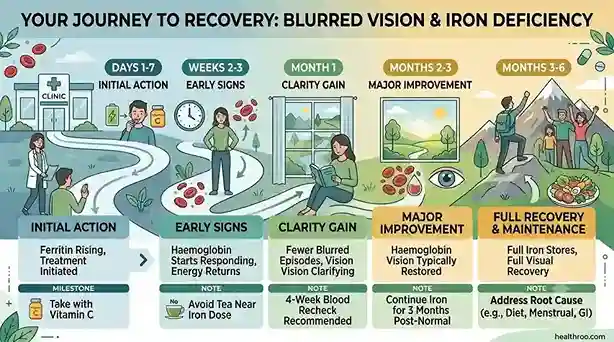
| Timeframe | Iron/Hb Status | Expected Eye Symptom Changes | Practical Notes |
| Days 1 to 7 | Ferritin begins to rise (oral iron) | Little visual change; energy improving | Take iron with Vitamin C for maximum absorption |
| Weeks 2 to 3 | Early haemoglobin response begins | Visual fatigue reducing, dizziness improving | Avoid tea within 1 hour of an iron dose |
| Month 1 | Haemoglobin rising toward normal | Blurred vision episodes becoming less frequent | Recheck Hb and ferritin at 4 weeks |
| Months 2 to 3 | Haemoglobin normalised; ferritin replenishing | Vision typically restored in uncomplicated cases | Continue iron 3 months post-Hb normalisation |
| Months 3 to 6 | Full iron stores restored (ferritin > 50) | Full visual recovery in most patients | Address root cause: diet, menstrual loss, GI issues |
Can Blurred Vision Iron Deficiency Cause Permanent Eye Damage?
Mild to moderate IDA causing blurred vision is almost always fully reversible. Your retina and optic nerve recover as haemoglobin and ferritin normalise.
Severe anemic retinopathy, with structural haemorrhages at the macula or optic disc changes, can leave residual visual deficits if treatment is delayed. This is why early detection matters so much.
Clinical Case Vignette (Anonymised Template): A 28-year-old female teacher from North Bengal presented with progressive visual fatigue, bilateral blurred vision on exertion, and pale conjunctiva over 3 months. Serum ferritin: 9 ng/mL. Haemoglobin: 8.4 g/dL. Fundoscopy: early flame haemorrhage, superior temporal quadrant, right eye.
Treated with oral ferrous sulphate 200 mg twice daily plus ascorbic acid. By Week 8, haemoglobin rose to 11.2 g/dL. Blurred vision resolved fully by Month 3. Fundoscopy at Month 3: haemorrhage absorbed, no residual deficit. [DRAFT TEMPLATE — Requires editorial review before publication]
India-Specific Dietary Recovery for Blurred Vision Iron Deficiency
Your diet plays a central role in how fast your iron recovers. Here is what the evidence supports for an Indian context.
High-iron foods to add:
- Haem iron (non-vegetarians): liver, red meat, fish — absorbed at 15 to 35% efficiency
- Ragi (finger millet): 3.9 mg iron per 100g (IFCT 2017)
- Drumstick leaves (Moringa): high non-haem iron; used traditionally in Tamil Nadu and Karnataka
- Horse gram (kulthi dal): one of India’s highest non-haem iron legumes
- Fortified rice: now included in India’s public distribution system (PDS) under POSHAN 2.0
Absorption enhancers:
- Amla (Indian gooseberry): exceptionally high Vitamin C content; significantly boosts non-haem iron uptake
- Lemon juice squeezed over dal or rice: a practical and effective daily habit
- Eating Vitamin C-rich foods in the same meal as iron-rich foods
Absorption inhibitors to avoid near meals:
- Tea (chai) within 1 hour before or after meals: tannins chelate iron and block absorption by up to 62%
- Unsoaked legumes: phytates in raw or under-soaked dal reduce iron bioavailability
- Calcium-rich foods taken at the same time as iron supplements
Clinical Note: Traditional South Asian dietary wisdom, including Moringa in Tamil Nadu cuisine and ragi in Karnataka, aligns strongly with evidence-based iron recovery. These are not alternative remedies. They are validated by IFCT 2017 data and nutritional biochemistry.
Section 10: When to See a Doctor — Self-Assessment for Blurred Vision Iron Deficiency
When to See a Doctor: Self-Assessment Checklist for Blurred Vision Iron Deficiency
See Your GP Within 1 to 2 Weeks If:
- You have had blurred vision iron deficiency symptoms for more than 2 weeks
- You feel persistent fatigue combined with visual symptoms and dietary risk factors
- You are a vegetarian, have heavy periods, or are pregnant or planning pregnancy
- Your ferritin or haemoglobin has not been tested in the past 12 months
See an Ophthalmologist If:
- Visual symptoms have not improved after 6 to 8 weeks of iron therapy
- You notice new floaters, flashing lights, or a curtain-like shadow across your vision
- You have reduced colour vision or a dark spot in your central vision
- A previous eye examination showed a pale optic disc
IMPORTANT: EMERGENCY — Seek same-day care: Sudden vision loss in one or both eyes. Severe headache with vision disturbance. Eye pain with vision changes. Any vision changes combined with slurred speech, facial weakness, or arm weakness (F.A.S.T. stroke protocol). Do not wait. Call emergency services immediately.
FAQs: Blurred Vision Iron Deficiency — People Also Ask
Can blurred vision iron deficiency cause permanent eye damage?
Most cases of blurred vision iron deficiency are fully reversible once you start appropriate iron therapy. Mild to moderate anaemia that causes retinal hypoxia and blurred vision typically resolves within 2 to 3 months as haemoglobin and ferritin normalise. However, if severe anaemia with anemic retinopathy, meaning structural retinal haemorrhages or disc changes, is left untreated for months, residual visual deficits are possible. Early detection of blurred vision iron deficiency is the single most important factor in preventing lasting eye damage.
Can low ferritin cause blurry vision even if haemoglobin is normal?
Yes, and this is the most commonly missed pattern in blurred vision iron deficiency. When ferritin falls below 30 ng/mL, your body’s functional iron reserves are already depleted, even if haemoglobin remains within the normal range. The pre-anaemic state is when visual fatigue, eye strain, and intermittent blur often begin. A standard CBC haemoglobin test will not catch this. You need a specific serum ferritin test to identify low ferritin blurry vision before it progresses to frank anaemia.
How long does blurred vision last with iron deficiency anemia?
With consistent iron supplementation, most people notice a reduction in visual fatigue and episodes of blurred vision iron deficiency within 4 to 8 weeks, as haemoglobin begins to rise. Full visual recovery typically occurs within 3 months for uncomplicated cases. However, iron stores measured by ferritin take longer to replenish, often 3 to 6 months. Continue iron therapy for at least 3 months after haemoglobin normalises to ensure your ferritin reaches a safe level and vision is fully restored.
Can iron tablets improve vision problems from iron deficiency anemia blurry vision?
Yes. Oral iron supplements, typically ferrous sulfate 200 mg twice daily or as prescribed by your doctor, correct the underlying iron deficiency that drives retinal hypoxia. As haemoglobin rises and retinal oxygenation improves, the blurry vision in iron deficiency anemia resolves in most uncomplicated cases. For better absorption, take your iron supplement with a Vitamin C source such as a glass of lemon water or amla juice. Avoid taking iron with tea, coffee, or calcium-rich foods, as these inhibit absorption.
Is blurry vision common with iron deficiency anemia (anemia eyes)?
Mild visual fatigue and intermittent blurring are underreported but relatively common among people with moderate to severe IDA. Many patients describe ‘anemia eyes’ as a heaviness or haziness rather than sharp visual loss. Dizziness on standing, causing a momentary visual greyout or blackout, is particularly prevalent. Retinal-level complications such as haemorrhages are less common and primarily occur in severe IDA with haemoglobin below 7 g/dL. The prevalence of blurred vision iron deficiency symptoms increases significantly when both ferritin and haemoglobin are low simultaneously.
How is blurred vision iron deficiency different from migraine or diabetes?
Iron deficiency anaemia blurry vision develops gradually, affects both eyes simultaneously, and comes with systemic anaemia signs: fatigue, pallor, hair loss, and cold extremities. Migraine aura causes transient, unilateral visual disturbances, typically zigzag lines lasting 20 to 60 minutes, followed by headache. Diabetic retinopathy produces progressive floaters, blurring, and vision loss linked to elevated blood glucose and HbA1c. Blood tests differentiate these conditions clearly: serum ferritin confirms blurred vision iron deficiency; fasting glucose and HbA1c confirm diabetes; and migraine is a clinical diagnosis based on symptom pattern.
What blood test should I ask for if I suspect iron deficiency is causing my blurred vision?
Request a serum ferritin test specifically. Do not rely on a standard CBC or haemoglobin test alone. Ferritin is the earliest and most sensitive marker of iron store depletion and can identify blurred vision iron deficiency in the pre-anaemic stage, weeks or months before haemoglobin drops. Also request serum iron and transferrin saturation for a complete picture. If your GP is initially resistant, explain that you are experiencing visual fatigue and blurred vision alongside tiredness and ask for ferritin as part of a nutritional panel.
Are there special risks of blurred vision iron deficiency in India?
Yes, significant ones. India has among the world’s highest rates of iron deficiency anaemia. NFHS-5 (2019-21) reports 57% prevalence among women aged 15 to 49. Multiple converging factors drive this: predominantly vegetarian diets with low haem iron, routine tea consumption with meals inhibiting non-haem iron absorption by up to 62%, high phytate content in unsoaked dal and whole grains, and frequent pregnancies depleting iron stores. Adolescent girls and women of reproductive age face the greatest risk of blurred vision iron deficiency in India. The standard primary care screening tool, the SAHLI haemoglobin estimate, misses early ferritin depletion entirely, leaving the pre-anaemic phase undetected.
Conclusion and Action Steps
- Blurred vision iron deficiency is real. Retinal hypoxia from low haemoglobin directly impairs your photoreceptors and visual processing.
- Ferritin depletes before haemoglobin drops. You can have normal haemoglobin and critically low ferritin, and still experience blurred vision, visual fatigue, and eye strain.
- Seven signs to watch: blurred or foggy vision, visual fatigue, floaters, pale conjunctiva, blue sclera, dizziness on standing, and retinal haemorrhage.
- Standard CBC tests miss early blurred vision iron deficiency. Always request a serum ferritin test specifically.
- Recovery is achievable. Most cases of iron deficiency anemia with blurry vision resolve fully within 2 to 3 months of consistent iron therapy.
- Diet matters. For Indian readers, adding ragi, Moringa, amla, and lemon juice while reducing tea with meals can meaningfully accelerate iron recovery.
- Emergency signs are non-negotiable. Sudden vision loss, eye pain, or vision changes with any neurological symptoms require emergency care immediately.
Your Action Plan for Blurred Vision Iron Deficiency
- Request a serum ferritin test, not just a haemoglobin or standard CBC
- If blurred vision and anaemia symptoms persist for more than 2 weeks, see your GP
- Take your iron supplement with a Vitamin C source and avoid tea for 1 hour around your dose
- Return for a fundus examination if visual symptoms persist after 6 to 8 weeks of iron therapy
- Address the root cause: dietary patterns, menstrual blood loss, or gastrointestinal absorption issues
Reference
World Health Organization/Iron deficiency anaemia: assessment, prevention, control
New England Journal of Medicine/Camaschella C. Iron-deficiency anemia. 2015
National Institutes of Health (NIH)/Iron deficiency anaemia overview and clinical criteria
American Academy of Ophthalmology/Anemic retinopathy, retinal hypoxia, ocular findings
National Eye Institute (NEI)/Systemic disease and eye conditions, retinal complications
ICMR – National Institute of Nutrition/Dietary Guidelines for Indians; IFCT 2017 iron data
NFHS-5 India (IIPS)/Anaemia prevalence data: Indian women and adolescents
Indian Journal of Ophthalmology/Ocular manifestations of anaemia in South Asian patients
PubMed (NCBI/NIH)/Peer-reviewed search: anemic retinopathy; retinal hypoxia
Author Bio — Sajal Samanta
MSc in Anthropology and has 15+ years of experience in wellness research, RCT clinical research methodology, and adolescent counseling
Sajal bridges evidence-based nutritional science with cross-cultural health perspectives, with a particular focus on iron deficiency, adolescent health, and ocular wellness in South Asian populations.









This si very informative content
This is very informative content